
Specializing LLM Agents on Graphs Using Structural Fingerprints
In MAAGL, the graph is divided into communities, each managed by a separate agent. It encodes the structure in a compact representation that is robust to node permutations, and uses past trajectories to assess confidence and decide whether to initiate debates; across four datasets, the method outperformed previous approaches to graph-based agent learning.

How MAAGL Assigns Specializations
MAAGL divides the graph into communities and assigns an independent agent to each one. Each agent specializes in the area corresponding to its community.
The graph community becomes the unit of specialization. Agents are not described as general-purpose executors of one shared task.
Practical criterion: in this scheme, an agent’s area of work is defined by the graph structure.
How Structural Signatures Work
MAAGL separates structural and semantic evidence. Structural evidence is combined into a dynamically updated, fixed-size structural signature.
The signature is permutation-invariant. Semantic evidence is selected from the top-k nodes ranked by relevance.
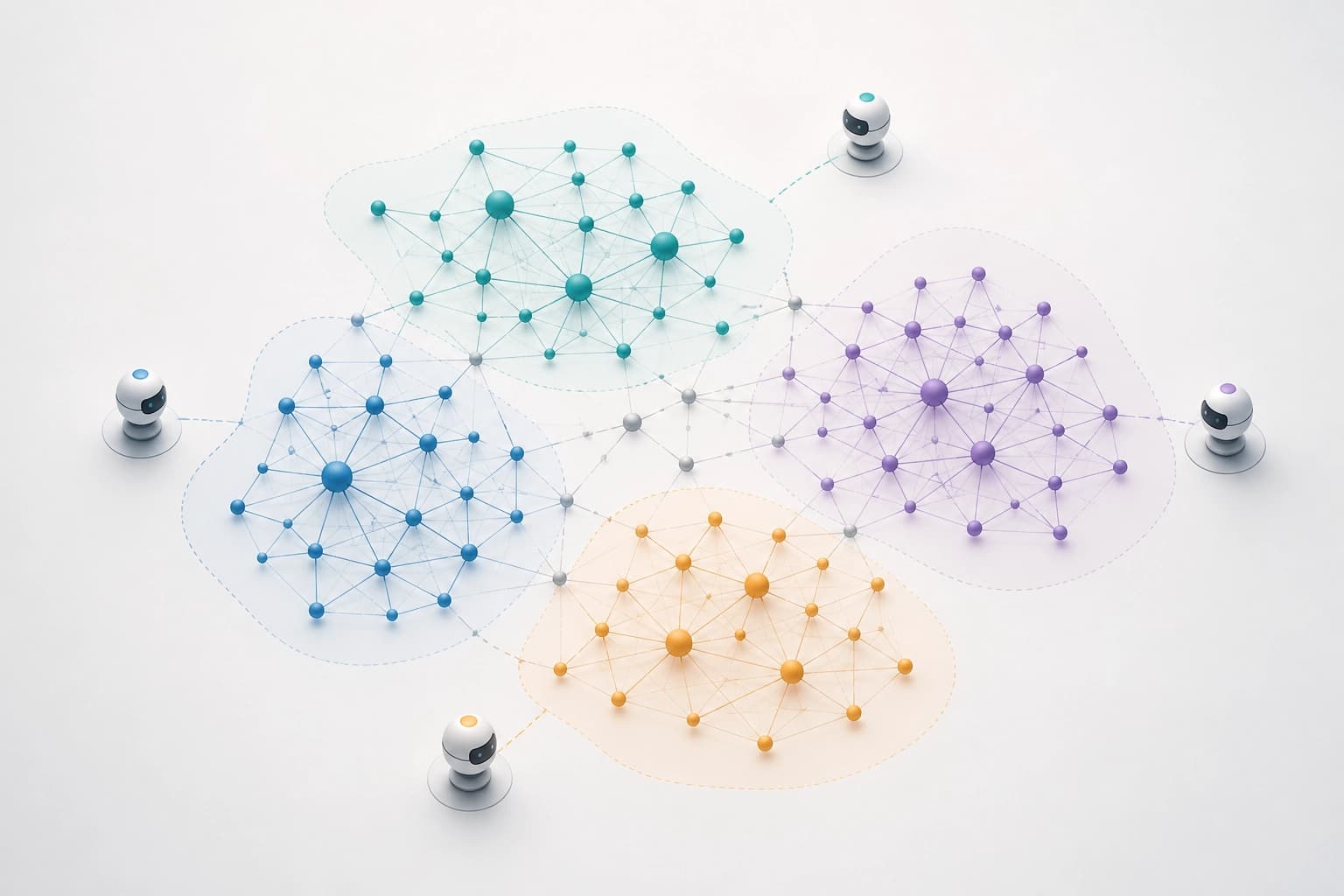
This separation distinguishes structural representation from the selection of significant nodes. Practical criterion: the structural signature is suitable for representing graph features in a permutation-insensitive way.
How Agents Use History and Debates
Agents refer to historical trajectories with similar signatures. They use these to assess confidence in their conclusions.
If necessary, agents initiate a joint discussion in the form of a debate. The paper describes debate as a conditional stage, not a mandatory part of every decision.
Practical criterion: the scheme links confidence assessment to similar cases and brings in discussion when needed.
What Limitations of Existing Methods Does MAAGL Address
The authors identify two problems with graph learning methods. Verbal descriptions of structure can make reasoning sensitive to the order of information and violate the graph’s permutation invariance.
Increasing the size of sampled neighborhoods quickly expands the context. In MAAGL, structural evidence is condensed into a fixed-size signature, while semantic evidence is selected by relevance.
| Problem | MAAGL component |
|---|---|
| Sensitivity of verbal descriptions to the order of the structure | Permutation-invariant structural signature |
| Context growth as sampled neighborhoods increase in size | Fixed-size signature and top-k node selection |
Practical criterion: compare the limitations of a graph method with how it represents structure and selects semantic evidence.
What the Experiments Show
In experiments on four benchmark datasets, MAAGL outperformed state-of-the-art AGL methods. The paper description does not provide numerical results.
The paper Multi-Agent Agentic Graph Learning via Structural Signatures was written by Liang Qu, Jianxin Li, and Hua Wang. It is posted on arXiv under the number arXiv:2609.09565; the submission date is 9 Sep 2026.
Practical criterion: the result confirms a comparison on the specified datasets, but does not report numerical results.
Frequently asked questions
Related materials
All materials
AURA-Eval: How to Check Whether an LLM Agent Recognized a Risk and Changed Its Next Step
The framework evaluates LLM agents’ behavior not by their final verdict, but by how they respond to risk at key decision points: tool-call trajectories are interrupted, after which the model must continue reasoning and acting, while a panel of LLM judges assesses risk detection, the nature of the step, and its safety. Across 1,249 tasks drawn from 157 R-Judge trajectories, unsafe actions become more frequent among 20 models when no safe path is available, and removing oversight before execution turns 52.3% of initially safe cases into unsafe ones.
10 November 2026
Chern–Simons Reservoir Memory: Autonomous Connectivity Dynamics and Density Transport
The article explores how a reservoir preserves the history of input signals both in its density distribution and in its geometric degrees of freedom. A comparison of four mechanisms shows that current creates a separate connected component that alters the subsequent density response, while accounting for all measured features yields a small improvement in decoding pulse order.
10 November 2026
STAR: Adaptive Normalization of Temporal Context and Service Graphs for End-to-End Incident Management
The STAR framework trains representations from metrics, logs, and traces, using learnable normalization that accounts for multiscale temporal dynamics and dependency structures between services. On two real-world datasets, this pipeline delivers consistent improvements in anomaly detection, failure ranking, and root cause analysis over state-of-the-art baselines.
10 November 2026