
LoopVLA — how to teach a model to stop in time when refining representations for robot control
New LoopVLA architecture, instead of always using the deepest layer of the vision-language backbone, iteratively refines representations through a shared Transformer block and decides at each step whether enough information is available for action. Through self-supervised distribution alignment, the model reduces parameter count by 45% and speeds up inference by up to 1.7x, matching baseline approaches in success rate.

Why depth doesn't always help a robot
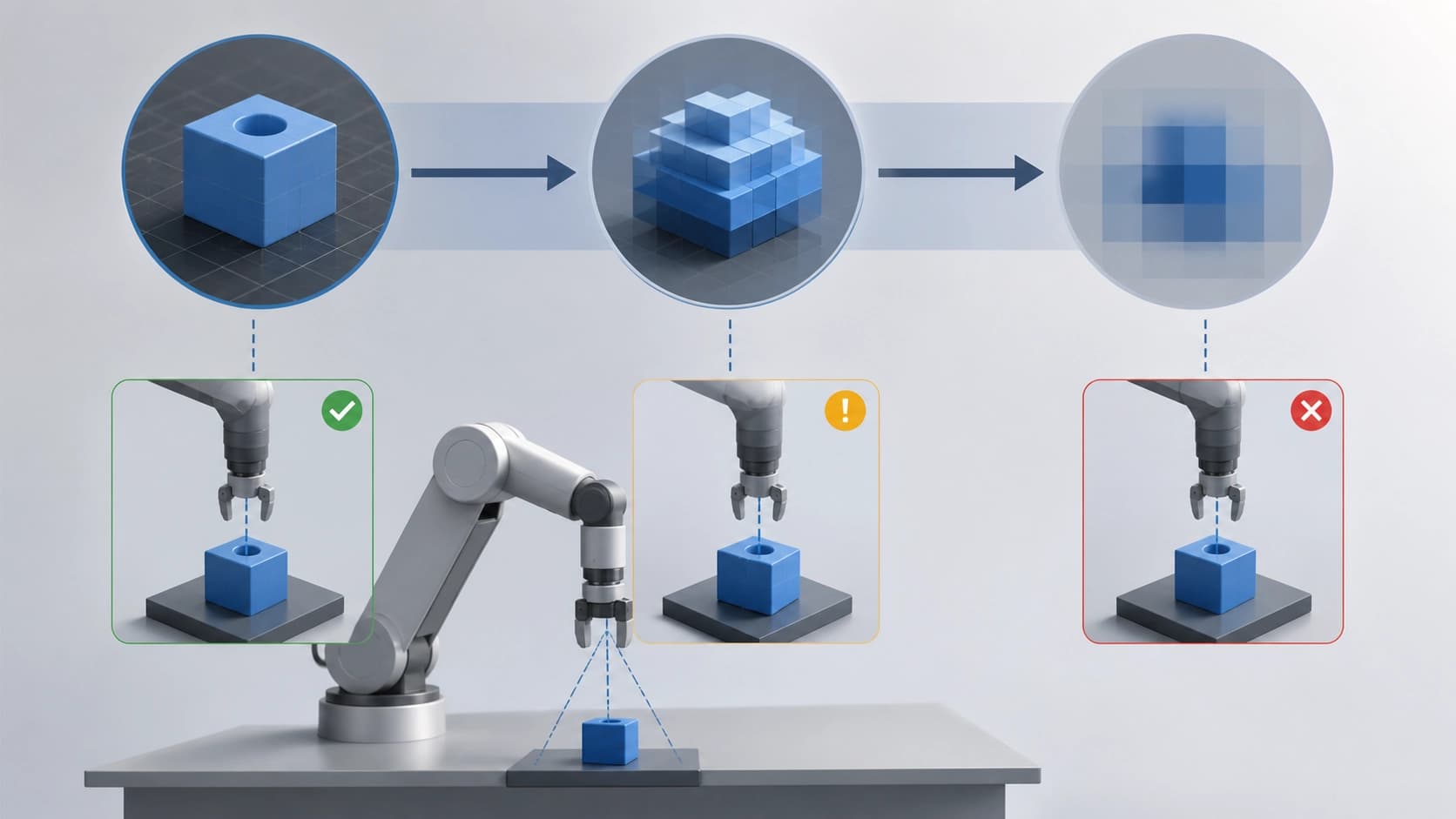
In modern vision-language-action (VLA) models, a rule has taken hold: the deeper the layer of the vision-language backbone, the more abstract—and supposedly more useful for control—the representation. However, robotic manipulation is not one big reasoning task, but a sequence of frequent, closed-loop spatial corrections. For these, excessive abstraction often proves unnecessary: it requires more computation and erases the low-level geometric details that precise control depends on.
Imagine a robot reaching for a cup. On every frame, it needs to make small adjustments to its trajectory, and these adjustments depend on the object's exact position. If the model has abstracted the input too deeply, it may simply "fail to see" the required angle or offset. And if it has to recompute everything from scratch each time, there won't be enough time for real-time control.
Existing ways to save resources in such networks—early exit at a pre-selected layer or heuristics like checking action consistency across adjacent steps—don't answer the key question: is the current representation sufficient to take the right action right now? The decision is usually made based on external rules, not on the content of the data itself.
That's why a group of authors proposed the LoopVLA architecture, which attempts to formalize "the moment when you can stop" and embed it directly into the training process.
Recurrent refinement with sufficiency estimation
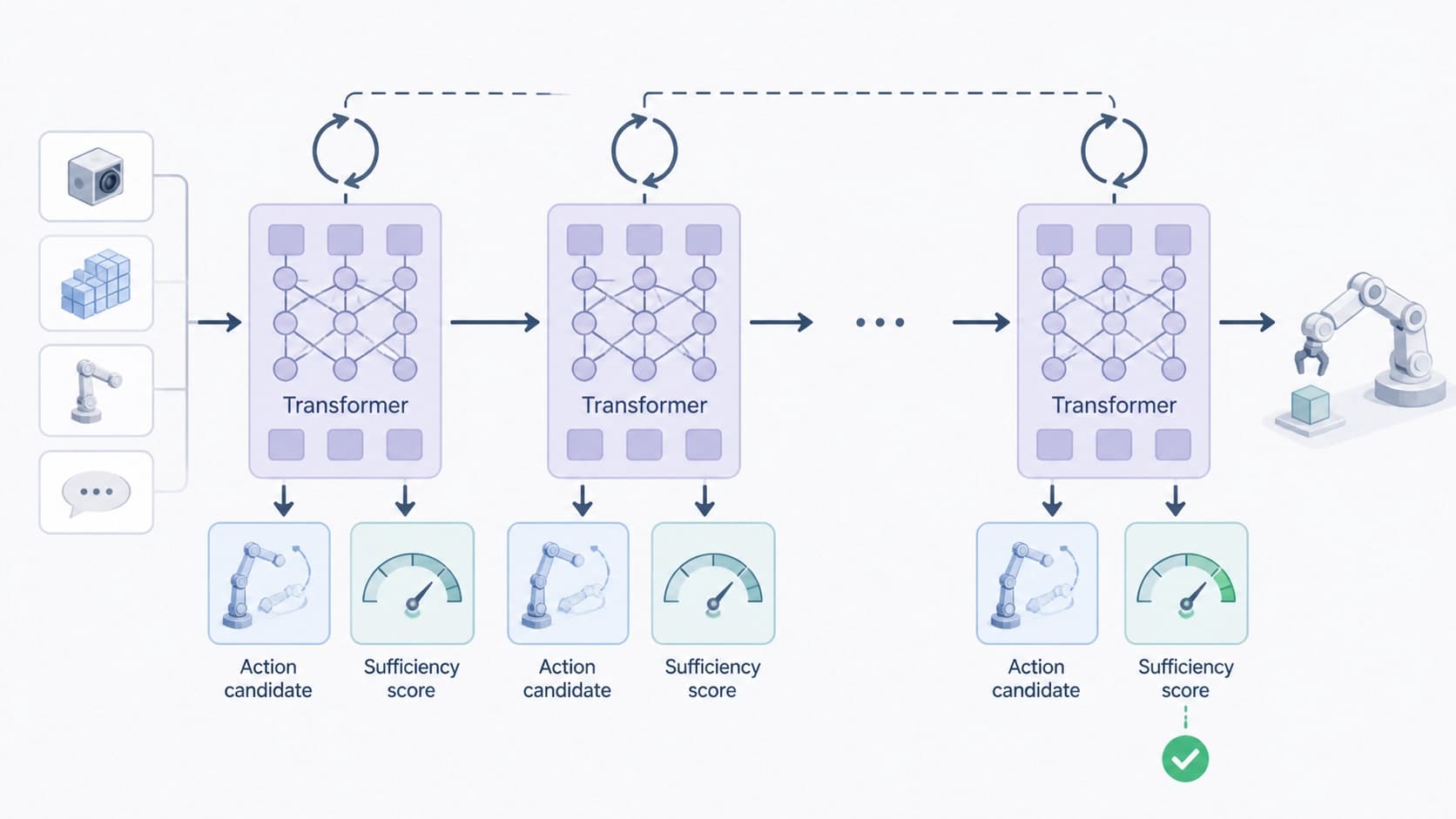
The idea behind LoopVLA is to use a recurrent loop instead of a rigid chain of layers. The same Transformer block is applied to multimodal tokens multiple times, gradually refining the representation. At each iteration, the model produces two outputs: a candidate action and a sufficiency score—a number that predicts whether refinement should continue.
This is similar to an internal dialogue the model has with itself: on the first pass, it acts quickly but perhaps not accurately enough; on the second, it is already more confident but may still hesitate. The sufficiency score is the indicator of that confidence.
Shared parameters across all iterations are a fundamental difference from classical deep networks. The model stops being tied to an absolute layer number: what matters more is what happens to the representation itself. This allows stopping at different points for different examples, based on the dynamics of the evolving state vector. Since the model uses the same set of parameters for each iteration, training remains stable and doesn't require separate tuning of the number of steps. At inference, the loop can run a different number of times for different examples, effectively turning the model into one that adapts its complexity.
How the model is taught to understand sufficiency
There is no direct annotation like "you can stop here." So the authors used a self-supervised technique: they align the distributions of confidence scores with the relative quality of actions at neighboring iterations. Simply put, intermediate sufficiency scores start to correspond to how much better or worse the current action is compared to the action from the previous pass. This way, the sufficiency signal comes from the policy itself, not from external annotation.
As a result, the chain of "representation refinement → action prediction → sufficiency estimation" is trained as a single system, where the stopping decision is directly tied to the control objective. You can think of it as confidence distillation: the model transfers knowledge about when an action is good enough from later iterations to earlier ones. This allows it to understand already at early stages whether further work is needed.
What this delivers in practice
In experiments on three benchmarks—LIBERO, LIBERO-Plus, and VLA-Arena—the model showed that smart stopping really works. LoopVLA reduces the number of parameters by 45% and increases inference throughput by up to 1.7× compared to strong baseline VLA policies. At the same time, task success rates do not drop, and in several cases even improve.
In the language of applied robotics, this translates into a double win:
- Reduced computational load: fewer operations per control step, which is especially important for onboard systems.
- Preserved accuracy: the model doesn't lose geometric details where they are critical, and doesn't waste resources where a coarse abstraction is enough.
These results matter especially for real-world systems with limited computational resources, such as mobile robots or industrial manipulators. The ability to stop dynamically allows more efficient use of energy and faster response to environmental changes. Interestingly, the parameter savings come not from simplifying the architecture, but from using existing components more rationally. A recurrent block with shared weights is not a small model—it's a model that knows when to stop.

Summary
LoopVLA is an example of how abandoning the dogma of "deeper is better" in favor of adaptive computation control can improve both performance and efficiency. The model learns to stop in time, and this turns out to be more productive than unconditionally deepening the network. This approach paves the way for more practical VLA systems for real robots, where every millisecond and every watt counts.
Frequently asked questions
Related materials
All materials
STAR: Adaptive Normalization of Temporal Context and Service Graphs for End-to-End Incident Management
The STAR framework trains representations from metrics, logs, and traces, using learnable normalization that accounts for multiscale temporal dynamics and dependency structures between services. On two real-world datasets, this pipeline delivers consistent improvements in anomaly detection, failure ranking, and root cause analysis over state-of-the-art baselines.
10 November 2026
Chern–Simons Reservoir Memory: Autonomous Connectivity Dynamics and Density Transport
The article explores how a reservoir preserves the history of input signals both in its density distribution and in its geometric degrees of freedom. A comparison of four mechanisms shows that current creates a separate connected component that alters the subsequent density response, while accounting for all measured features yields a small improvement in decoding pulse order.
10 November 2026
Validating Candidates Costs More Than Generating Them: Honeypots Against LLM Vulnerability Hunting
The study examines the cost asymmetry in agentic vulnerability discovery: generating candidate versions is cheap, while confirming them through reachability analysis, execution, and PoC development consumes most of the budget, making verification a potential standalone target for defense. The proposed RedHerring—repository-adapted decoys with a hidden certificate—reduced the number of real vulnerabilities found by 38.7–60.4% at equal cost across 33 OSS-Fuzz projects; even after the agent was warned, the reduction remained at 37.2%.
9 November 2026