
What Llama 3.1 405B is and why it stands out
Llama 3.1 405B is Meta's flagship open language model, released in the summer of 2024. It has 405 billion parameters, and at the time of its release it was one of the largest models made publicly available. Training ran on a cluster of NVIDIA H100 GPUs — meaning the project is backed by serious infrastructure, not a research experiment.
The stated strengths are predictable for a model of this size: a broad reserve of general knowledge, solid mathematical reasoning, and decent multilingual translation. Meta positions the model as an alternative to closed flagship models — primarily OpenAI's offerings — and bets on the fact that the weights are available to everyone: you can download them, deploy them yourself, fine-tune them for your task, and embed them in a product without depending on someone else's API.
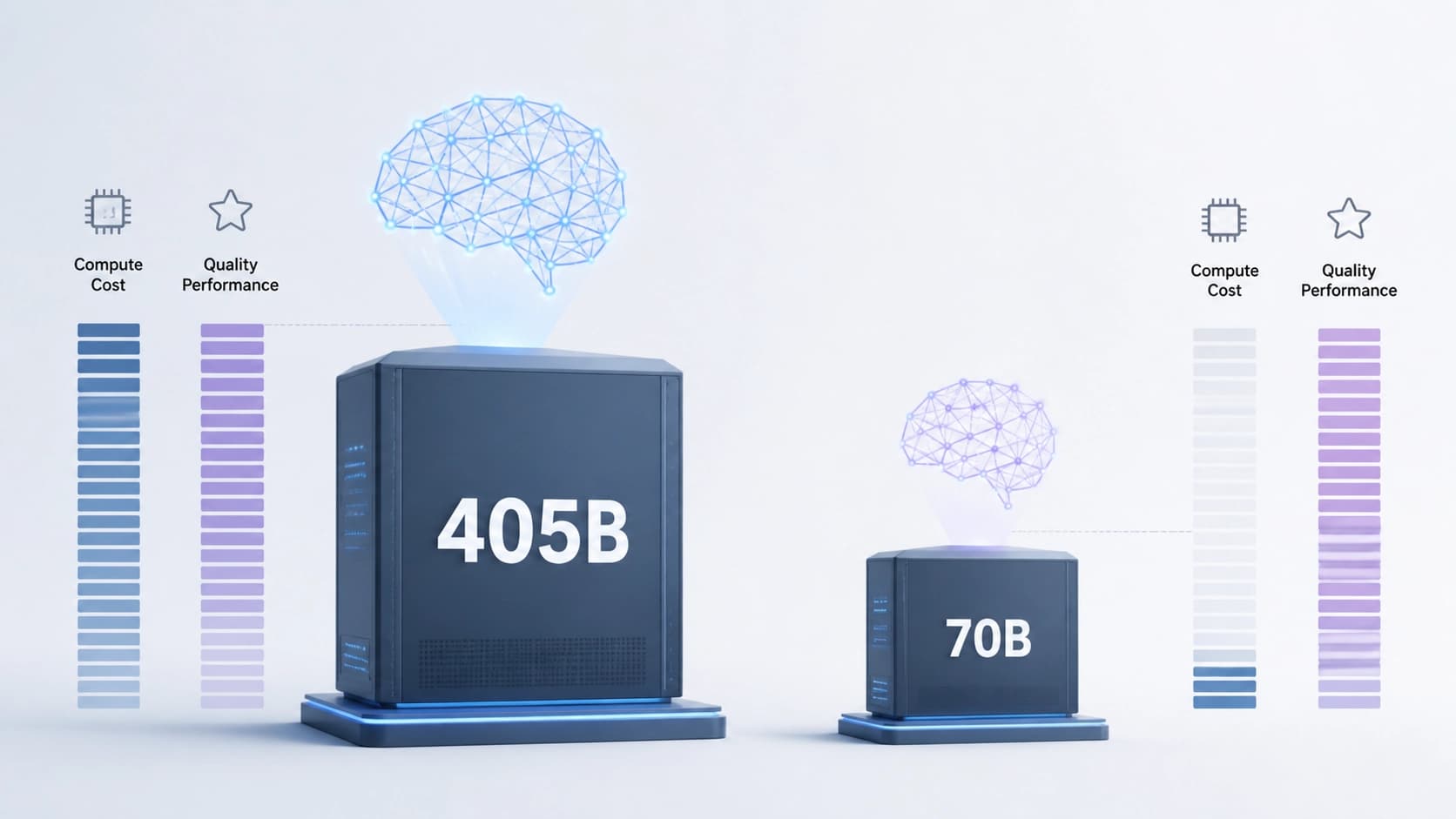
An important caveat that's easy to miss behind the "405B" figure: bigger doesn't mean "always better." The more compact Llama 3.3 70B shows comparable quality on many benchmarks while using roughly five times less compute. So choosing the flagship should be a deliberate decision, not one made "by size."
Where a model like this is genuinely useful
Scenarios where the large size pays off:
- Customer support. Parsing incoming requests, drafting replies, sorting tickets by topic and priority. The model handles instructions and long conversation context well.
- Content production. Articles, social media posts, marketing copy — especially when you need not one variant but a series in a consistent style.
- Education. The role of a tutor: explaining a topic in different words, finding examples, building a personalized path around weak spots.
- Research. Condensing a dozen papers into a review, drafting a report, helping with literature on a topic.
- Medicine and administration. Draft reports, summaries of publications, routine paperwork. Here it's especially important that a human reviews the result.
- Development. Code generation, finding the cause of a bug, writing documentation and tests.
The general principle: the more complex and multi-step the task, the more noticeable the difference between the flagship and smaller models. For simple paragraph rewrites, there's no need to pay extra.
How to get access
There are two paths, and they differ greatly in their barrier to entry.
Quick start via a web portal
The simplest option is third-party platforms that have already deployed the model and provide a chat interface for it. For example, on AIPURE the process looks like this:
- Open the site and find the section with the model chat (there it's labeled "Chat With Meta Llama 3.1 405b").
- Log in to an account or register a new one — this is needed so that conversation history and settings are saved.
- Start a dialogue: type your requests into the input field and wait for a response.
- If you want, take a look at the GPT Store with ready-made builds for specific tasks, or get VIP access if the basic limits aren't enough.
The official path and self-hosting
Through Meta AI or a compatible service, the model is available via credentials and granted permissions — here everything depends on the terms of the specific platform.
Running it yourself is a story for those who have the hardware: in full format the weights take up hundreds of gigabytes, so a single consumer graphics card won't cut it. In practice, people use quantized versions, multiple GPUs, or rent cloud capacity by the hour.
Step-by-step walkthrough: from prompt to finished result
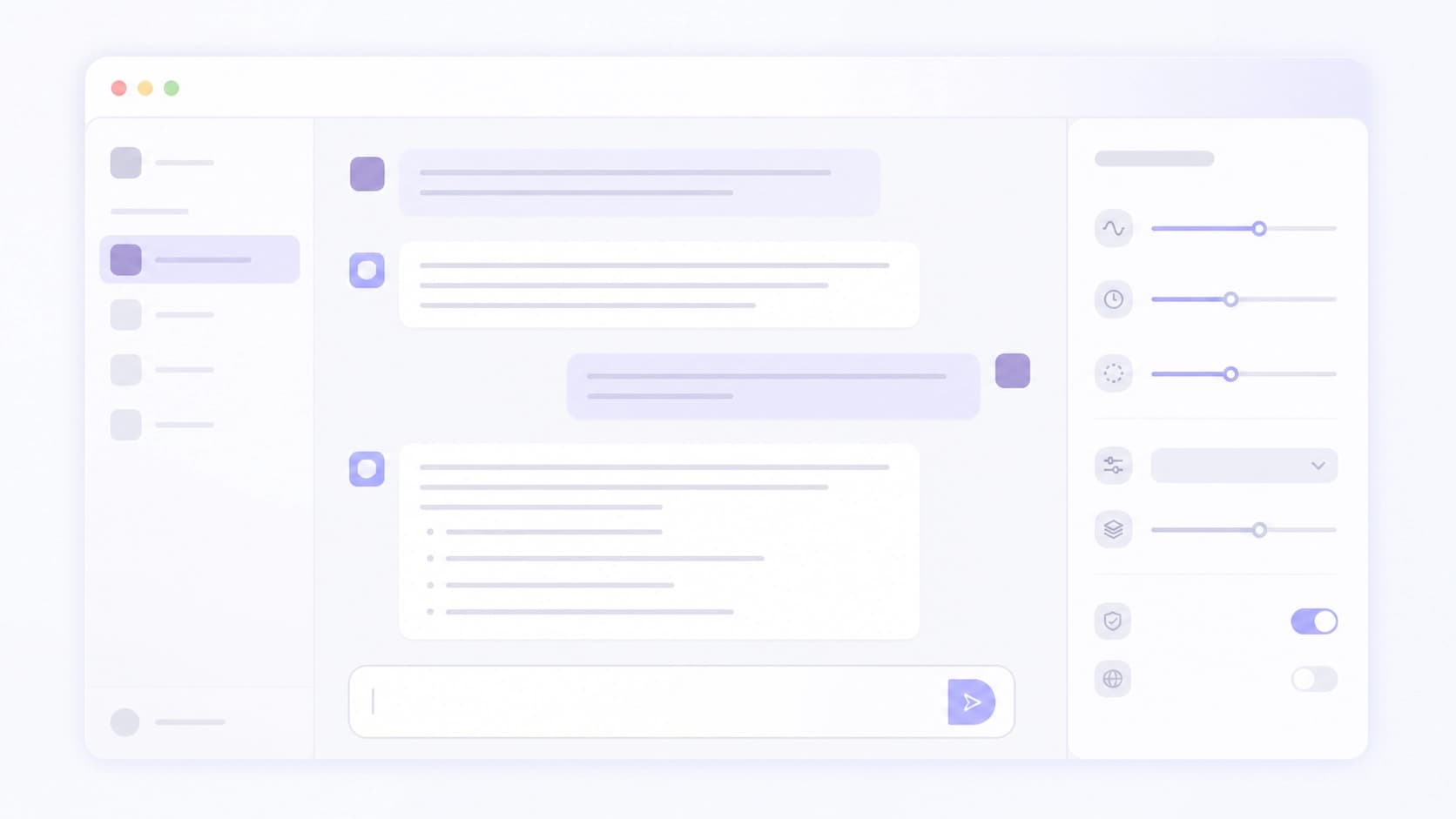
- Access. Decide on your channel: a web interface, a provider's API, or your own deployment. The second and third will require keys and permissions.
- Prompt. Formulate the task in the input field. Both a short question and a large spec for refactoring a module will work — but in the second case, you should explicitly describe the context, constraints, and expected response format.
- Capabilities. Choose the mode of operation for the task: multilingual translation, chain-of-thought reasoning, code generation. Don't mix everything into one request — quality will suffer.
- Parameters. Configure context length, temperature, and top-p (more on those below).
- Generation. Run the model and see what comes out. The first response almost always needs refinement — that's a normal part of the work, not a sign of error.
- Analysis and application. Check the result against your expectations, adjust the wording, verify the facts, and only then take it into your project, report, or application.
Which parameters are worth tweaking
- Context length. How much text the model holds "in mind" at once. More — you can feed it entire documents, but memory usage and response time grow.
- Temperature. The degree of randomness. Closer to zero — predictable, almost deterministic answers: code, data extraction, calculations. Higher — livelier and more varied: creative work, copy, brainstorming.
- Top-p. An alternative way to limit word choice by probability mass. Usually it's enough to adjust just one — either temperature or top-p, not both at once.
For Llama 3.1 405B, a reasonable starting point is low temperature for technical tasks and moderate (around 0.7) for text. From there, tune it to your own examples.
What to look for in responses and where people usually stumble
- Always verify facts. Even a large model confidently produces plausible nonsense — especially in narrow domains and where fresh data is needed.
- Code — only with a test run. A generated snippet can look logical and fail to compile. Tests and a linter are mandatory.
- Long context isn't infinite. Even if the limit allows loading a document in full, the model may "lose" the middle. Key fragments are better placed closer to the beginning or the end of the request.
- Data and privacy. Anything that goes to someone else's server should be considered potentially public. Personal and medical data — only through a perimeter you control.
- Cost. The flagship is more expensive to run. Before locking it into production, work out where 405B is genuinely needed and where a model an order of magnitude lighter will do.

A short summary
Llama 3.1 405B is about maximum quality in an open setup: complex reasoning, code, multilingual tasks, and anything that needs depth rather than speed. It's easier to start with a ready-made web chat, and move to an API or your own server when you have clear requirements for privacy, load, and budget. And keep the alternative in mind: if the task doesn't require maximum power, a less heavy model will deliver a similar result noticeably cheaper.