
The Model Looks but Doesn't Ask: Where Interactive Visual Grounding Breaks Down in LVLMs
A new work (Zhengxiang Wang and Owen Rambow, EMNLP 2026) proposes a controlled benchmark in which models receive varying amounts of hints about the target and must fill in the gaps through dialogue. The result is discouraging: LVLMs lag noticeably behind humans, especially when there is no initial description at all, and on top of that they overestimate their confidence relative to actual accuracy.

Why "show me where it is" is the wrong question
The classic visual grounding test looks almost like a school exercise: you're given an image and a phrase like "the blue folder on the bottom shelf," and the model has to point to where the target object is. One query, one answer, a metric — hit or miss.
The setup is convenient, but it describes a command, not a conversation. In real communication, a person rarely gives an exhaustive description on the first try. They say "you know, that thing near the window" and expect the other person to either guess or ask again. Mutual understanding gets built up over the course of a dialogue — sometimes in two turns, sometimes in five.
The authors of arXiv:2608.23978 (Zhengxiang Wang and Owen Rambow, accepted at EMNLP 2026) propose treating this very missing stage as the object of measurement. Their question is this: can a model not only look, but also ask, when images and words aren't enough for an unambiguous conclusion?

How the experiment is structured
Controlled information deficit
The key idea is not to measure accuracy "on average," but to smoothly regulate how much information about the target is given in advance and how much the model has to obtain on its own. At one end of the scale, the task is almost indistinguishable from a standard one-step test: the description is detailed, the target is obvious. At the other, there's no initial phrasing at all, and everything the model knows about the target object it has to extract from its own clarifying questions.
This design makes it possible to separate the skill of recognition from the skill of conducting a dialogue. A model that perfectly finds an object given a precise hint can fail completely when the hint has to be assembled piece by piece.
Four contexts and four protocols
The experimental environment relies on four visual contexts close to human scenarios, and four different interaction protocols. This matters: the result doesn't boil down to a single lucky or unlucky configuration. It also tested who exactly formulates the description — a human or another model — as well as how the volume of reasoning, retries, and switching the description provider affect things. The patterns discussed below reproduced across all these variants.
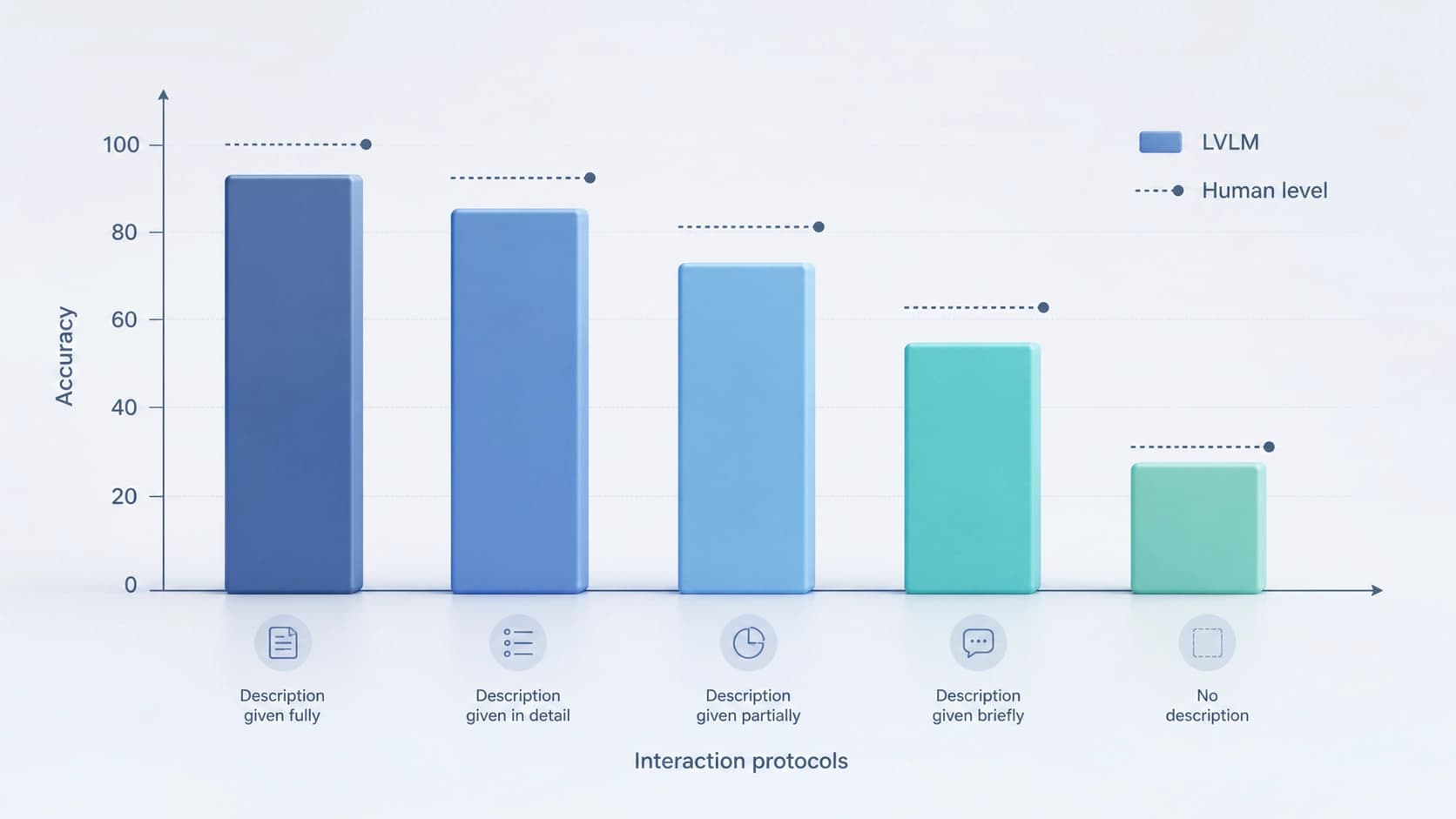
Where exactly it breaks
The gap with humans holds across all protocols
The main takeaway is grim: in none of the modes did current large vision-language models come close to human baselines. The gap persists both when the task looks almost trivial and when it requires genuine dialogue. We're not talking about a few percentage points, but a qualitative difference in reliability.
Worst of all — when there's no description at all
The lowest results were recorded in the scenario where there's no initial phrasing of the target. The model has to build its own hypothesis about what to look for, ask questions, and narrow down the search area based on the answers. This is no longer about recognition, but about proactive behavior: it has to decide on its own that information is lacking and formulate a query that closes that gap.
This is where the failure that gave the paper its title shows up: the model can look, but it can't ask. It either bets on a guess or asks questions that clarify nothing.
Clarification works, but not always
Interaction isn't useless. When a clarifying question corrects or supplements the initial description, accuracy rises noticeably. So the dialogue mechanism is present in the model and does bring benefits — but only in the role of an editor of someone else's phrasing. As soon as the phrasing has to be created from scratch, the advantage disappears.
Confidence ahead of accuracy
A separate line of analysis is calibration. Models systematically claim confidence higher than what their actual accuracy confirms. In practice, this means you can't judge from a model's answer whether it's worth trusting: both correct and incorrect choices come with equally upbeat tone.
For applications, this is more dangerous than mere errors. If a system makes a mistake but honestly signals uncertainty, you can ask it again or call in a human. If it makes a mistake with a confident look — you can't build in that kind of safeguard.
Why the task is harder than it seems
Interactive visual grounding requires three mechanisms to work simultaneously:
- visual matching — linking words to objects in the image, including spatial relations and attributes;
- information seeking — understanding what information is missing and obtaining it through a question rather than brute-force enumeration;
- synthesis — assembling disparate answers into a single hypothesis without losing it along the way.
Each skill individually exists in modern models to one degree or another. What breaks is the junction between them: what's seen doesn't turn into a question, and an answer to a question doesn't restructure the model's picture of the world.
What this means in practice
If you're building a product on top of a multimodal model — say, GPT-4o or any other image-capable API — the paper's findings translate easily into engineering decisions:
- Don't rely on the first description. If the user phrases a request vaguely, build in a clarification loop rather than a single query-response.
- Don't trust stated confidence. Calibration is better built on your own labeling for the specific task, not on the model's self-assessment.
- Design questions for the model. If the system can't figure out on its own what it's missing, an external logic layer will have to take on the role of the asker.
- Test on your own information deficit. It's worth checking how the pipeline behaves in exactly the modes where, according to the authors' data, accuracy collapses.
Bottom line
The paper documents not an absence of abilities, but a mismatch of skills. Models see enough to answer well-posed questions, but don't understand the situation well enough to ask them themselves. Until this gap is closed, interactive visual grounding will remain a task where the human continues to be the most reliable link in the dialogue.
Frequently asked questions
Related materials
All materials
MathAdv: What the Final Accuracy of Machine-Generated Proofs Conceals
A diagnostic suite of tasks spanning 13 undergraduate and graduate mathematics topics evaluates machine-proving systems in Lean 4 not only by their final results, but also by their subject-matter mastery, the quality of their informal reasoning, and their robustness to rephrased conditions. A component-by-component analysis shows that translating a problem into formal form remains the main obstacle, and that success depends heavily on the area of mathematics and how the problem is framed.
9 November 2026
AffordanceWAM: Affordances as an intermediary between scene prediction and manipulator control
The work describes a generative model that jointly predicts future RGB observations, scalar fields, affordance heatmaps, and continuous robot commands, using human videos to broaden interaction diversity without action annotations or retargeting. On RoboCasa, CALVIN ABC→D, and real-world tasks, the approach delivers consistent gains over RGB-only and robot-data-only baselines.
9 November 2026
Presentation Editing as Controlled Operations: The EditPPT Framework and DeckEdit-Bench Benchmark
The authors break down slide editing into specific objects, permitted actions, and checks to ensure unrelated content remains untouched, rather than relying on free-form code generation. To measure quality, they created DeckEdit-Bench (183 tasks across 28 human-made presentations), and the multi-agent EditPPT framework achieves a 66.7–74.9% task success rate across five base models while preserving over 97% of the content.
8 November 2026