
Model Merging by Compatible Groups: GRAM Reduces Subspace Interference
The GRAM method determines which fine-tuned models are worth merging based on the geometry of the principal angles between their subspaces, then performs low-rank merging within groups. The approach requires only model weights, reduces projection loss, and demonstrates advantages in language, vision, and medical experiments.
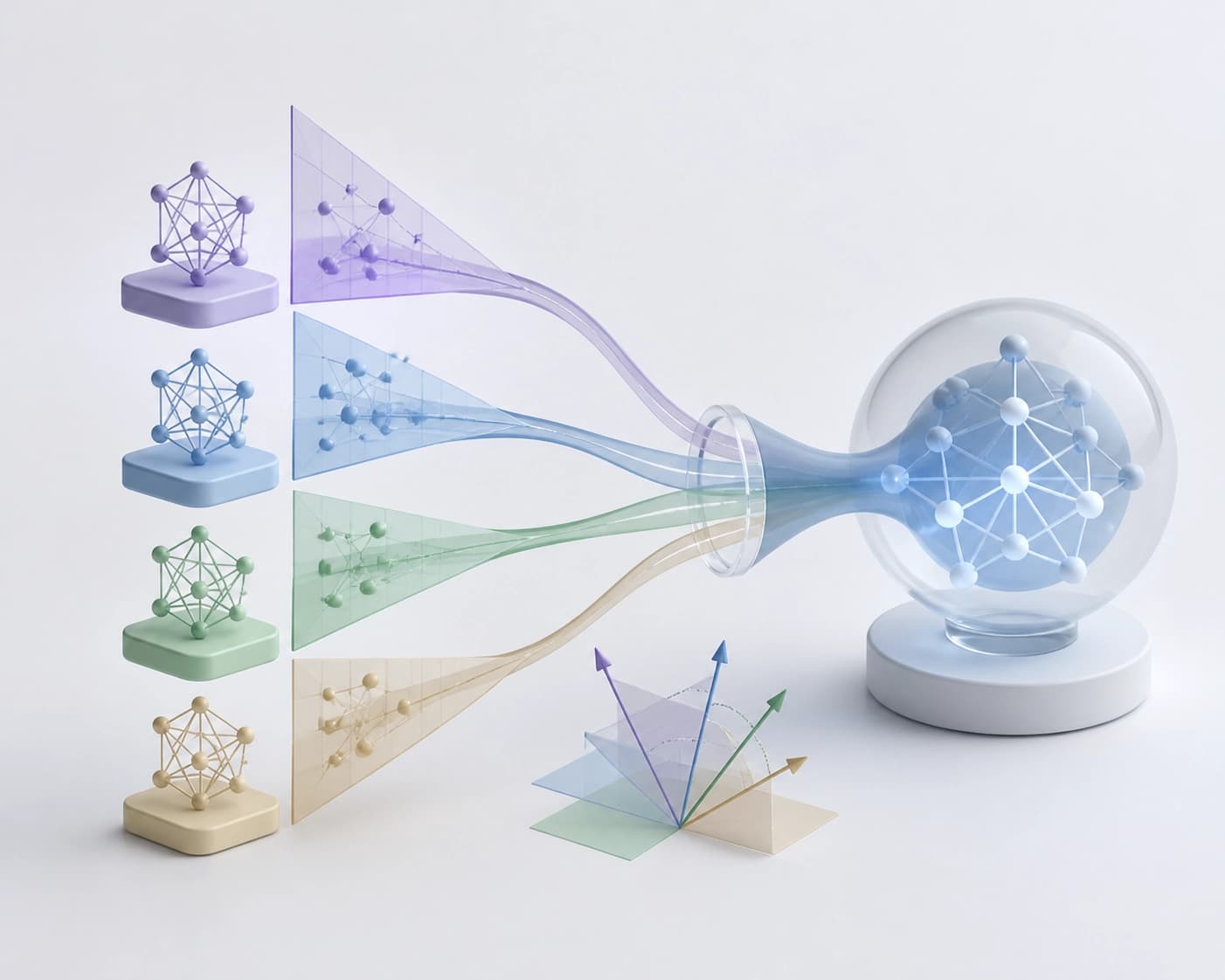
The Problem of Subspace Interference
Merging different models into one is necessary for multi-task deployment. In regulated fields such as healthcare, data often remains local. As a result, merging can only use fine-tuned weights.
Earlier methods apply the same merging approach to every task. They do not account for geometric relationships between learned subspaces. If task updates occupy misaligned subspaces, projecting them onto a shared low-rank basis discards important directions. The authors call this phenomenon subspace interference.

The projection error for each task is determined by principal-angle alignment. Principal-angle alignment shows how closely a task's subspace matches the shared subspace. The takeaway: uniform merging creates a risk of losing directions that are important for individual tasks.
How GRAM Works: Groups Based on Principal Angles
GRAM (Group-wise Rank-Aware Model Merging) uses the principal-angle geometry of task vectors. The method works in three stages:
- Calculate the principal angles between task vectors.
- Use these angles to determine which tasks to merge together.
- Perform standard SVD-based merging within each group.
At the merging stage, the method uses only fine-tuned weights. It does not require access to the original data. According to the authors, grouping geometrically compatible tasks provably reduces projection error within each group.
Practical criterion: GRAM is suitable when data cannot be shared and tasks may occupy misaligned subspaces. The method provides a way to split tasks into compatible groups before merging.
What Changes at K=2
The scenario of adding just one model (K=2) demonstrates GRAM's effect. In this case, the method significantly reduces subspace interference. It consistently outperforms previous merging methods in tests.
The evaluations cover three areas:
- language understanding — GLUE with Flan-T5;
- computer vision — 8-task CLIP;
- medical instruction tuning — Qwen2-7B-Instruct with four English/Chinese medical LoRAs.
The takeaway: the advantage is already apparent when merging two models. For the minimal scenario of adding one fine-tuned model, GRAM offers a tested way to reduce interference.
Selection Criteria
Choosing between uniform merging and a group-wise approach depends on the task conditions. Below are criteria based on the description of GRAM.
| Criterion | What to consider |
|---|---|
| Data access | Only fine-tuned weights are available for merging. |
| Task geometry | Tasks may occupy misaligned subspaces. |
| Interference risk | Projection onto a shared basis may discard important directions. |
| Merging approach | Grouping compatible tasks reduces projection error within each group. |
| Tested scenario | K=2: adding one model to an existing one. |
Practical takeaway: if data remains local and tasks differ in their subspace geometry, group-wise merging reduces the risk of losing directions. Uniform merging across all tasks does not account for this risk.
Frequently asked questions
Related materials
All materials
Evaluating Coding Agents in Interactive XR Development: Findings from GenXR-Bench
GenXR-Bench has been released—a set of 112 expert tasks for end-to-end evaluation of coding agents in interactive XR development, from feature enhancements and bug fixes to building applications with behavior validated on consumer hardware. The best result among the ten models tested was 50.9% Pass@1; recurring failures included handling asynchronous sensor events, anchoring objects in real-world space, and understanding interactions in a physical context.
5 November 2026
From Scalar Reward to the Pareto Frontier: LLM-Based RTL Synthesis with Multi-Objective Reinforcement Learning
A method is proposed for training a language model to generate not just one design, but a set of RTL candidates with different trade-offs between area, latency, and power consumption; the reward is based on each candidate’s contribution to the Pareto-front hypervolume. On RTLLM v2, the relative hypervolume increased by 13.3 percentage points compared with the baseline without PPA optimization and by 14.4 percentage points compared with single-objective reinforcement learning.
5 November 2026
Medical LLMs learn about guideline updates but often still answer according to outdated rules
A ChronoEvo study of 1,709 changes to clinical guidelines shows that in the primary model, 90.8% of responses identified the update, but only 58.5% applied it fully; a gap of 32.3 percentage points persisted across 14 models. Even making updates more salient did not significantly improve the full incorporation of new rules into clinical recommendations.
4 November 2026