
GeoPatch: Fixed Patch Framework and Geometric Conditioning for Retrieval under Temporal Shifts
The authors propose GeoPatch, an encoder in which signal geometry does not determine the number, order, or support of local tokens, but instead influences continuous representation conditions through slope, curvature, acceleration, affine-model residuals, and confidence. On ECG, speech, and multivariate time series, the method improves top-ranked positions under temporal variations, but demonstrates a trade-off between local surface matching and strict non-overlapping search.

Why Temporal Deformations Break Patch-Based Encoders
The paper Geometry-Conditioned Fixed-Scaffold Encoders for Time-Warp Robust Sequence Retrieval (arXiv:2609.36809, by Cassandra Yang and Yufan Tang) examines the instability of patch-based encoders. If patch boundaries are determined by signal geometry, tokenization can change under the very temporal deformation that the representation is supposed to be robust to. This creates a conflict between the goal of robustness and the tokenization mechanism.
Key elements of the problem:
- patch boundaries are determined by signal geometry;
- temporal deformation changes tokenization;
- the representation must still remain robust to deformation.
Practical criterion: check whether token support depends on geometry. Such dependence makes the representation’s robustness conditional.
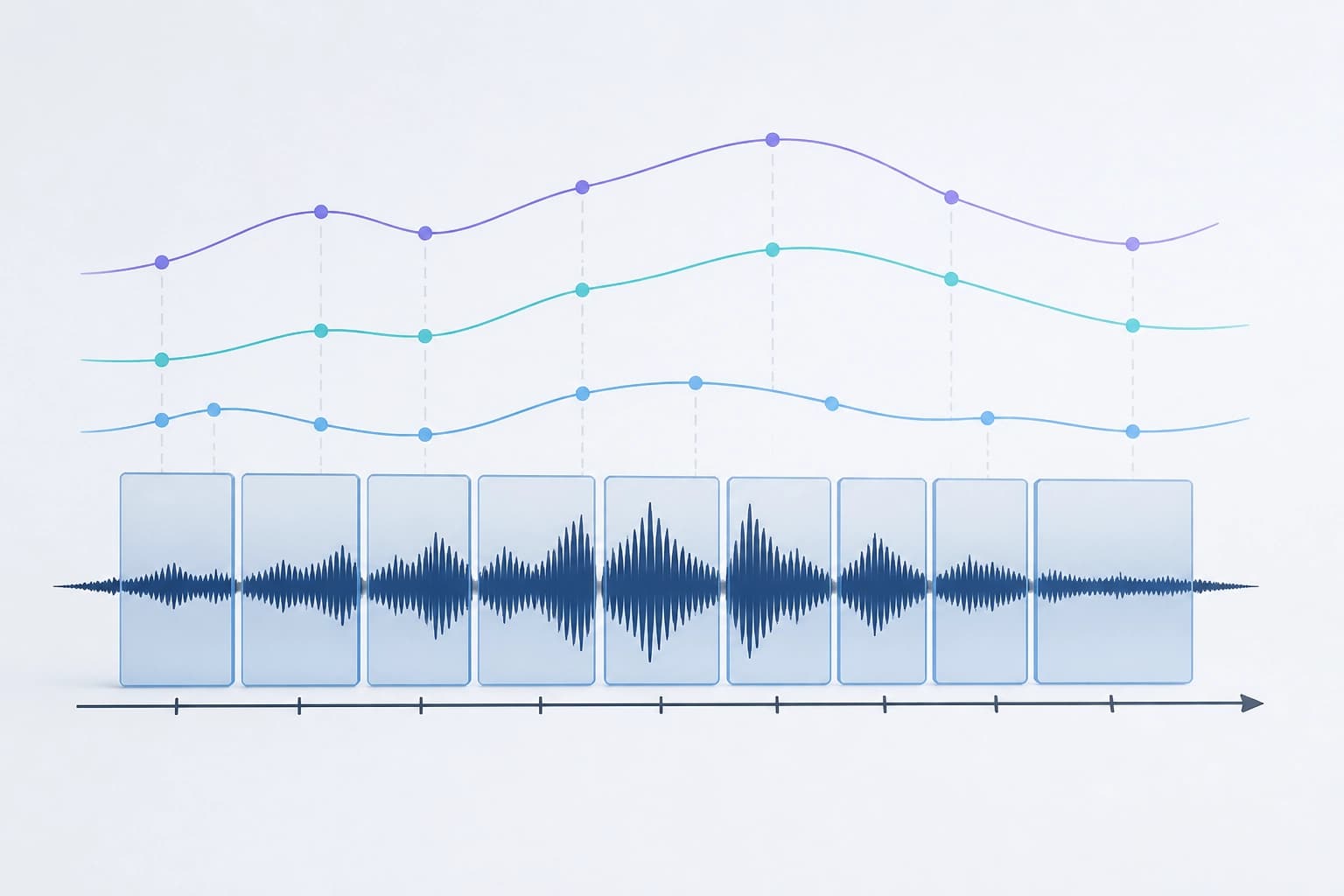
Fixed Scaffold and Continuous Conditioning
GeoPatch is an encoder with a fixed patch scaffold. Token support does not depend on geometry. Slope, curvature, acceleration, affine-residual, and confidence are used only as continuous conditioning variables. Geometry can change the embedding through a controlled pathway, but cannot change the number, order, or support of local tokens.
Solution characteristics:
- fixed patch scaffold;
- token support independent of geometry;
- geometric features as continuous variables;
- controlled influence on the embedding without changing the discrete structure.
Conclusion: geometry does not control the number, order, or support of tokens. This distinguishes a fixed scaffold from geometry-dependent tokenization.
Mechanism-Level Robustness Analysis
In GeoPatch, the same local tokens are used for global embedding retrieval and late-interaction scoring. The robustness analysis separately examines boundary drift, affine timing variation, confidence-weighted geometry perturbation, and retrieval-margin effects. The scoring rule can be aligned with the evaluation protocol.
Analysis mechanisms:
- boundary drift;
- affine timing variation;
- confidence-weighted geometry perturbation;
- retrieval-margin effects.
Conclusion: evaluation is not reduced to a single general metric. It is broken down into mechanisms, and the scoring rule can be aligned with the protocol.
Results on Retrieval Tasks
On ECG, speech, and multivariate time-series retrieval tasks, GeoPatch improves early-rank performance under temporal variations.
Domains:
- ECG;
- speech;
- multivariate time-series.
Effect:
- improved early-rank performance under temporal variations.
Conclusion: the method demonstrates an effect across three types of sequences under temporal variations.
Applicability Limits: A Trade-Off
The results reveal a trade-off between local surface matching and strict non-overlapping retrieval. Improved early-rank performance does not eliminate this trade-off. The choice depends on the task’s priorities.
What to consider:
- the importance of early ranks;
- the presence of temporal variations;
- whether overlap is acceptable;
- the priority of local matching or strict retrieval.
Conclusion: the method is relevant when temporal deformations distort tokenization and early ranks matter. If strict non-overlapping retrieval is required, the trade-off becomes a limitation.
Frequently asked questions
Related materials
All materials
Validating Candidates Costs More Than Generating Them: Honeypots Against LLM Vulnerability Hunting
The study examines the cost asymmetry in agentic vulnerability discovery: generating candidate versions is cheap, while confirming them through reachability analysis, execution, and PoC development consumes most of the budget, making verification a potential standalone target for defense. The proposed RedHerring—repository-adapted decoys with a hidden certificate—reduced the number of real vulnerabilities found by 38.7–60.4% at equal cost across 33 OSS-Fuzz projects; even after the agent was warned, the reduction remained at 37.2%.
9 November 2026
Checking LLM Hallucinations via SQL-Based Source Representation Without Fine-Tuning
The study examines whether an LLM can apply a basic symbolic skill—building a SQL database from source documents—to ground its outputs in sources without supervision when detecting hallucinations. On RAGTruth and DiaHalu, this neuro-symbolic pipeline proves more accurate than direct prediction and comparable to state-of-the-art methods, without requiring domain-specific fine-tuning.
9 November 2026
MathAdv: What the Final Accuracy of Machine-Generated Proofs Conceals
A diagnostic suite of tasks spanning 13 undergraduate and graduate mathematics topics evaluates machine-proving systems in Lean 4 not only by their final results, but also by their subject-matter mastery, the quality of their informal reasoning, and their robustness to rephrased conditions. A component-by-component analysis shows that translating a problem into formal form remains the main obstacle, and that success depends heavily on the area of mathematics and how the problem is framed.
9 November 2026