
FormalAnalyticGeo: automatic generator of analytic geometry problems with precise drawings
The new framework combines neural networks and symbolic methods to generate consistent text, diagrams, and task answers without human involvement. Based on it, the AnalyticGeo7K dataset was built: over 7,000 verified examples with a median error of reference answers below 1%.

Analytic Geometry: The Unspoken Stumbling Block for AI
Modern models have become quite good at solving geometry problems where figures are already depicted in a diagram. The situation is much more complicated with analytic geometry: here, objects are defined by equations, coordinates, and conditions of tangency or intersection. Training such systems requires labeled examples — a problem statement, a task, an accurate figure, and an answer. And that's precisely where the big trouble lies: ready-made datasets are almost nonexistent, and obtaining them automatically is very difficult.
Why can't we simply generate images from a template? It turns out that classic problem generators only work with rigidly defined scenarios. As soon as a constraint like "a circle is tangent to a parabola at a point with integer coordinates" appears, the template breaks down. Generative neural networks, in turn, can draw plausible diagrams but do not guarantee mathematical accuracy: curves may intersect in the wrong places, and tangency may be merely visual.
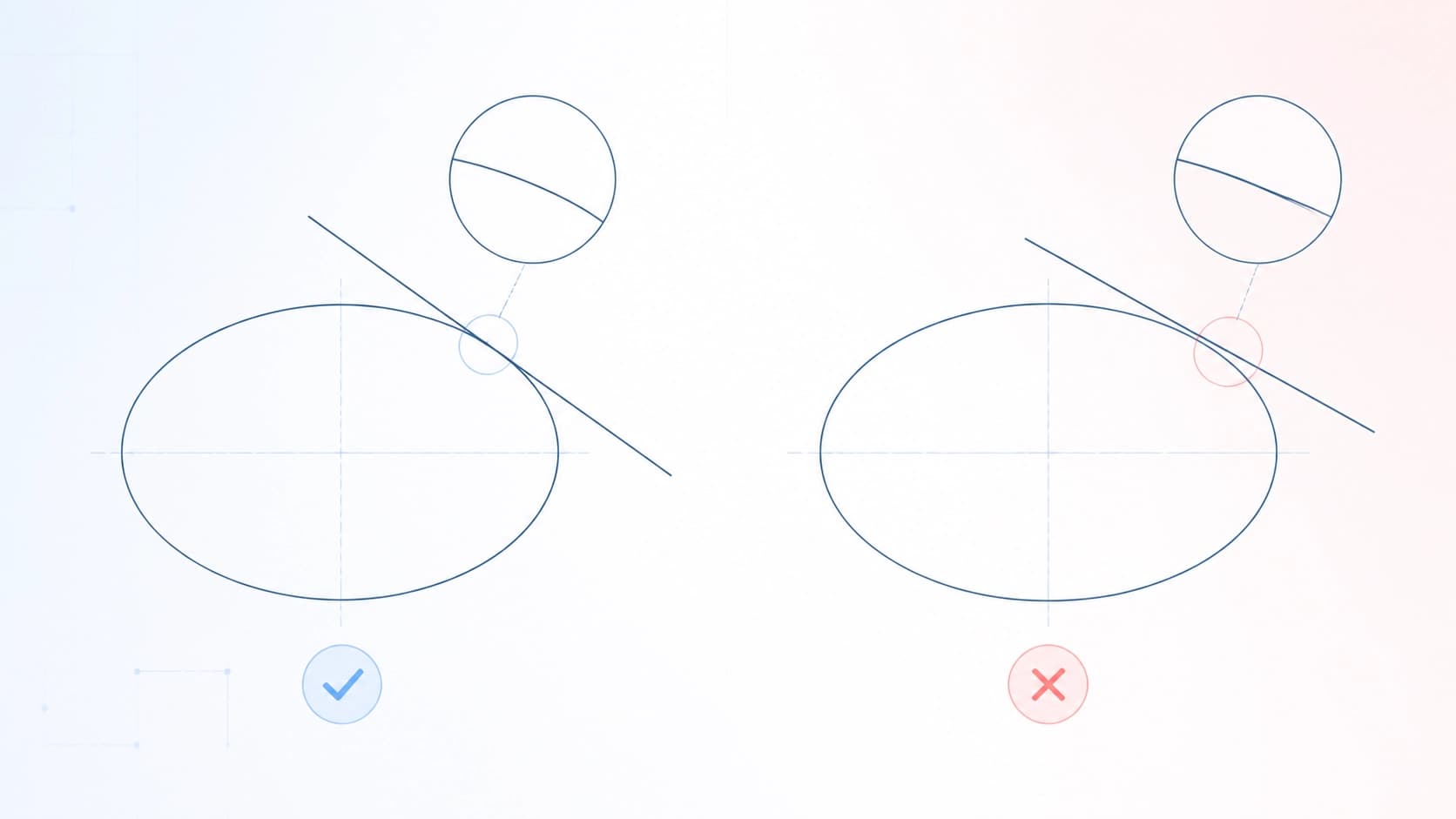
What is needed is an approach that builds a diagram from formal rules from the very start, rather than from an "average" picture found on the internet.
How the Framework Works: From Problem Statement to Accurate Drawing
The researchers proposed FormalAnalyticGeo — a fully automatic pipeline that combines neural networks with symbolic verification. Instead of trusting generative models to construct the figure, the system translates the problem into an intermediate formal description and only then renders the diagram. This keeps geometric accuracy under control throughout the entire process.
CDL and SDF: A Bridge Between Text and Figure
The central idea is the Condition Description Language (CDL). This is an intermediate representation that plays two roles: it structures the problem conditions, paraphrased in free text, and simultaneously contains all the data needed for rendering. This format turns out to be far more flexible than traditional parametric templates: it can express arbitrary combinations of points, lines, and conic sections.
Rendering is performed by an engine based on Signed Distance Field (SDF) technology. Each object is described by a distance function to its boundary — positive outside, negative inside. This makes it easy to compute the relative positions of objects: intersections, tangencies, and point-on-curve membership. It is SDF that provides the mathematical precision so lacking in conventional generative approaches.
Four Components: Generation, Formalization, Measurement, and Control
Four specialized LLM components work within the framework, each with its own function:
- Generator — devises the problem statement, selecting parameters and the geometric scenario.
- Formalizer — translates the text into CDL, turning the free-form wording into a formal structure understandable by the engine.
- Measurer — analyzes the computed diagram and "measures" the reference answer from it, mimicking human actions.
- Quality Verifier — checks quality at each of the three previous steps: correctness of the text, formal validity of the CDL, and consistency of the answer with the drawing.
The Quality Verifier does not simply reject bad examples. It generates structured feedback and sends the pipeline back to re-execute the necessary step. This creates a closed loop with no human involvement: errors are corrected automatically until the result passes all checks.

AnalyticGeo7K: A Test on Real Data
To test the framework in practice, the authors collected and cleaned a dataset called AnalyticGeo7K. It includes over seven thousand problems, each with four aligned elements: the problem statement, the diagram, the formal annotation, and the answer. Previous datasets lacked this level of comprehensiveness.
The results look promising. The median relative error of the reference answers, obtained by visually measuring the diagrams, was approximately 0.7%. If a tolerance of up to five percent from the exact symbolic solution is allowed, then 82.3% of all generated answers fall within this interval. This means the automated pipeline can produce not just plausible, but genuinely correct problems with accurate drawings.
What's Next
The authors plan to release both the framework and the dataset for public use. This opens up interesting prospects: educators will be able to quickly obtain an unlimited number of fresh problems with precise illustrations, and researchers will be able to use the new data to train models in mathematical reasoning. Furthermore, the architecture can likely be transferred to other branches of geometry or even related disciplines where a strict connection between text, formula, and image is important.
For now, FormalAnalyticGeo demonstrates the key point: combining neural network generation with formal verification makes it possible to produce high-quality multimodal data without manual work, and this principle is likely to become the standard for future generators of educational materials.
Frequently asked questions
Related materials
All materials
Validating Candidates Costs More Than Generating Them: Honeypots Against LLM Vulnerability Hunting
The study examines the cost asymmetry in agentic vulnerability discovery: generating candidate versions is cheap, while confirming them through reachability analysis, execution, and PoC development consumes most of the budget, making verification a potential standalone target for defense. The proposed RedHerring—repository-adapted decoys with a hidden certificate—reduced the number of real vulnerabilities found by 38.7–60.4% at equal cost across 33 OSS-Fuzz projects; even after the agent was warned, the reduction remained at 37.2%.
9 November 2026
Checking LLM Hallucinations via SQL-Based Source Representation Without Fine-Tuning
The study examines whether an LLM can apply a basic symbolic skill—building a SQL database from source documents—to ground its outputs in sources without supervision when detecting hallucinations. On RAGTruth and DiaHalu, this neuro-symbolic pipeline proves more accurate than direct prediction and comparable to state-of-the-art methods, without requiring domain-specific fine-tuning.
9 November 2026
MathAdv: What the Final Accuracy of Machine-Generated Proofs Conceals
A diagnostic suite of tasks spanning 13 undergraduate and graduate mathematics topics evaluates machine-proving systems in Lean 4 not only by their final results, but also by their subject-matter mastery, the quality of their informal reasoning, and their robustness to rephrased conditions. A component-by-component analysis shows that translating a problem into formal form remains the main obstacle, and that success depends heavily on the area of mathematics and how the problem is framed.
9 November 2026