
Black-box jailbreak: why compare attacks with an equal number of model calls
Researchers proposed the Fair-ASR protocol, which evaluates attacks on LLMs under an equal query budget to the target model, while accounting for the attacker's costs separately. A review of 11 known methods showed that their ranking heavily depends on the budget, and simple templates perform on par with complex LLM-based approaches—this prompted the authors to develop a new attack, ReCode.

Why jailbreaking is a problem
Modern language models try to refuse harmful or dangerous requests, but no defense is perfect. Jailbreak attacks craft prompts that bypass these restrictions: they ask the model to imagine a hypothetical scenario, switch roles, rewrite the task in a "safe" way, and so on. Researchers and defenders want to understand how dangerous such attacks really are.
Most attacks work in a black-box mode: the attacker has no access to the model's weights and no way to analyze its internal mechanisms. There is only an API to send requests to and receive responses from. So all the attacker's efforts come down to crafting text. To assess how good an attack is, you need to understand not only whether the defense was bypassed, but also at what cost.
Usually, a simple metric is used — the attack success rate (ASR). But it does not show how many requests had to be made. Yet it is precisely the number of calls to the model that often becomes the main constraint in practice: the more requests, the higher the chance of being noticed, and the more expensive the attack in terms of time and money.
ASR as a misleading metric
Let's imagine two attack methods. The first tries hundreds of prompt variations until one works. The second uses a pre-validated template and gets a result in three attempts. If both have the same success rate, they will look equivalent when looking at ASR. But in real conditions, the second method is clearly more dangerous: it is faster, cheaper, and leaves fewer traces.
That is why comparing only by ASR is like a shooting competition where one shooter fires from three meters and another from thirty, but the win is awarded by the number of hits. Without accounting for the conditions, the result is meaningless. For jailbreaks, that condition should be the budget of calls to the model.
Fair-ASR: counting calls
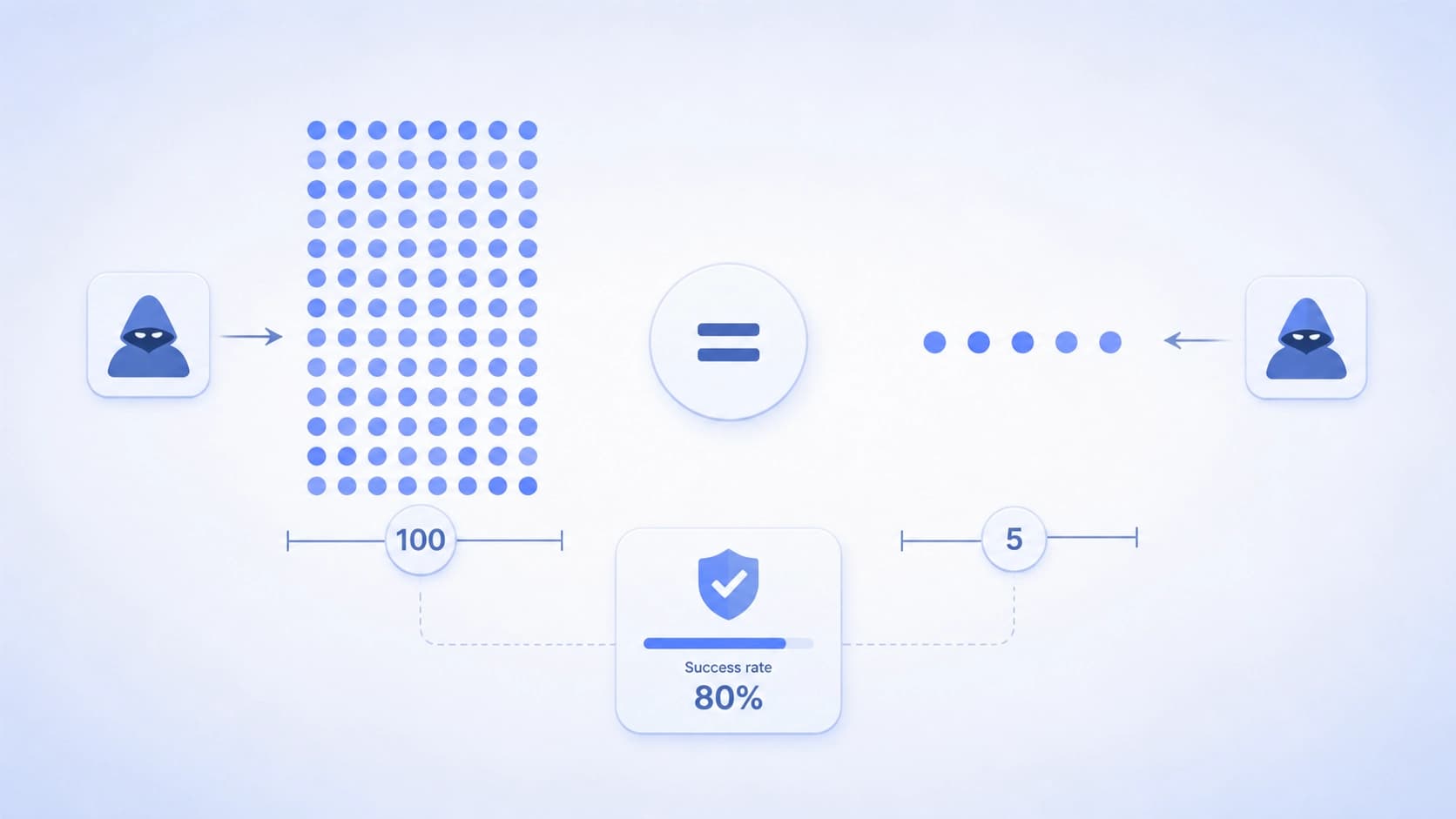
In a recent paper on arXiv, researchers proposed the Fair-ASR protocol. Its essence is to compare attacks under the same limit on the number of target calls. A target call is a request directly to the attacked model: you send a prompt, you get a response. This constraint is easy to control, it is the same for any method, and it does not require knowing the model's internals.
Why does this matter? Some metrics try to account for computational complexity, for example via FLOPS. But for closed and proprietary models, such estimates are inaccurate. The number of calls, on the other hand, is a direct and clear indicator. If one attack succeeds in 10 requests and another needs 1000, then with a budget of 10, the second simply will not happen.
At the same time, the researchers suggest separately tracking so-called attacker calls — requests to auxiliary tools, such as another language model that generates prompts. This allows you to see the full picture: first, how many requests went to the target model, and second, how many additional resources were required.

What changed with a fair comparison
The authors re-evaluated 11 known attacks using Fair-ASR and found that their ranking changes significantly depending on the allocated budget. An attack that looks powerful with a hundred calls may turn out to be weak with five, and vice versa. This means that previous conclusions about effectiveness were at least incomplete.
What also came as a surprise is that simple methods have not gone away. Random prompt perturbations and manually crafted templates remain highly competitive when access to the target model is limited. They do not require large computational resources and work almost immediately.
LLM-driven attacks, where an auxiliary model comes up with bypass variations on its own, performed worse. They spend many calls both on the target model and on their own generation. None of the tested attacks of this type proved effective on both metrics at once. Either the result is achieved with a large budget, or the attack is too expensive in auxiliary calls.
ReCode: an efficient attack inspired by the study
This gap between desired effectiveness and real costs prompted the researchers to create their own method — the compositional attack ReCode. It uses desensitizing rewriting: the original harmful request is reformulated so that it looks neutral and does not trigger defensive reactions. Then two simple and cheap primitives come into play, which performed well during the Fair-ASR re-evaluation.
The results look strong. With a budget of just 20 target calls, ReCode achieves 85% success on GPT-5, and on average each request costs only 7.19 calls to auxiliary tools. For comparison, many other attacks are practically useless under such a limited budget. And those that can boast comparable results usually require several times more auxiliary resources.

Conclusions
The study sends a clear signal: evaluating attacks only by the success rate is no longer acceptable. A common reference point is needed, and the number of calls to the target model is the most transparent and universal measure available. Fair-ASR offers exactly this approach, and it could become the standard for future comparisons.
For those who defend models, there is an important practical takeaway: do not fixate on complex attacks with artificial intelligence as the adversary. Simple and cheap methods — random perturbations, templates — remain a real threat under limited resources. It is their resistance to defenses that should be tested first. Complex LLM-driven attacks may look impressive in lab reports, but in real conditions they are too expensive and not as dangerous as they seem.
Frequently asked questions
Related materials
All materials
MathAdv: What the Final Accuracy of Machine-Generated Proofs Conceals
A diagnostic suite of tasks spanning 13 undergraduate and graduate mathematics topics evaluates machine-proving systems in Lean 4 not only by their final results, but also by their subject-matter mastery, the quality of their informal reasoning, and their robustness to rephrased conditions. A component-by-component analysis shows that translating a problem into formal form remains the main obstacle, and that success depends heavily on the area of mathematics and how the problem is framed.
9 November 2026
AffordanceWAM: Affordances as an intermediary between scene prediction and manipulator control
The work describes a generative model that jointly predicts future RGB observations, scalar fields, affordance heatmaps, and continuous robot commands, using human videos to broaden interaction diversity without action annotations or retargeting. On RoboCasa, CALVIN ABC→D, and real-world tasks, the approach delivers consistent gains over RGB-only and robot-data-only baselines.
9 November 2026
Presentation Editing as Controlled Operations: The EditPPT Framework and DeckEdit-Bench Benchmark
The authors break down slide editing into specific objects, permitted actions, and checks to ensure unrelated content remains untouched, rather than relying on free-form code generation. To measure quality, they created DeckEdit-Bench (183 tasks across 28 human-made presentations), and the multi-agent EditPPT framework achieves a 66.7–74.9% task success rate across five base models while preserving over 97% of the content.
8 November 2026