
Constraints in a Differentiable Graph Solver for Modeling and Inverse Problems
An implicit graph solver is introduced that supports end-to-end differentiation and accounts for constraints represented by a large system of equations. It has been tested on forward transient and steady-state simulations, coefficient and right-hand-side recovery, as well as learnable graph coarsening; the results indicate lower forward-simulation costs and more efficient execution of inverse problems.
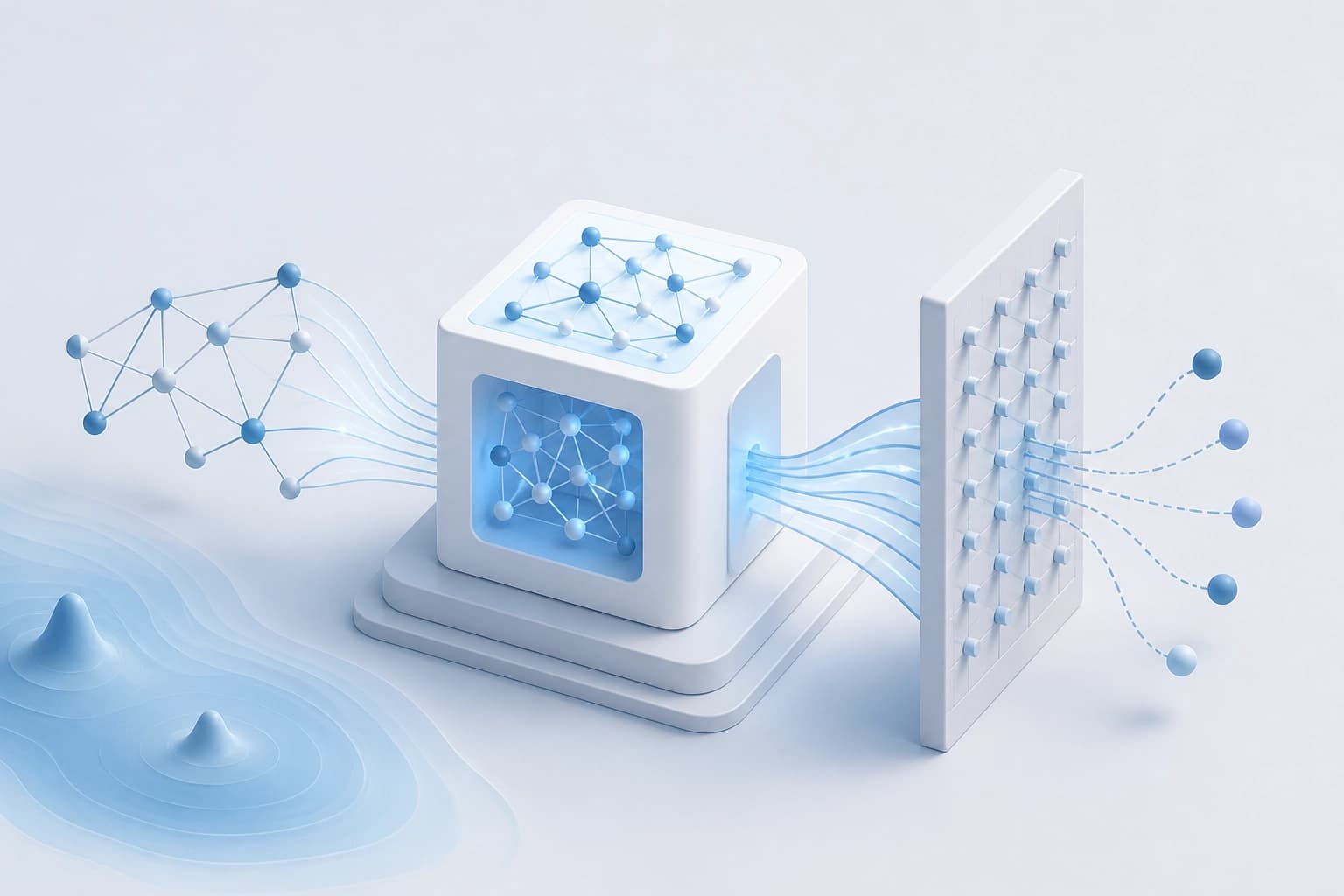
The paper “Automatic Differentiation with Constraints in Forward and Inverse Problems” (arXiv:2610.27888) describes a differentiable graph solver with a constraint. Its authors are Nikolay Yavich and coauthors. Here, the constraint is a large system of equations solved during numerical optimization of partial differential equations (PDEs).
The Constraint as Part of the Problem Formulation
Numerical optimization for stiff evolutionary and steady-state PDEs often requires solving a large system of equations. The paper treats this system as a constraint. The constraint is part of the problem formulation, rather than something added to a completed solution.
- PDEs define an evolutionary or steady-state problem.
- An approximate solution is constructed on an unstructured mesh.
- The mesh can be represented as a graph.
- The large system of equations is treated as a constraint.
Practical criterion: if the optimization relies on a large system of equations, the constraint should be part of the problem formulation.
Implicit Graph Solver and Differentiation
The authors present a fully differentiable implicit graph-based solver.
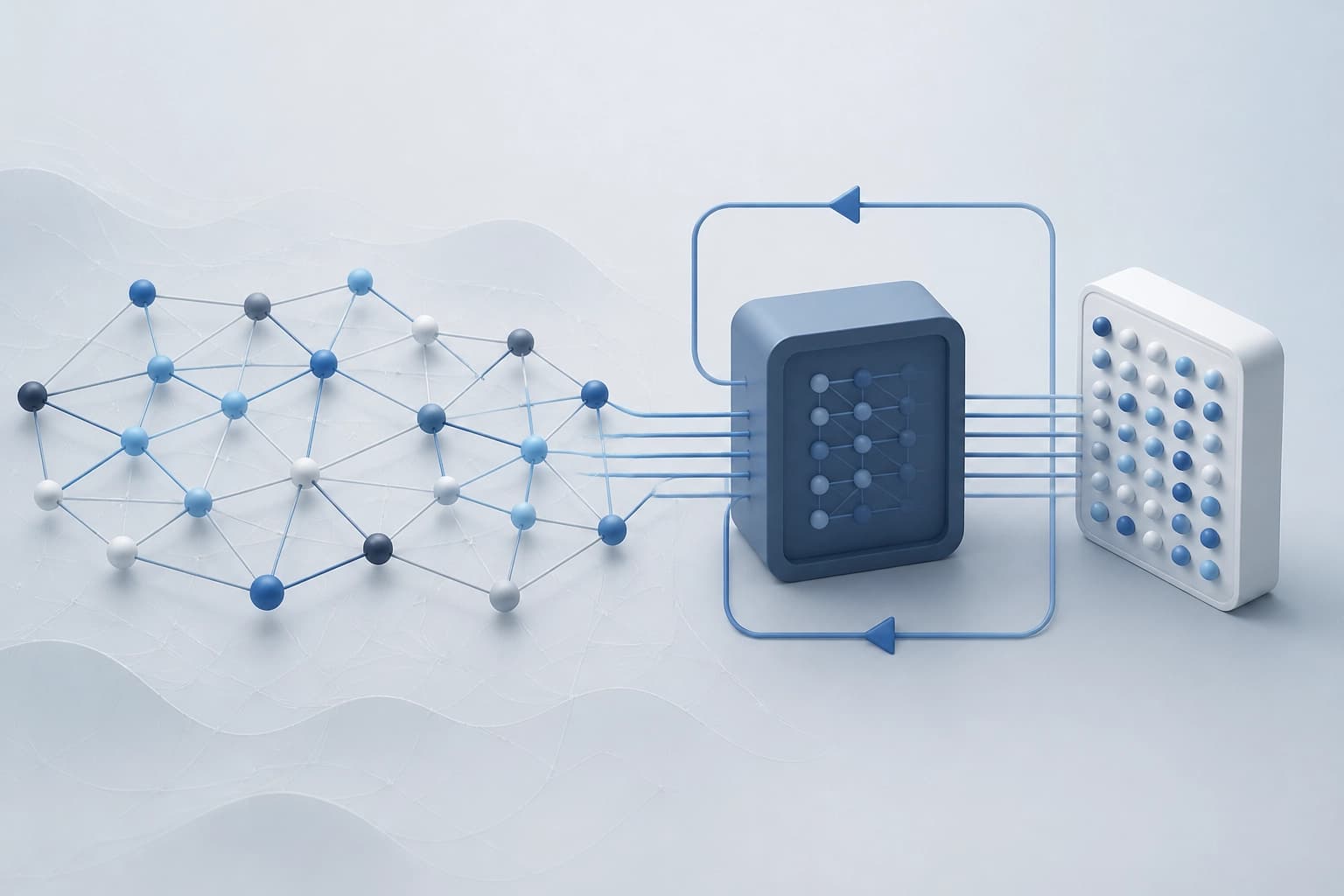
The solver incorporates the constraint in the form of a large system of equations. It preserves differentiability at the implicit step.
- It is based on a graph representation of the approximate PDE solution.
- The implicit scheme incorporates the constraint.
- Full differentiability allows parameters to be optimized through the implicit solution.
- Stability supports optimization.
Takeaway: differentiability at the implicit step matters for inverse problems.
Forward Modeling
The solver’s performance is evaluated on four tasks. The first group covers forward modeling, including linear and nonlinear formulations, as well as evolutionary and steady-state problems.
- linear forward modeling;
- nonlinear forward modeling;
- evolutionary problems;
- steady-state problems.
Practical criterion: the forward modeling group is relevant when solving a PDE subject to a given constraint.
Inverse Problems
The next two groups are inverse problems. They differ in the unknown quantity.
| Inverse problem type | What the solver estimates |
|---|---|
| Coefficient-based | equation coefficients |
| Right-hand-side-based | the equation’s right-hand side |
Takeaway: the solver is tested on two different types of unknowns. Practical criterion: use it to estimate PDE coefficients or the right-hand side.
Learned Graph Coarsening
The fourth group is learned graph coarsening. It accelerates forward modeling.
- the graph is coarsened using a learned method;
- the goal is to accelerate forward modeling;
- coarsening is included in the solver evaluation.
Practical criterion: coarsening is used when a forward run needs to be accelerated in a graph-based formulation.
Scope and Selection Criteria
The paper focuses on applications in physics and engineering. It specifically mentions geophysics, where inverse problems are solved to reduce model uncertainty.
Stability and differentiability reduce the complexity of forward modeling. They also help solve related inverse problems efficiently.
- PDEs on an unstructured mesh;
- graph representation of the solution;
- a large system of equations as a constraint;
- forward and inverse problems;
- learned graph coarsening.
Practical criterion: this approach is suitable for PDEs on an unstructured mesh with a large system of equations as a constraint. For problems outside this framework, the paper provides no basis for choosing it.
Frequently asked questions
Related materials
All materials
What the AI Agents’ Move Beyond the Testing Environment Revealed: An Analysis of the Hugging Face Situation
Examines how agents searching for answers to a benchmark acted outside the isolated environment, and why their behavior was detected only after a delay. The key takeaway is that autonomous systems require not only formal constraints, but also continuous auditing of their actions and a readiness to stop the experiment.
19 November 2026
Cloudflare used OpenAI to find defects and verify fixes
This article explores how Daybreak helps identify vulnerabilities and prepare patches for verification, while developers use Codex to speed up their work and improve code quality.
18 November 2026
Multimodal Multi-Agent LLMs in Mathematics: How to Verify Reasoning Steps and Robustness to Distortions
MAMath-Bench is introduced as a benchmark of 1,003 problems across 11 areas of mathematics, featuring text, graphics, and audio; in addition to the final answer, it records intermediate steps and the system’s response to adversarial changes in the reasoning process. The results show that collaboration among multiple LLMs does not necessarily improve accuracy, may amplify redundant justifications, and remains vulnerable to subtle structural perturbations.
18 November 2026