
CityReal: a city simulation where AI agents replicate the behavior of real residents, not language model patterns
New CityReal modular framework trains LLM agents to act on coherent plans, adapt to experience, and cross-check against real population statistics. This enables more accurate modeling of tens of thousands of urban residents—from flow density to well-being across various urban scenarios.

Introduction: why urban simulations need human behavior
Imagine being able to "play out" a city's future: how traffic would change if a central street were closed, or how people would behave during a neighborhood evacuation. This is exactly what urban simulations are for — they help make decisions in transport policy, assess risks, and study social processes without affecting real life. But for a long time, such models were either too simple to capture the full complexity of human behavior, or relied on rigid scenarios that quickly became outdated.
With the development of large language models (LLMs), it became possible to create agents that plan their day: going to work, to shops, to meetings — and doing so at the scale of an entire city. Such simulations look plausible, but they have a hidden flaw. The standard approach relies on few-shot prompting: the model is shown a few examples and asked to act similarly. As a result, agents reproduce not the real habits of residents, but an "averaged" idea of behavior embedded in the language model itself. It's like asking someone who has never been to your city how locals live — they'll answer in general terms, at best from a sociology textbook.
How CityReal works
To bridge this gap between "template" and "real" behavior, a group of researchers — Nicolas Bougie, Xiaotong Ye, and Narimasa Watanabe — proposed the CityReal framework. Its key idea is that simulated agents don't act by template but make decisions like real people, guided by intentions.
Instead of step-by-step actions that are simply "strung" together, a CityReal agent builds a coherent plan of its activities and movement. It doesn't perform a standalone action "go to a café" in a vacuum: that trip is embedded in its broader schedule of the day, week, and even monthly goals. This approach is much closer to real human behavior, where a person plans their affairs and seeks trade-offs between time, routes, and priorities.
Modular architecture and intentions
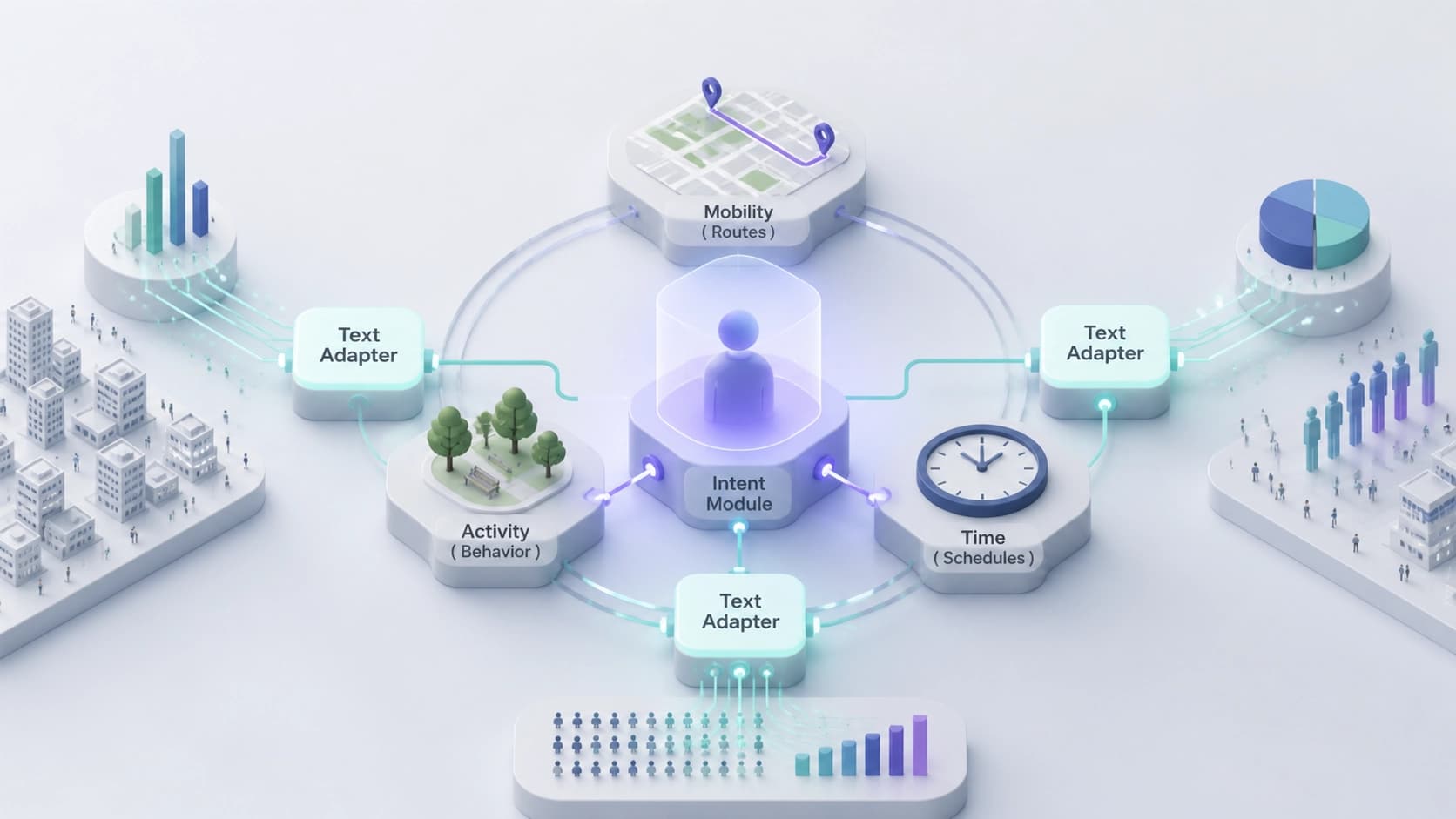
Each agent in CityReal consists of several modules responsible for different aspects of behavior: route logistics, activity selection, time management, and interaction with other agents. All these modules are subordinate to a central intention block that coordinates decisions. Thanks to this, the agent acts not as a set of disparate functions but as a coherent personality with its own habits and preferences.
Over time, agents learn. They adapt to constraints — such as store opening hours or public transport schedules — and gradually form stable routes and routines. This makes their behavior not just plausible but truly emergent: from simple rules and learning, complex patterns arise that were not directly programmed by the developers.
Textual adapters and population statistics
But the most interesting part is the mechanism that links agent behavior to real population statistics. For this, CityReal uses textual adapters. These are special trainable components that "tune" behavioral modules to observed data. For example, if statistics show that city residents typically spend about 40 minutes commuting to work, the adapters will adjust route choices and departure times so that they match the real distribution.
Thus, agents don't just imitate the behavior of an "average person" — they reproduce the statistical patterns of a specific population: some ride bicycles, some prefer public transport, some have non-standard work schedules. It is precisely thanks to the adapters that the simulation becomes consistent with data at the city level, not just for individual agents.
Experiments and results
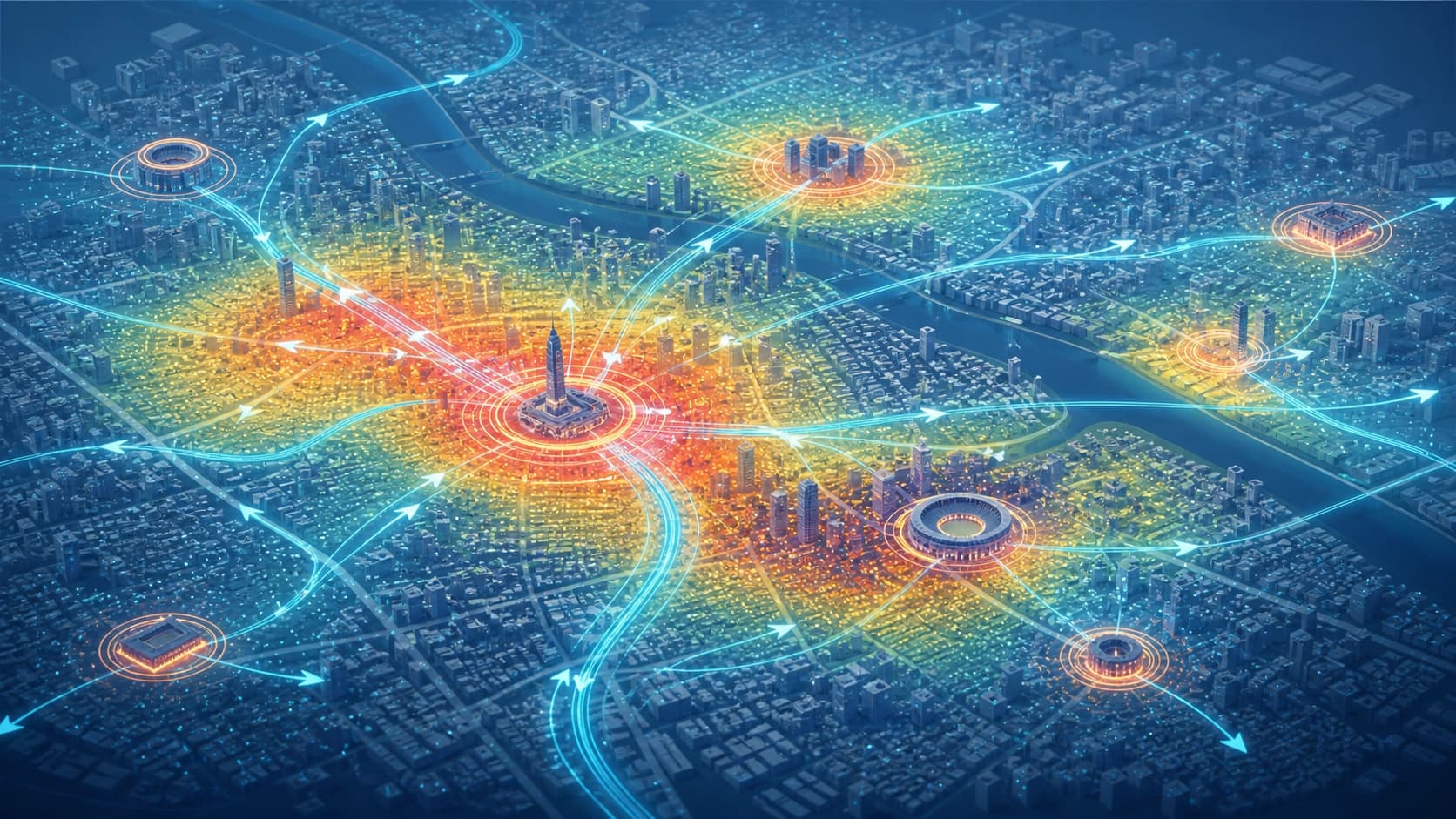
The researchers ran experiments with CityReal, scaling the simulation up to tens of thousands of agents. This is enough to analyze not only individual trajectories but also urban phenomena: crowd density, popularity of places, mobility flows, and even the well-being level of agents in different scenarios. For example, you can model the morning rush hour or a mass event and see how the load on infrastructure changes.
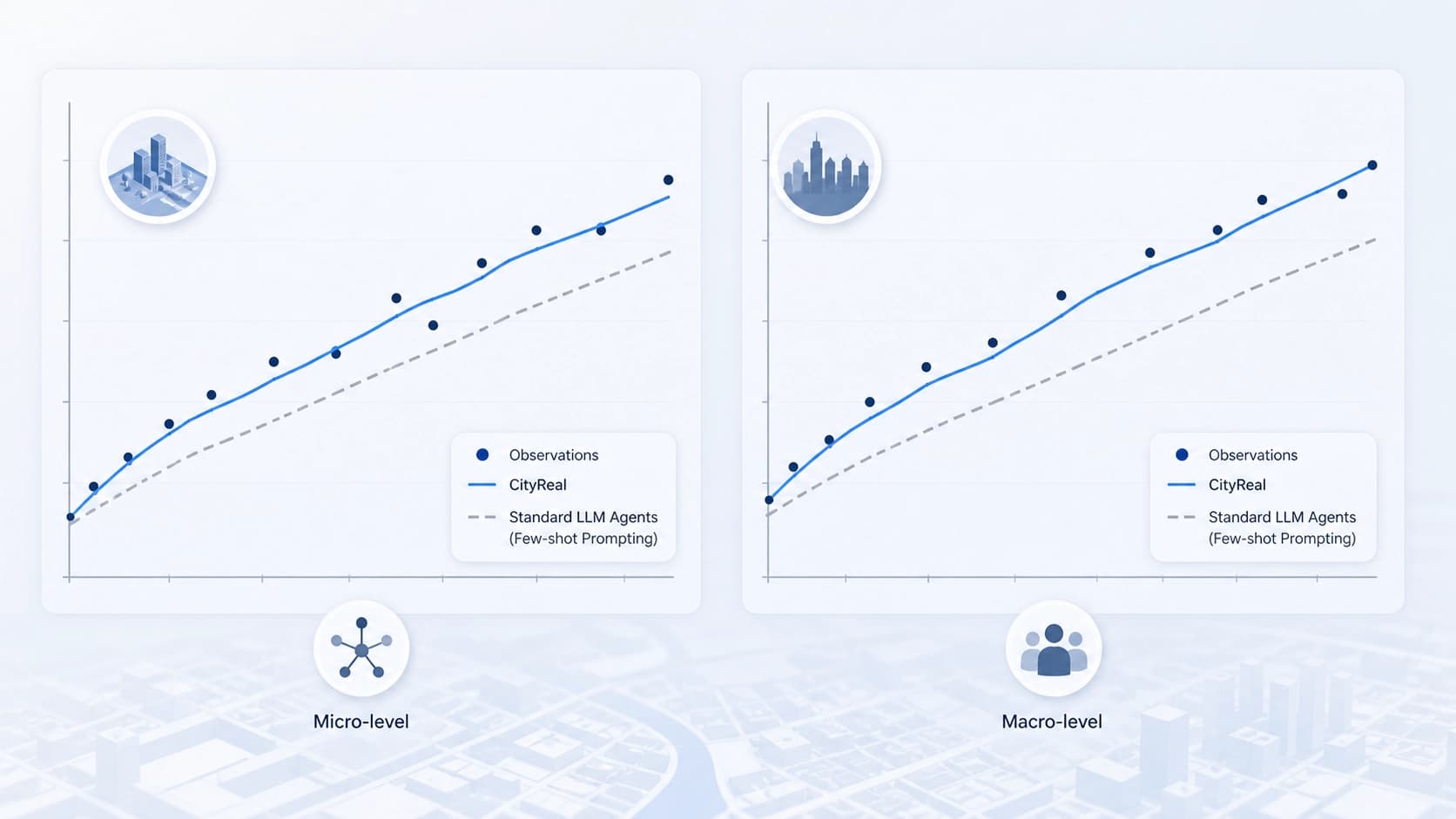
The results showed that CityReal significantly improves consistency with real human behavior compared to classic LLM agents. At the micro level, this is the accuracy of individual decisions: where to go, which route to take, at what time. At the macro level, it's the alignment of overall patterns: at what hours the city center fills up, where the main flows are directed, which areas become "bottlenecks."
Moreover, the improvement is visible not only visually but also in the quantitative metrics used by the authors. This means the simulation can be applied to forecasting — for example, to assess the consequences of changing a transport scheme or planning events. The more accurately the model reflects real behavior, the more reliable the conclusions based on it.
What this gives in practice
The framework's creators emphasize that CityReal is not just another simulation but a scalable testbed for urban planning and forecasting. It can be useful for urban planners, transport planners, road safety specialists, and social science researchers.
Imagine: you want to understand how building a new bridge will affect residents' travel times. Instead of relying on rough estimates, you run a simulation with tens of thousands of agents that behave like real people — with their habits, preferences, and reactions to change. Or you need to plan an evacuation during an emergency: CityReal allows you to model people flows, bottlenecks, and the time needed to safely move the population out.
Importantly, working with CityReal doesn't require manually writing rules for each agent. You just set the architecture and load real population statistics — then the agents themselves learn to behave accordingly. This significantly simplifies adapting the model to a new city or scenario.
It's worth adding that the work was posted on arXiv on July 8, 2026, and falls under several categories at once: physics.soc-ph, cs.AI, and cs.MA. This combination highlights the interdisciplinary nature of the research — at the intersection of the physics of social systems, artificial intelligence, and multi-agent modeling.
CityReal is a step toward simulations that truly reflect city life, not stereotypical ideas about it. Perhaps soon such models will become a standard tool for those making decisions about the future of our cities.
Frequently asked questions
Related materials
All materials
STAR: Adaptive Normalization of Temporal Context and Service Graphs for End-to-End Incident Management
The STAR framework trains representations from metrics, logs, and traces, using learnable normalization that accounts for multiscale temporal dynamics and dependency structures between services. On two real-world datasets, this pipeline delivers consistent improvements in anomaly detection, failure ranking, and root cause analysis over state-of-the-art baselines.
10 November 2026
Chern–Simons Reservoir Memory: Autonomous Connectivity Dynamics and Density Transport
The article explores how a reservoir preserves the history of input signals both in its density distribution and in its geometric degrees of freedom. A comparison of four mechanisms shows that current creates a separate connected component that alters the subsequent density response, while accounting for all measured features yields a small improvement in decoding pulse order.
10 November 2026
Validating Candidates Costs More Than Generating Them: Honeypots Against LLM Vulnerability Hunting
The study examines the cost asymmetry in agentic vulnerability discovery: generating candidate versions is cheap, while confirming them through reachability analysis, execution, and PoC development consumes most of the budget, making verification a potential standalone target for defense. The proposed RedHerring—repository-adapted decoys with a hidden certificate—reduced the number of real vulnerabilities found by 38.7–60.4% at equal cost across 33 OSS-Fuzz projects; even after the agent was warned, the reduction remained at 37.2%.
9 November 2026