
How to check what the end-to-end driving scheduler actually relies on
The new CADET approach enables causal auditing of already-trained end-to-end planners without retraining them. It identifies cases where the model makes decisions based on random incidental scene objects rather than actual causes, and helps correct such errors.

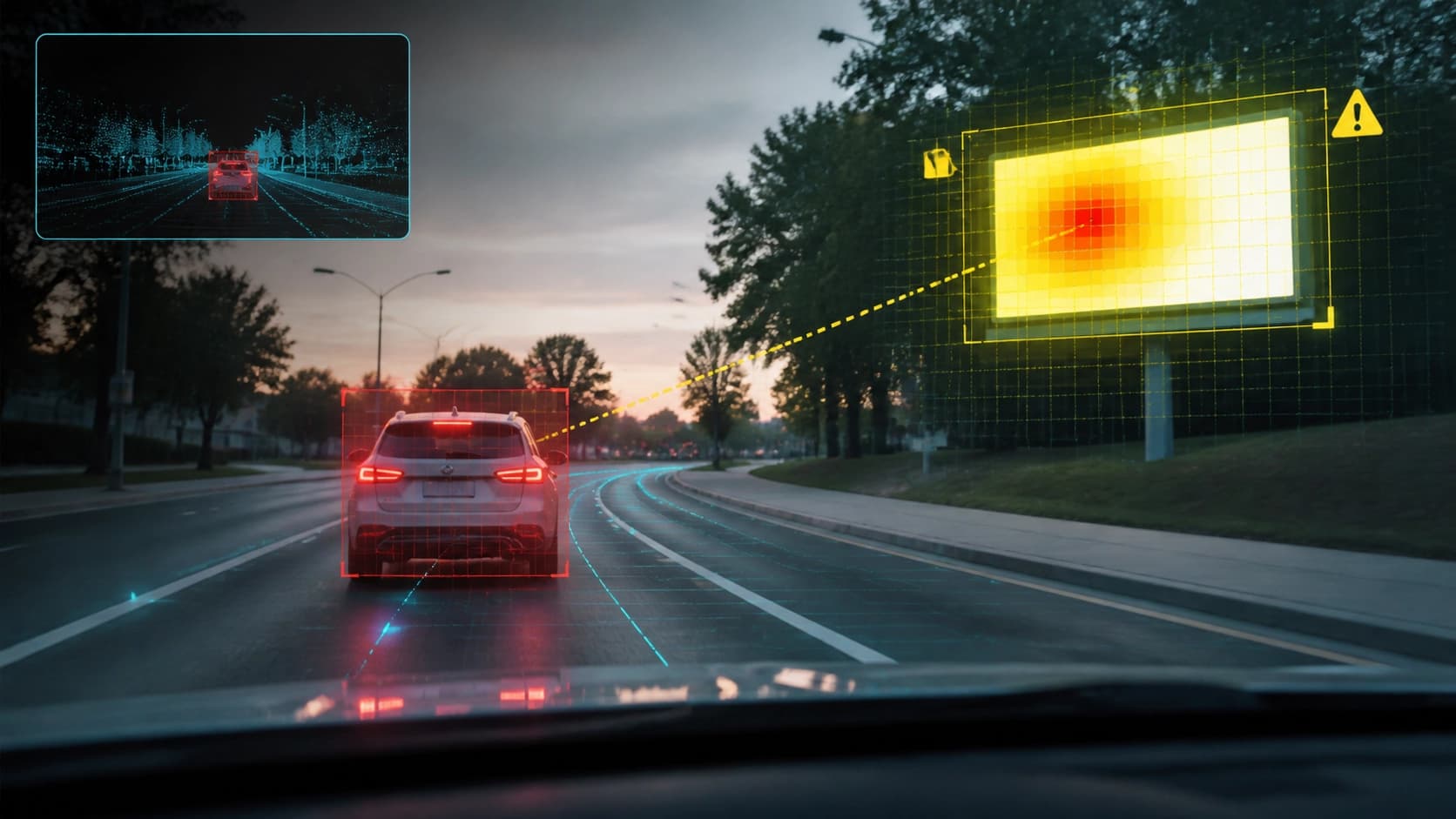
The image from the camera is directly transformed into a trajectory — that is the main promise of end-to-end driving planners. However, behind the apparent simplicity, an unpleasant surprise often lurks: a model that has learned driver behavior from recordings may find an easier way to "guess" the correct action than honestly analyzing the road situation. Instead of causal relationships, it often uses statistical coincidences found in the training data.
Why an end-to-end planner latches onto random details
End-to-end planners are trained using imitation: they are shown examples of expert actions and are expected to reproduce the same decisions under similar conditions. This approach works as long as the data contains enough variety. The problem is that objects only indirectly related to the maneuver almost always surround the expert's trajectory. This could be a roadside sign, a building facade, a distinctive barrier, or even an ordinary pole.
If such an object regularly appears in the training set at moments when the driver, for example, brakes or changes lanes, the planner memorizes this association. From a formal standpoint, the model finds a statistical pattern where a causal one was expected: it begins to treat the object as the cause of the action, when in reality it merely coincides with it. In ordinary scenarios, this goes unnoticed because the correlation aligns with actual behavior. But as soon as the road situation becomes rare — "long-tailed" — the spurious dependency makes itself known: the model may brake where it should drive, or vice versa.
This causal confusion is quiet and insidious. It does not manifest as an obvious error on standard tests but instead undermines robustness precisely in the unusual situations that modern driver assistance systems are designed for. Therefore, simply adding more examples to the dataset usually does not work: the model will still seek out any correlations if they help reduce error on the training set.
Why open-loop metrics do not reveal the true cause
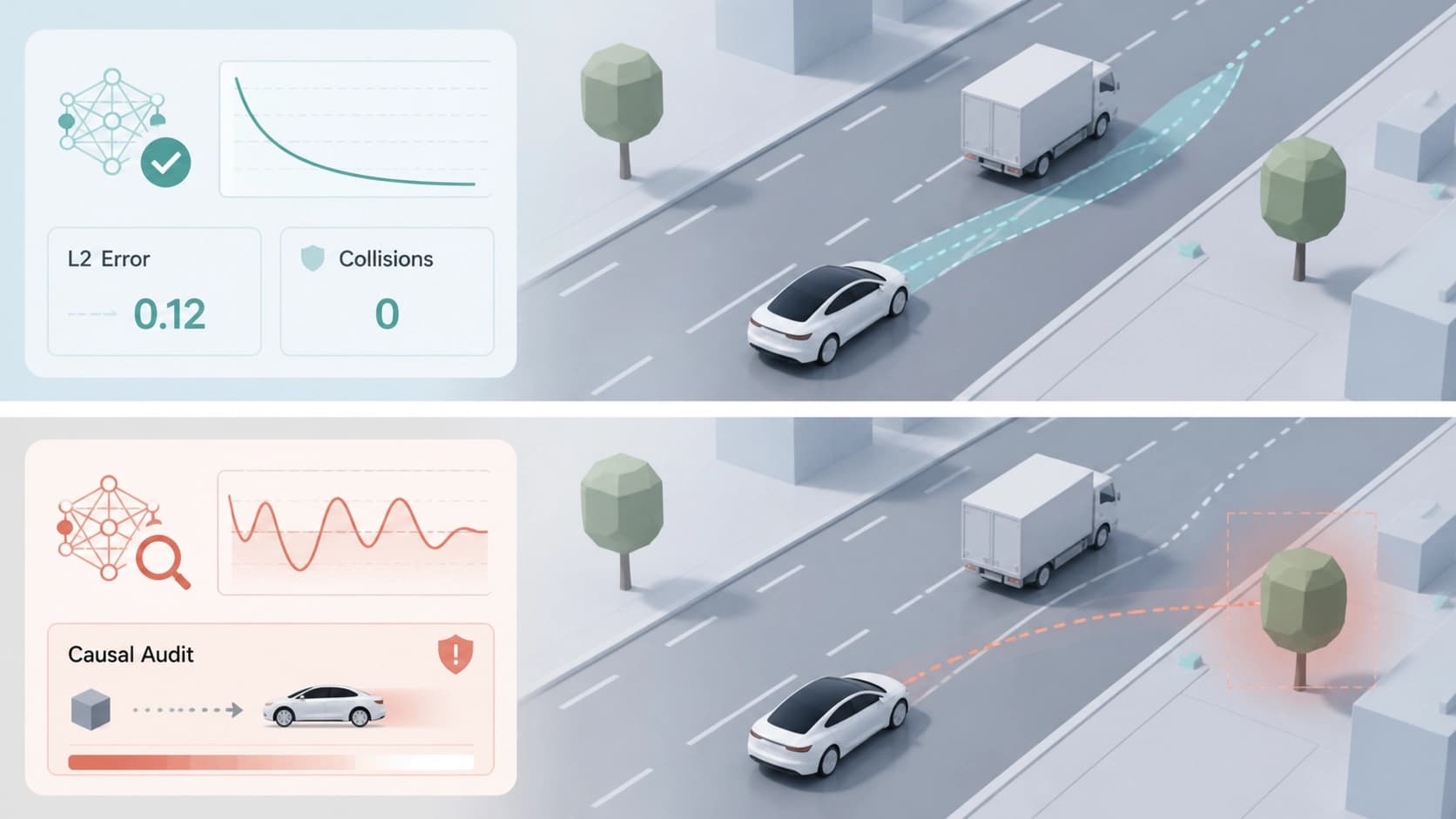
How can you tell what exactly the planner is looking at when making a decision? The simplest way is to run it on recorded scenarios and measure classic open-loop metrics: trajectory mean squared error (L2) and collision rate. These are the parameters most often used to evaluate autonomous driving. However, as research shows, such metrics are almost entirely determined by the current state of the vehicle itself: its position, speed, and acceleration. They do not answer the question of which scene elements influenced the maneuver.
Imagine two planners: one carefully avoids a pedestrian, the other brakes because of a bright patch on the asphalt that happens to appear frequently near pedestrians in the data. On open-loop metrics, both will show low L2 error and zero collisions — because their output trajectories are similar. But in the second case, the system is useless in the real world: as soon as it encounters a scene without the spurious signal, the planner loses its bearings. Standard metrics do not see this, and therefore cannot warn about the fragility of the behavior.
Causal audit without retraining
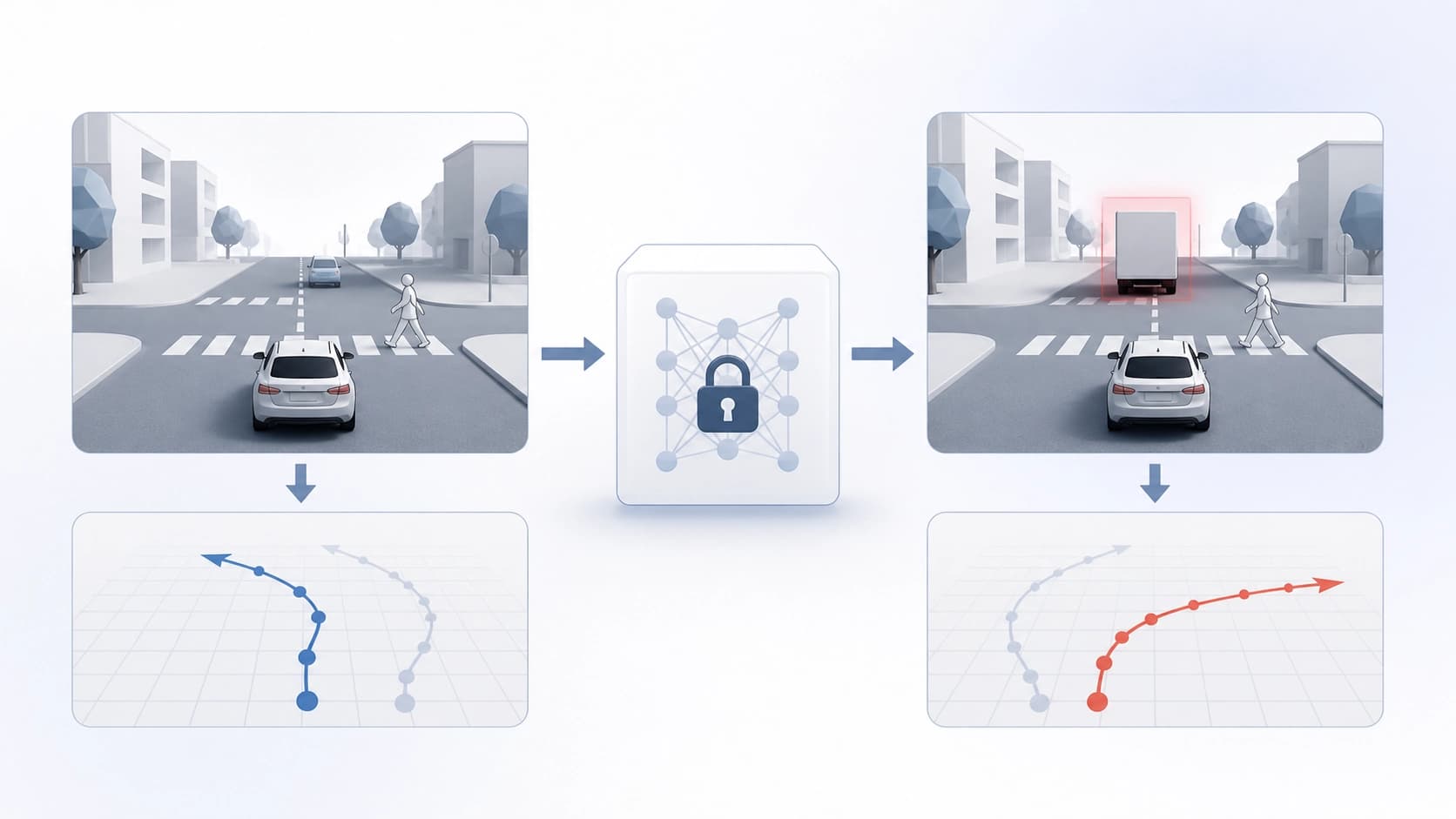
To uncover spurious dependencies, causal interventions are needed: you must intervene in the scene, change individual elements within it, and observe how the decision changes. The logic is simple: if the planner drastically alters its trajectory after replacing an insignificant background object, it means it was relying on that very object. But classical causal analysis methods require retraining the model: for each intervention, the weights of a large neural network must be updated anew. For an already deployed planner, this is impossible — no one in real-world operation has spare resources for retraining after every test.
The authors of the proposal behind the acronym CADET chose a different path. Their framework operates without training (training-free) and can probe pre-trained end-to-end planners without the slightest parameter update. Instead of changing weights, CADET uses carefully designed interventions within the scene itself and tracks how the planner's output responds.
This approach unlocks three capabilities at once:
- audit — identifying the specific objects the planner relies on incorrectly;
- benchmarking — comparing different planners by the degree of "noisiness" in their decisions;
- correction — mitigating the influence of spurious features on the output, again without fine-tuning.
The result is a universal diagnostic tool that can be applied to any ready-made model. Instead of testing the system only against accident statistics, a developer gains a mechanism that uncovers the cause of a potential crash before it happens. This is especially valuable for long-tailed scenarios, where collecting a complete set of real-world examples is practically impossible.
What makes this approach practically useful
For engineers integrating an end-to-end planner into a vehicle, what matters is not just accuracy on test tracks but also the predictability of behavior. CADET makes it possible to answer the question "why did the system choose this trajectory" — and to do so before deployment in real vehicles. There is no need to wait for a rare situation to occur on the road; a series of targeted interventions in a virtual environment is enough to reveal the weak points.
Such an audit also changes the development approach. If you have two candidate models with roughly identical open-loop metrics, the choice used to be almost random. Now you can see which model pays less attention to random features and prefer that one. Even if the second model is formally more accurate on standard tests, a causally "cleaner" system is more likely to withstand contact with the real world and its infinite diversity.
It is telling that the work, which appeared in 2026, already offers a complete toolkit rather than merely describing the problem. End-to-end planners are one of the most promising directions in autonomous driving, but their applicability in industry directly depends on whether we can understand the internal logic of their decisions. Without causal auditing, high accuracy on standard scenarios remains merely a lucky coincidence, not a guarantee of safety.
Frequently asked questions
Related materials
All materials
OpenCollab: programmable agent coordination, controlled execution environment, and policy compliance metric
The framework brings together the specification of agent interaction structures, a shared environment for experiments, and detailed event tracing, while the newly introduced Adherence metric reflects how closely actual execution follows the declared schema. In benchmarks, the Duo configuration achieves a new state of the art, while the single-agent variant uses the fewest tokens.
11 November 2026
Toollery: Choose tools for LLM agents from tens of thousands of options without fine-tuning
Toollery builds a search index from descriptions of skills and tools, then passes the model only a limited set of candidates for each query. In experiments with libraries containing tens of thousands of functions, the approach helps maintain selection quality at a fixed top-K, although the overall effect depends on the workload profile and the provider’s caching.
11 November 2026
WILSON: combining magnifications and patient slides for pathomorphological analysis and report generation
The preprint introduces WILSON, a vision-language model that encodes images of whole slides and series of slides from a single patient at different magnifications, rather than just a single “best” slide. Without task-specific fine-tuning, it outperforms specialized and larger slide models on a range of metrics while requiring substantially less compute, and its diagnostic descriptions received higher ratings from pathologists.
11 November 2026