
User Persona as a Stress Test: What the AgentWorld Simulator Revealed for Agentic Search
Researchers from Agent4IR @ KDD 2026 presented AgentWorld — an environment where AI agents are tested for robustness by introducing virtual users with different personality profiles based on the OCEAN model and adding adversarial perturbations. This approach exposes failures in agent behavior that conventional uniform testing simply does not catch.
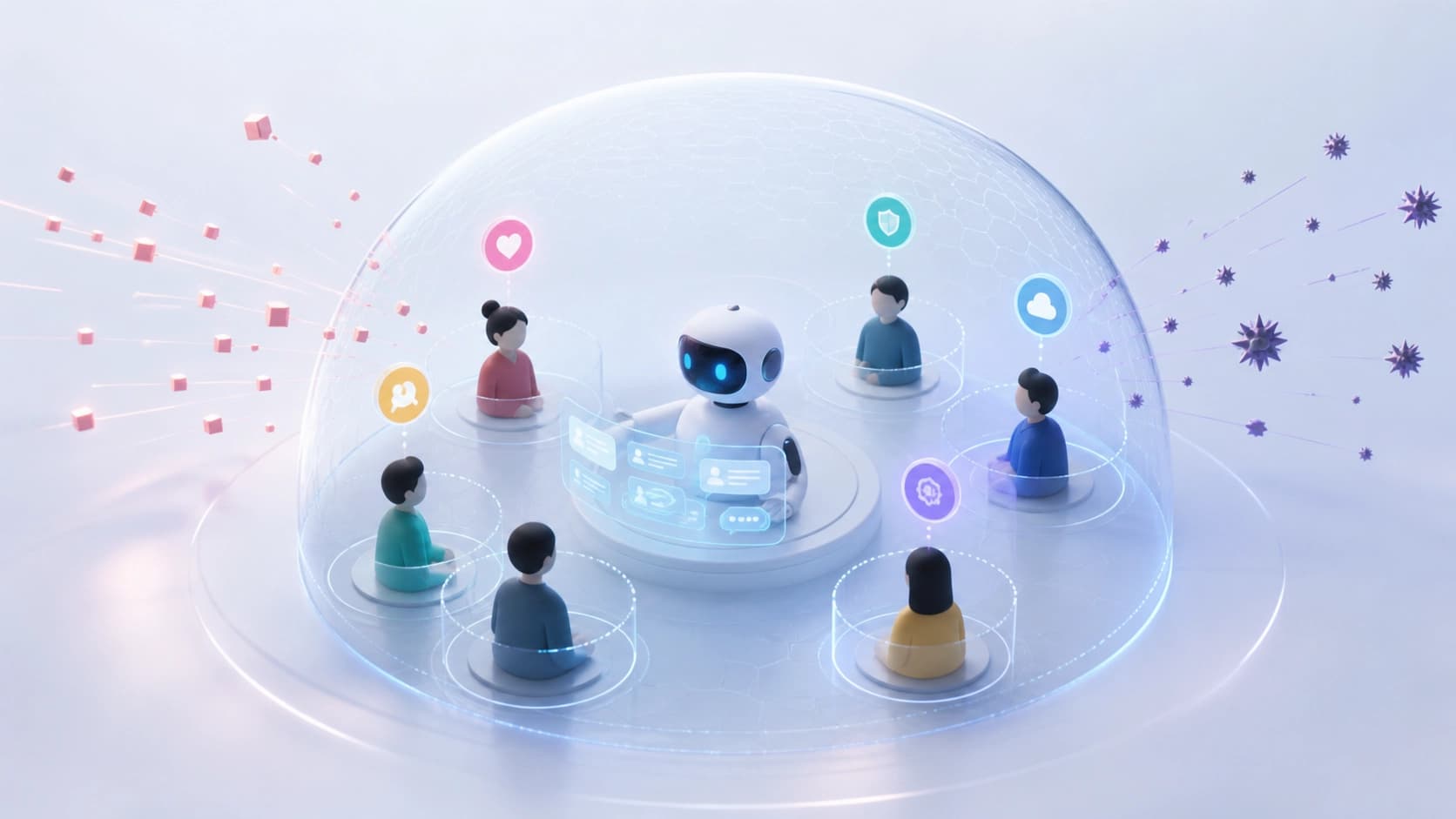
Evaluating search agents is usually built on carefully scripted scenarios: pre-known utterances, predictable queries, one "average" user. This approach is convenient to measure, but it poorly reflects reality, where the same interface is used by people with vastly different pacing, styles, and patience. The paper AgentWorld: Personality-Aware Reliability Evaluation for Agentic Information Retrieval (arXiv:2608.24076, accepted to the Agent4IR workshop @ KDD 2026) proposes looking at agent reliability differently — through the character of the interlocutor and through attempts to break that character.
From scripts to personalities: where the gap lies
A classic benchmark for agentic search answers the question "did the agent solve the task." But it stays silent about what happens between steps and says almost nothing about the spread of results. If all users in a test behave identically and attacks on the system are not modeled at all, the conclusions come out sterile: such a measurement cannot reveal where exactly the agent starts to stumble.
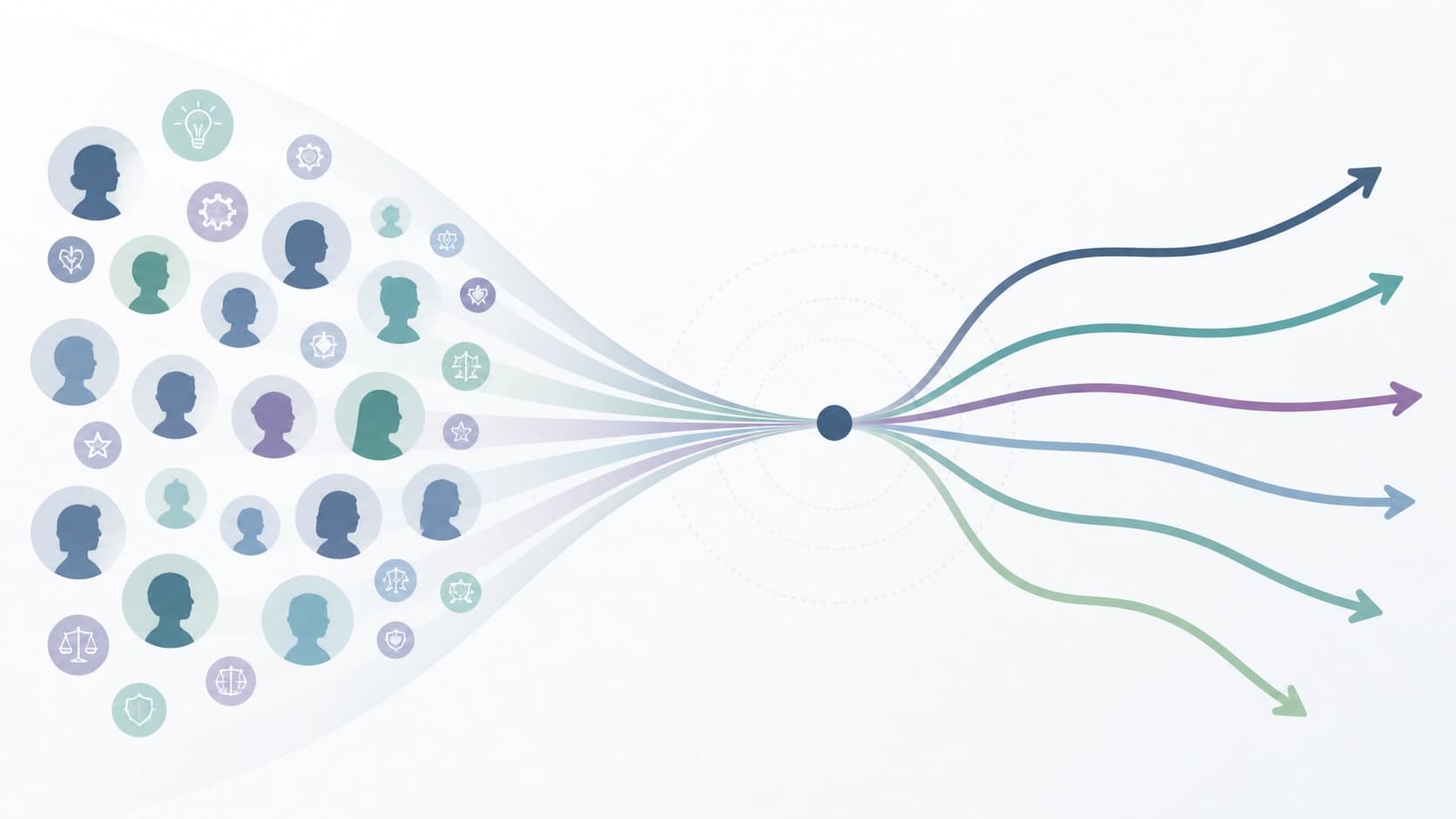
This is precisely the gap the authors — Gunja Agarwal, Arup Kumar Das, Arun Menon, Jitesh Chandra Mishra, and Vignesh Divakaran — are trying to close. Their key idea is simple: the spread of user behavior should not be smoothed out but turned into a separate measuring instrument.
What AgentWorld is
AgentWorld is a simulator, not a standalone search engine. It does not solve tasks instead of the agent but creates an environment in which the agent can be run through various scenarios and various types of interlocutors, capturing not only the final answer but also the trajectory of obtaining it.
Four core blocks
- Big Five user models. Personas are defined by the five-factor model (also known as OCEAN), and they do not operate in a vacuum: each user has their own state and their own set of available tools, and these states change over the course of the dialogue.
- The pass^k consistency metric. This is not just "how many times it worked." Alongside it there is a structural classification of failures, partial credit for incomplete but meaningful progress, and double verification of handoff — that is, whether the agent correctly handed control to a human or another system is verified separately.
- Data export for fine-tuning. The simulator can export accumulated runs, filtering out those with weak scores, in six formats suitable for fine-tuning.
- An adversarial Risk Analyser. This module takes snapshots of the "ridges" of intermediate states that the agent must pass through, then branches runs via Monte Carlo across four types of perturbations tied to a specific task. The final risk is computed via the ΔP / ΔT ratio, Dempster–Shafer evidence fusion, and Shapley attribution of attack categories.
Note the logic: the first three blocks are about measurement and learning, the fourth is about predicting breakdowns. The framework is built from the outset as a tool not only for diagnostics but also for stress testing.

Three runs: from analytics to adversarial attack
The experimental part consists of three parts with varying degrees of "load."
- A conversational analytical agent was run against ten OCEAN personas. For quality annotation, 240 judge ratings were collected.
- A customer support agent was tested on five tasks, each in four persona variants.
- An adversarial stress test of the same five tasks: perturbations were added here to see how quickly trajectories fall apart.
The third run proved the most telling. Even in the absence of perturbations, the minimum trajectory stability was V_min = 0.375 — that is, even "clean" conditions provide no margin of safety. And when attacks were enabled, it turned out that the most dangerous blows are not against the content of the query but against tools and infrastructure: Shapley attribution assigns about 46% to the system level and roughly 38% to the action level.
This is an important shift in emphasis. Discussion of agent security often boils down to prompt injections in text, whereas the numbers say the main risk lives in the layer responsible for tool calls and their state.
Character as a source of divergence
The most interesting thing in the paper is not the absolute scores but the spread between personas. On the same task, the pass rate differed radically: 50% versus 100%. This is not measurement noise but a signal that the agent handles different communication styles differently.
Failure modes that unified testing simply does not reveal are listed separately:
- cross-domain leaks — when the context of one task bleeds into another;
- context drift — the gradual shift of topic and goals over the course of a long dialogue;
- a quality gap between personas of 0.27 points.
The authors emphasize that the Risk Analyser can measure fragility at the trajectory level — where a single pass^k metric is powerless, because it captures only the fact of success or failure and does not distinguish between "fell apart at the first step" and "made it almost to the end but failed to hold the state."
Why this is useful in practice
If you treat the findings as a recipe, it looks like this: test the agent not on one "average" user but on a set of characters, and look at the spread between them rather than the average. The average score may be quite decent while half the personas consistently fail the scenario.
The second practical layer is data. Since the simulator can label successful and unsuccessful runs and export them in ready-made formats, personalities become not only a trial but also a source of training material. The weak spot here is obvious: the quality of such a dataset depends entirely on the quality of annotation, and judge ratings are the most expensive and subjective part of the process.
Finally, the third layer is priorities in defense. Since the bulk of the risk falls on the system level and actions rather than on wording, what needs strengthening first and foremost is access rights, call verification, and correct handoff — not just filters on the input text.
What to keep in mind
It is worth keeping the scale in mind: we are talking about three sets of experiments, ten personas in one of them, and five tasks in the other two. Numbers like 50% versus 100% look dramatic but are built on a small sample — this is more an indication of direction than a final verdict. Moreover, simulating a user via the Big Five inevitably coarsens real character: a living person is inconsistent, whereas a persona in the simulator still follows a predefined profile.
Nevertheless, the methodological idea looks solid and transferable. Agent reliability is not a single number but a distribution across types of interlocutors and types of failures. The AgentWorld simulator takes the first serious step toward making this distribution measurable rather than guessed at.
Version v1 of the paper appeared on August 25, 2026; the current v2 is from August 26, 2026 (size 1,710 KB); DOI — 10.48550/arXiv.2608.24076, subject area — cs.AI.
Frequently asked questions
Related materials
All materials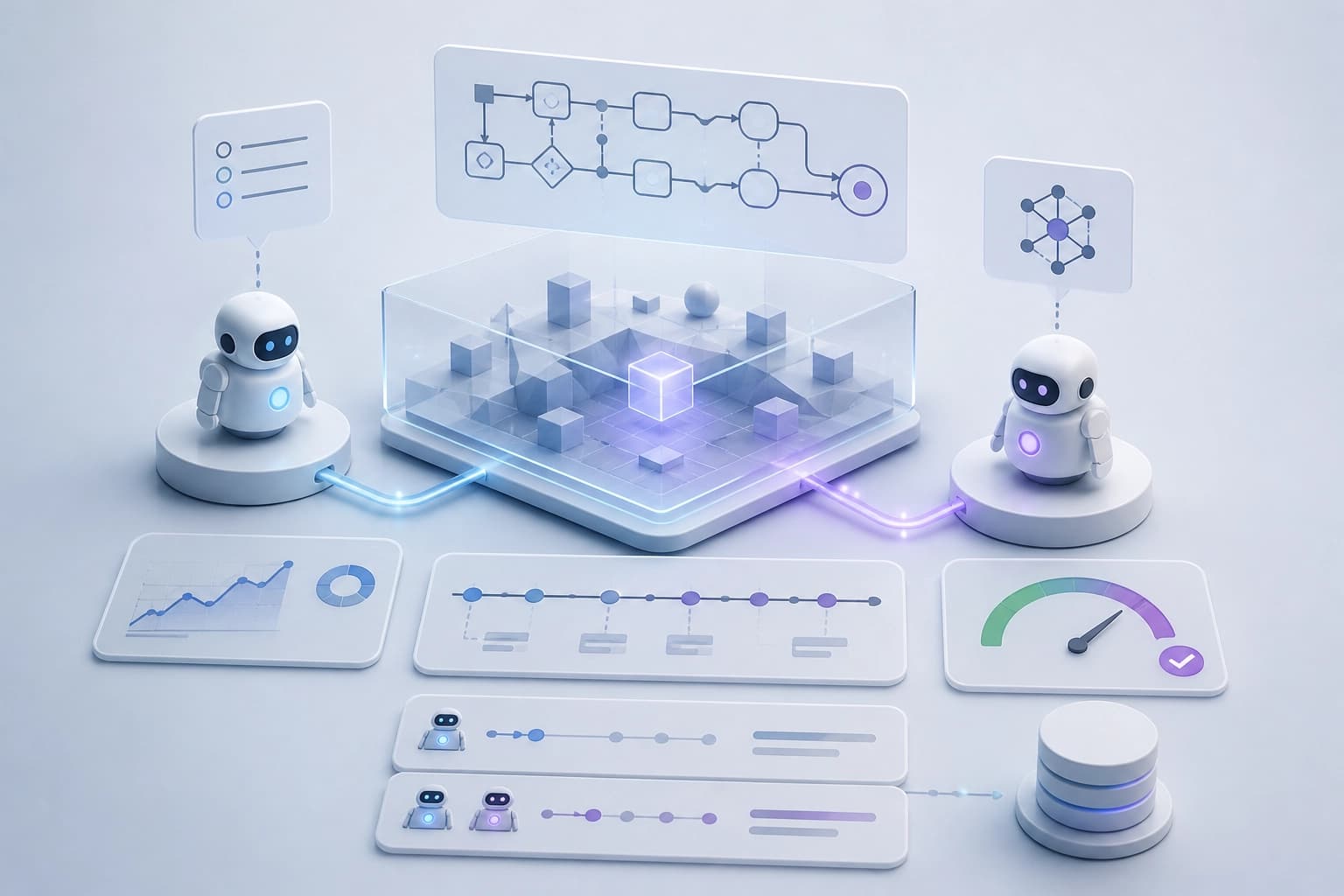
OpenCollab: programmable agent coordination, controlled execution environment, and policy compliance metric
The framework brings together the specification of agent interaction structures, a shared environment for experiments, and detailed event tracing, while the newly introduced Adherence metric reflects how closely actual execution follows the declared schema. In benchmarks, the Duo configuration achieves a new state of the art, while the single-agent variant uses the fewest tokens.
11 November 2026
Toollery: Choose tools for LLM agents from tens of thousands of options without fine-tuning
Toollery builds a search index from descriptions of skills and tools, then passes the model only a limited set of candidates for each query. In experiments with libraries containing tens of thousands of functions, the approach helps maintain selection quality at a fixed top-K, although the overall effect depends on the workload profile and the provider’s caching.
11 November 2026
WILSON: combining magnifications and patient slides for pathomorphological analysis and report generation
The preprint introduces WILSON, a vision-language model that encodes images of whole slides and series of slides from a single patient at different magnifications, rather than just a single “best” slide. Without task-specific fine-tuning, it outperforms specialized and larger slide models on a range of metrics while requiring substantially less compute, and its diagnostic descriptions received higher ratings from pathologists.
11 November 2026