What is Agent Lightning v1.0 and why is everyone talking about it
Modern AI agents rarely work alone: around them is built an agent harness — a layer that manages tools, context, and the execution flow. How effective the model is at tasks directly depends on how this "scaffold" is designed. However, for a long time it remained outside the training loop: the RL trainer only saw the model's responses and never dealt with how the agent actually interacts with the environment.
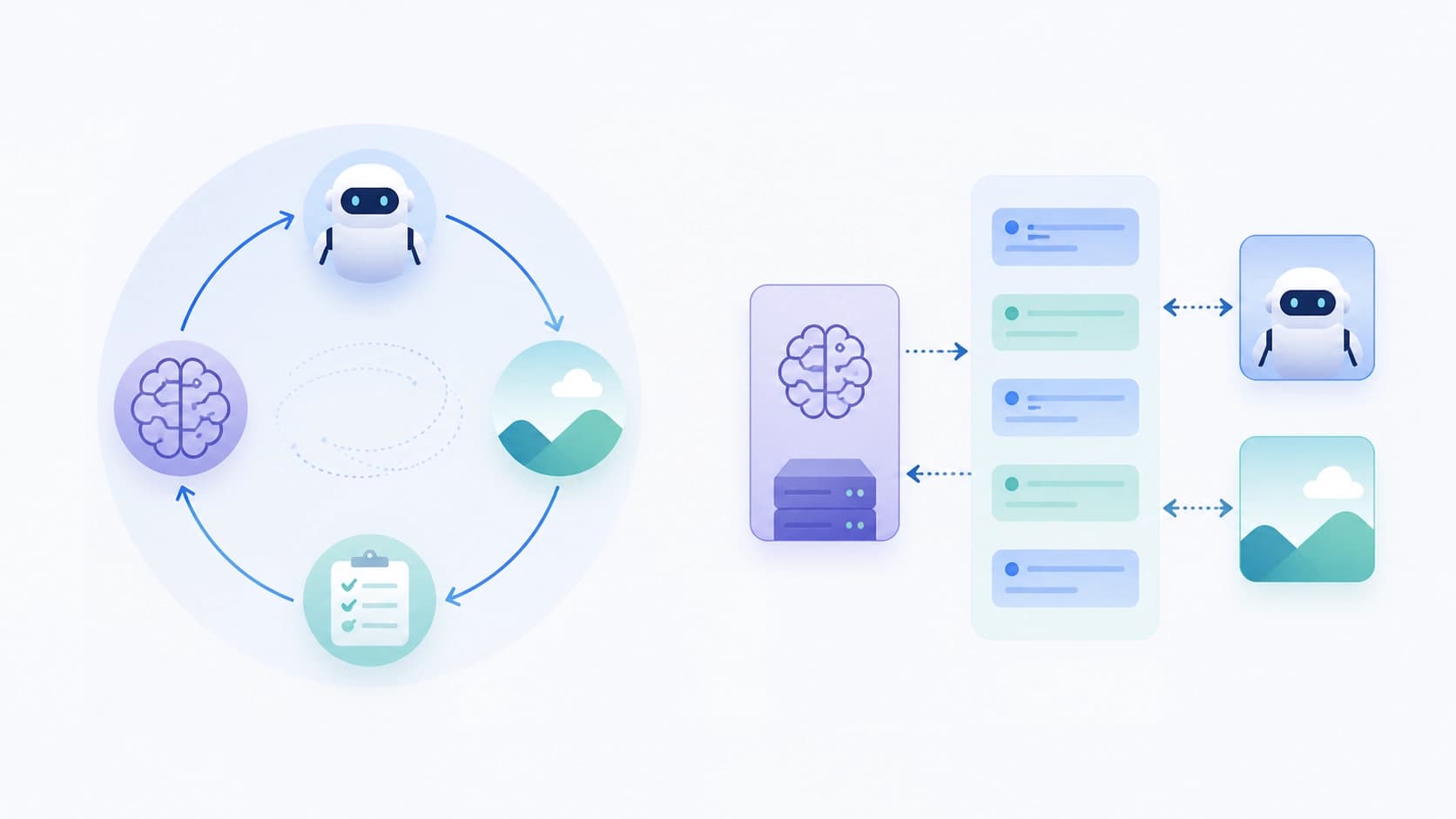
The Agent Lightning v1.0 project offers a different approach — harnessed agentic RL. The idea is to have the harness used at deployment time directly participate in the model's post-training. This allows the agent to be fine-tuned under the same conditions it will operate in production, and makes it much easier to connect arbitrary agents to an RL pipeline.
How harnessed agentic RL works
In traditional agentic RL, the "model → action → observation → new action" loop belongs to the training engine. In the harnessed variant, the harness takes over this entire loop, and the trainer only observes a sequence of LLM request-response pairs. This separation provides flexibility: you can use any agent framework by simply connecting it through an endpoint proxy.
This architecture is not new: the first version of Agent Lightning introduced a disaggregated scheme that other frameworks later adopted as well — verl Uni-Agent, AReaL 2.0, slime, and Polar. However, this approach has its own pitfalls.
Key challenges
The authors highlight several difficulties that arise in practical implementation:
- Retokenization — re-tokenizing sequences can distort training data.
- Sample merging — combining samples from different sources requires careful handling.
- Advantage calculation — computing advantage becomes more complex with non-standard data organization.
- Loss normalization — loss normalization must account for harness specifics.
- Backend scheduling — compute scheduling on the backend affects training stability.
These seemingly technical details can seriously impact the final result. To explore them, Agent Lightning v1.0 was created — a lightweight framework of roughly 3,500 lines of code.

Results: +14.6 points on SWE-bench Verified
The developers tested the approach on three classes of agents: instruction-following, search, and code-writing. For coding agents, a fully reproducible pipeline has been published.
The experiment looks like this: just 6,000 training examples and moderate compute resources. The Qwen3.5-9B model after RL fine-tuning scored 56.4% on SWE-bench Verified, compared to 41.8% before training. That's an absolute gain of 14.6 percentage points. This is a strong result for such a small amount of data and a lightweight framework.
Moreover, the authors openly publish the full workflow and training scripts, so anyone can reproduce the experiment or use Agent Lightning v1.0 as a testbed for their own research.
What this means for the industry
The emergence of harnessed agentic RL shifts the focus from "pumping" the model with data to the coordinated work of the model and its environment. If the harness was previously considered a supporting detail, it now becomes part of the trainable loop. For practitioners, this means more predictable agent behavior in real-world scenarios, and for researchers — a new set of open problems: from tokenization optimization to compute scheduling.
Agent Lightning v1.0 is not the only project in this niche, but its openness and simplicity make it a convenient starting point for experiments. It's quite likely that in the near future we'll see new frameworks that take these ideas to industrial adoption.