

Cala
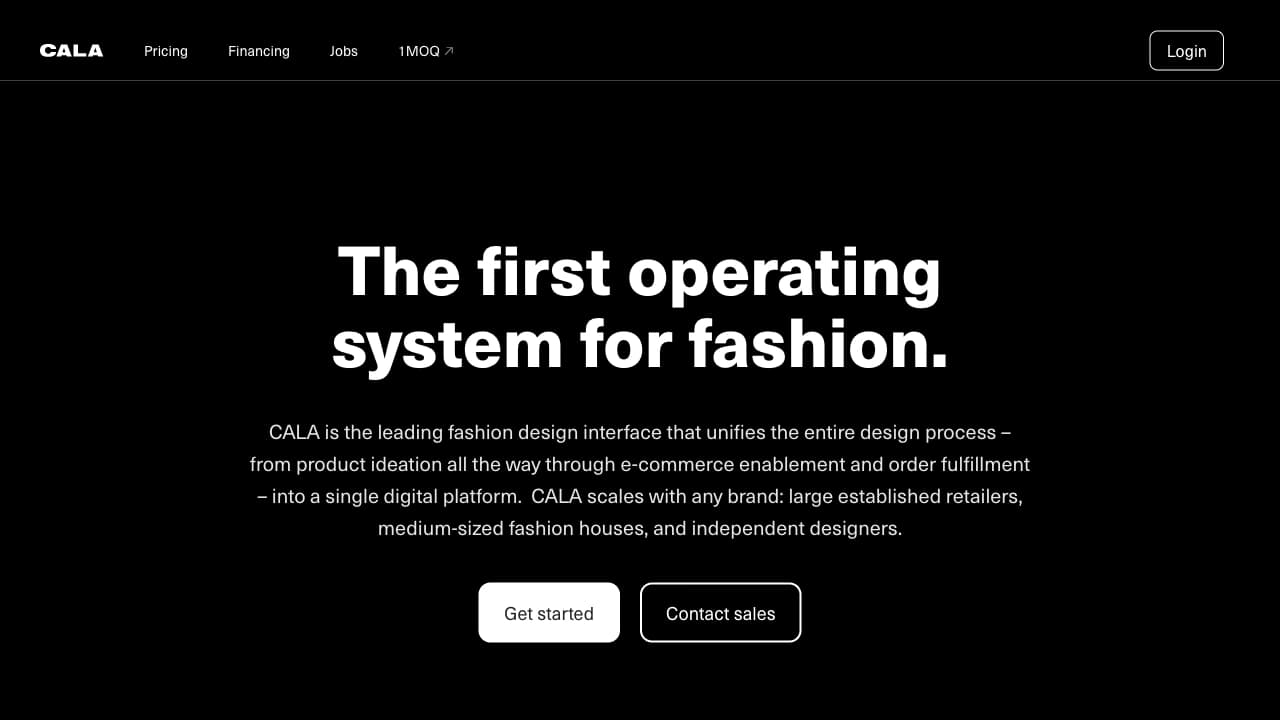
Cala is a platform for managing a fashion brand, combining design, production, and logistics processes.
Overview
Cala AI Description
Cala is positioned as an operating system for the fashion industry that connects the key stages of a product's lifecycle — from the initial idea to delivery of the finished item to the end customer. Instead of using disparate services for design, manufacturing, logistics, and sales, this platform offers a unified space for managing all workflows.
Cala's main goal is to simplify operational activities for brands by combining tools for concept generation, website development, order management, finance, and team communication. The platform also includes Shopify integration and a built-in materials library, helping to reduce time-to-market for new collections and minimize errors at each stage of production.
Cala Features
| Feature | Value |
|---|---|
| Type | All-in-one platform and app for fashion brands |
| Categories | E-commerce, Fashion, All-in-one |
| Platforms | Web |
| Editorial rating (NeuroFolder) | 8.3 out of 10 |
| User rating | 4.5 |
| Availability | International |
| Key features | Idea generation, order fulfillment, web development, e-commerce management, financing, Shopify integration, materials library |
| Use cases | E-commerce, Fashion |
| Alternatives | Pic Copilot, Vmake Fashion Model Studio, RetailRocket, 24AI |
Who is Cala AI for?
Sellers and fashion brand owners
The platform is primarily aimed at sellers and entrepreneurs who manage fashion brands. Cala allows them to control the entire product creation process — from idea to delivery — without the need to coordinate the work of multiple third-party contractors.
Teams of different sizes
Cala suits all types of activities within a fashion business: whether a small studio or a large company, the platform provides tools for collaboration, communication, and order tracking in a single interface.
How to use Cala AI?
General workflow
Working with the platform starts with using built-in tools for product idea generation. Once a concept is approved, the brand can move to the production and logistics stage, using Cala as a link between all process participants.
Integration with external services
To sell finished products, the platform offers Shopify integration. This allows syncing data on orders, inventory, and delivery between Cala and the brand's online store, simplifying e-commerce management.
Materials and web development
The platform includes a materials library that can be used when creating products. There are also tools for website development, allowing brands to launch their storefronts faster without involving external developers.
Key Cala Features
Product idea generation
The platform provides tools for generating concepts for future items. This helps teams move faster from idea to working prototype.
Order and fulfillment management
Cala automates order processing — from creation to fulfillment. This includes coordinating production and monitoring deadlines.
Web development and e-commerce
The service includes tools for creating and managing a brand's website, as well as managing sales through Shopify integration.
Finance and collaboration
The platform offers financial management features, as well as tools for communication and collaboration within the team, keeping all processes under control.
Cala Advantages
Unified space for all processes
Cala's main advantage is concentrating all key operations in one system. Brands don't need to switch between different tools to manage design, production, and sales — everything is available in a single interface.
Reduced time-to-market
Through automation and streamlined workflows, Cala helps brands bring new collections to market faster. This is achieved by reducing manual operations and accelerating communication between participants.
Minimized errors
Centralized process management reduces the likelihood of errors related to data loss or inconsistency between departments. The built-in materials library and order system help maintain order at all stages.
Cala Disadvantages
Limited availability in some regions
The service may have limited availability in certain regions, which can create additional barriers for local brands and potentially slow down work depending on connection stability.
Lack of detailed pricing information
Based on available data, specific prices and terms of paid plans cannot be confirmed without visiting the service's official website. This may complicate initial budget assessment for potential customers.
What problems does Cala solve?
Supply chain management
The platform addresses the challenge of automating and connecting all stages of the supply chain: from design and development to production and logistics. This simplifies control over each stage of a product's journey.
E-commerce
Cala helps brands set up online sales by providing tools for order management and Shopify integration. This makes e-commerce processes more structured.
Brand operations management
The platform combines financial management, communication, and team collaboration, solving the challenge of operational control over all aspects of a fashion brand's activities in one place.
Cala Pricing
Based on available data, Cala's distribution model is listed as paid. Exact pricing, available feature packages, and subscription terms are not disclosed on the official website in the source materials. It is recommended to visit the service's website for up-to-date cost information.
Cala Terms of Use
General provisions
The platform operates on a paid model, which implies subscribing or purchasing access to use the service. Detailed terms of use, including user requirements and platform rules, should be specified on Cala's official website.
Restrictions
It is important to note that detailed usage restrictions may apply depending on the user's region. These technical limitations can affect the terms of use, including connection speed and access to customer support.
Cala Availability
Platforms
Cala is available via web browser (Web), meaning no separate application installation is required on a computer or mobile device to use the service.
Geographic availability
The service operates internationally, though availability may vary by region due to potential infrastructure or company policy constraints.
How Cala differs from alternatives
Unlike specialized services such as Pic Copilot, Vmake Fashion Model Studio, RetailRocket, or 24AI, Cala is positioned as a comprehensive operating system. Alternatives typically solve one specific task — for example, generating model images, analyzing user behavior, or developing websites. Cala, on the other hand, combines all these functions along with production, logistics, and financial management.
This comprehensive offering allows brands to avoid integrating five different services and syncing data between them. Cala enables working within a single ecosystem, which is especially relevant for small teams and sellers looking to reduce organizational overhead. Competitors generally do not cover production processes, whereas Cala includes them within its platform's scope.
Conclusion
Cala is a niche solution for fashion brands that addresses the need for unified management of all business stages: from product idea creation to customer delivery. The platform offers a set of tools for design, web development, e-commerce, and finance, which can be particularly useful for sellers and small teams looking to reduce time-to-market. The main limitations are the paid distribution model and potential regional availability restrictions. For a final decision on purchasing a subscription, it is recommended to review the service's official website and check current pricing.
Frequently asked questions
See also


AI tool for creating presentations, documents, and web pages from a text description.

AI-powered platform for automatically generating ad banners, texts, and videos optimized for conversion.

Platform for automated geospatial analysis of satellite imagery and geographic data.


Neural network for generating images and short videos from text descriptions.
Automatically extract financial data from PDF documents and convert it to Excel or CSV.
AI business name generator with domain availability checking.

AI tool for automating social media marketing, including content generation, post scheduling, and analytics.
A platform for accountants that combines task management, file sharing, and client communication in a single interface.