
API.box: Suno API for AI Music Generation (Unofficial)
Unofficial API access to Suno AI for music generation and integration into applications.
Overview
API.box: Suno API for AI Music Generation (Unofficial)
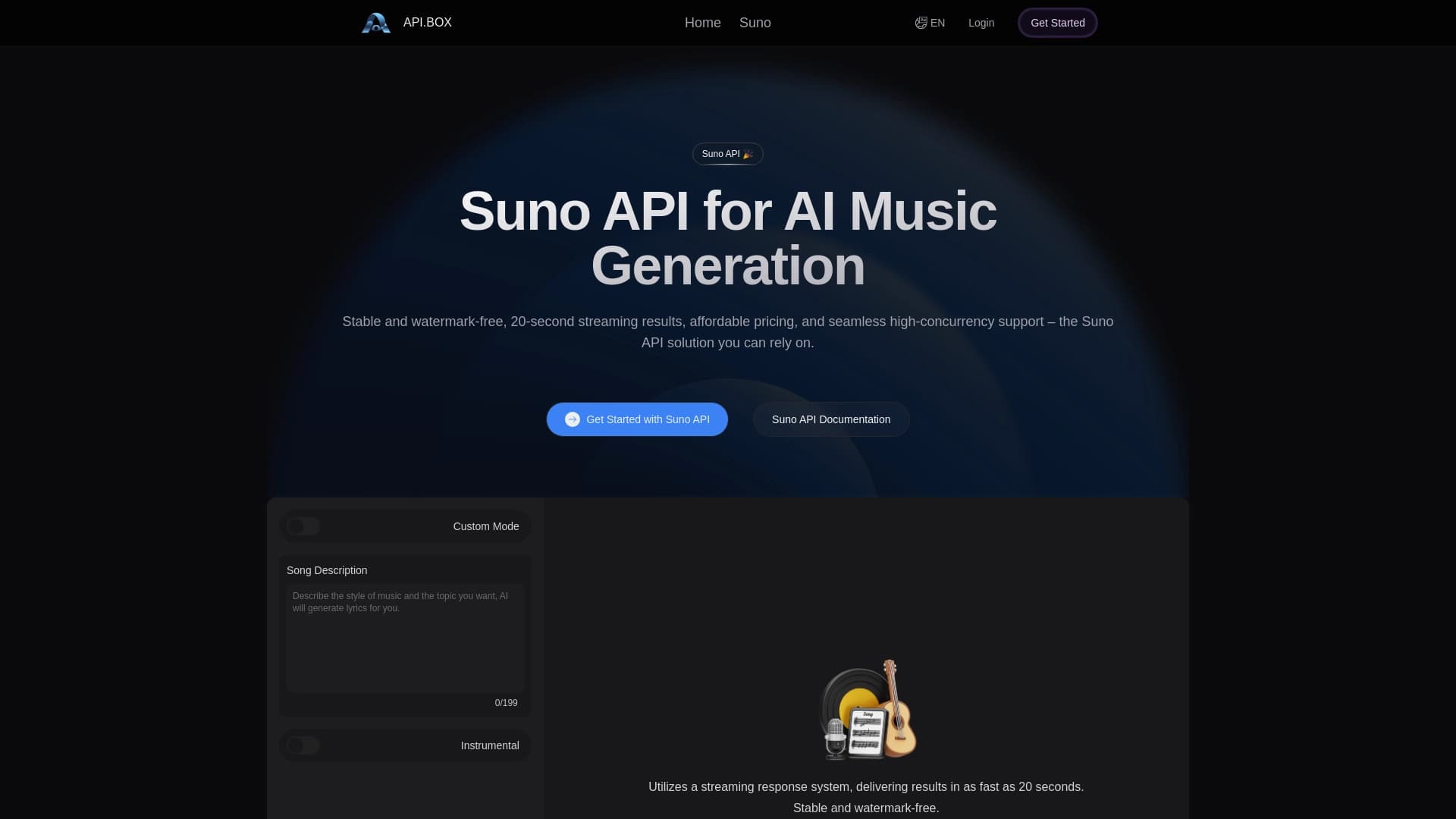
API.box is an unofficial application programming interface (API) for the Suno AI service, which specializes in music generation. The main purpose of this tool is to give developers the ability to integrate track creation features directly into their applications, web services, or scripts, bypassing manual query entry in the Suno interface.
Instead of manually opening the Suno AI website and entering a text description for each new track, a developer can write code that automatically sends generation requests through API.box. The service acts as an intermediary between the user and Suno's algorithms, accepting text descriptions and returning ready-made audio files.
It's important to understand that this service is not an official product of Suno and was created by third-party developers. Nevertheless, it solves the important task of automating creative processes, allowing music production to be scaled and integrated into any digital product.
Purpose of the Service
In simple terms, API.box turns a powerful music generation tool into a convenient builder for developers. This means you can now automate the creation of music soundtracks for videos, games, podcasts, or advertisements without requiring manual intervention for routine operations.
API.box: Suno API for AI Music Generation (Unofficial) — Characteristics
| Characteristic | Value |
|---|---|
| Access Type | Application Programming Interface (API) |
| Official Status | Unofficial (third-party) |
| Core Functionality | Music generation based on text description |
| Integration | Into applications, services, and automated systems |
| Workflow | Send request — receive finished track |
| Distribution Model | Not specified (data unavailable) |
Who is API.box: Suno API for AI Music Generation (Unofficial) for?
This tool will primarily be useful for developers and technical specialists who need to integrate music generation into their projects. However, the range of applications is much broader, and the service may be of interest to various categories of users.
Software Developers and Integrators
This is the primary target audience. Programmers can use the API to create applications that generate music on user request. These could be mobile apps for content creation, web services for video editing, game engines, or bots.
Content Creators and Media Producers
Video creators for YouTube, TikTok, or advertising campaigns can automate the process of selecting background music. Instead of searching for tracks in stock libraries or commissioning composers, they can set up automatic generation of music that matches a specific scenario.
Entrepreneurs and Business Owners
Those launching creative services (e.g., recording studios or content creation platforms) can use API.box to expand the functionality of their products. This allows offering clients unique capabilities without needing to develop their own AI model.
How to use API.box: Suno API for AI Music Generation (Unofficial)?
Since this is an API, its use requires technical skills. The entire process comes down to programmatic interaction with the service, but it can be broken down into several logical stages.
Connecting to the Service
The developer needs to gain access to the API. This typically involves registering on the platform and obtaining access keys (API keys) that allow authenticating requests on behalf of the user.
Configuring and Sending Requests
The user forms a request that includes a text description of the desired track. This can include genre, mood, instruments, or specific sound parameters. This request is then sent to the API.box server using standard HTTP requests.
Receiving and Using the Result
After processing the request, the service returns a link to the finished audio file in the response. This file can be listened to, downloaded, or immediately used in your application. This completes the music creation cycle, which can be repeated as many times as needed by varying the request parameters.
Key Features of API.box: Suno API for AI Music Generation (Unofficial)
The main task of the service is to provide access to Suno's music generation. Based on available data, the following key features can be highlighted.
Generation from Text Description
The service accepts text prompts (descriptions) and converts them into full-fledged musical compositions. The quality and character of the track directly depend on how accurately and detailed the request is formulated.
Programmatic Integration
API.box's functionality lies in its ability to connect to any software. This allows embedding music generation into existing workflows, making them automated.
Automation of the Creative Process
The API allows creating entire pipelines for music production. This means you can set up a system that independently generates the required number of tracks in a specified style, without manual human involvement.
Advantages of API.box: Suno API for AI Music Generation (Unofficial)
Using this API provides users with several significant advantages, especially in the context of development and automation.
- Automation Capability: The main plus is full automation of the music creation process. The system can operate continuously and does not require manual intervention.
- Versatility and Flexibility: The API can be used in a wide range of scenarios — from creating simple utilities to complex services with mass content generation.
- Integration Speed: Developers don't need to build their own neural networks or spend resources on training them. Simply connecting to a ready-made API simplifies and accelerates the implementation of music generation in projects.
- Expanding Existing Products: With the API, innovative features can be added to existing applications, increasing their value and appeal to end users.
Disadvantages of API.box: Suno API for AI Music Generation (Unofficial)
Like any unofficial tool, API.box has certain limitations and risks that should be considered when choosing it.
Unofficial Status
The service is not a product of Suno. This means it may be unstable, lack official support, and could be shut down or restricted by Suno's owners at any time regarding access to the underlying algorithms.
Lack of Stability Guarantees
Unlike official solutions, unofficial APIs provide no guarantees of uninterrupted operation. Outages, technical maintenance, changes in request structure, and other issues may occur that could disrupt applications relying on this service.
Unclear Distribution Model
Since the source data contains no information about the distribution model (paid/free), this adds uncertainty to long-term plans. Terms of use may change at any time, which could affect developers' budgets and plans.
What Problems Does API.box: Suno API for AI Music Generation (Unofficial) Solve?
API.box helps solve several practical problems related to the production and use of music in digital products.
Rapid Prototyping and Content
It enables quick creation of demo recordings or draft versions of tracks for presentations, pitches, or internal use. This saves time and money in the early stages of a project.
Scaling Music Production
It makes it possible to generate large volumes of music for catalogs, libraries, or background content, which cannot be done manually at the same speed. This solves the problem of a shortage of unique audio material.
Creating New User Scenarios
Developers can create applications where users control music generation themselves by entering their own descriptions. This adds interactivity and novelty to existing products, attracting audiences with the ability to influence the creative outcome.
API.box: Suno API for AI Music Generation (Unofficial) — Pricing
There is no reliable data on service costs or payment terms in open sources. The source texts contain no information about pricing plans, subscriptions, or payment methods. Potential users need to contact service providers or check official channels for up-to-date pricing information.
Most likely, the cost depends on factors such as the number of generated tracks, request processing speed, and the required level of support, but this is only a guess, not confirmed by facts. It is recommended to clarify financial terms directly when entering into a usage agreement.
API.box: Suno API for AI Music Generation (Unofficial) — Terms of Use
Detailed terms of service are not disclosed in the provided data. There is no full text of the user agreement or documentation with restrictions.
It is indirectly clear that the service is positioned as a tool for automating and expanding creative processes. Users should independently review the terms on the service's website before starting commercial use. Attention should be paid to issues regarding copyright on generated music, permissible generation volumes, and the service's liability for potential legal consequences.
API.box: Suno API for AI Music Generation (Unofficial) — Availability
The service provides access to its functions through a programmatic interface, which implies its availability to developers with technical skills. Work with the service is carried out remotely via network interaction, ensuring global availability with an internet connection.
Data on specific restrictions by country, region, or pricing plan is absent. The service is likely available to anyone who registers and obtains keys, but accurate information about geographic availability and the necessary conditions for connection cannot be confirmed based on available data.
How API.box: Suno API for AI Music Generation (Unofficial) Differs from Alternatives
The main difference of API.box lies in its focus on programmatic automation. While many other music generation services and neural networks offer only a web interface or an application for manual query entry, this tool is specifically designed for machine interaction.
The competitive advantage is that for the target audience (developers), this is not just a toy or creative tool, but a working module that can be embedded into their code. Thanks to this approach, API.box solves a different problem: it doesn't help a musician compose a melody, but allows a programmer to create a product that does this automatically.
If compared to Suno's official capabilities, which are aimed at regular users, API.box is oriented toward B2B scenarios and business process automation. It bridges the gap between a powerful generation algorithm and the need to use it on an industrial scale within third-party software products.
Conclusion
API.box is a specialized and narrowly focused technological tool that makes Suno AI's in-demand music generation function available for programmatic integration. The main value of the service lies in its ability to automate track creation, opening up broad prospects for application developers and digital content creators. At the same time, its unofficial status and the lack of transparent information about pricing and terms impose certain risks and require a cautious approach when used in critical projects. It is a reliable assistant for those who value automated workflow scenarios and are ready to build their services on top of third-party APIs.
Frequently asked questions
See also
A service for creating applications, neural networks, and AI clones, as well as a neural network for text generation and processing.

A codeless platform for tagging and tracking data simplifying kitting for computer vision.
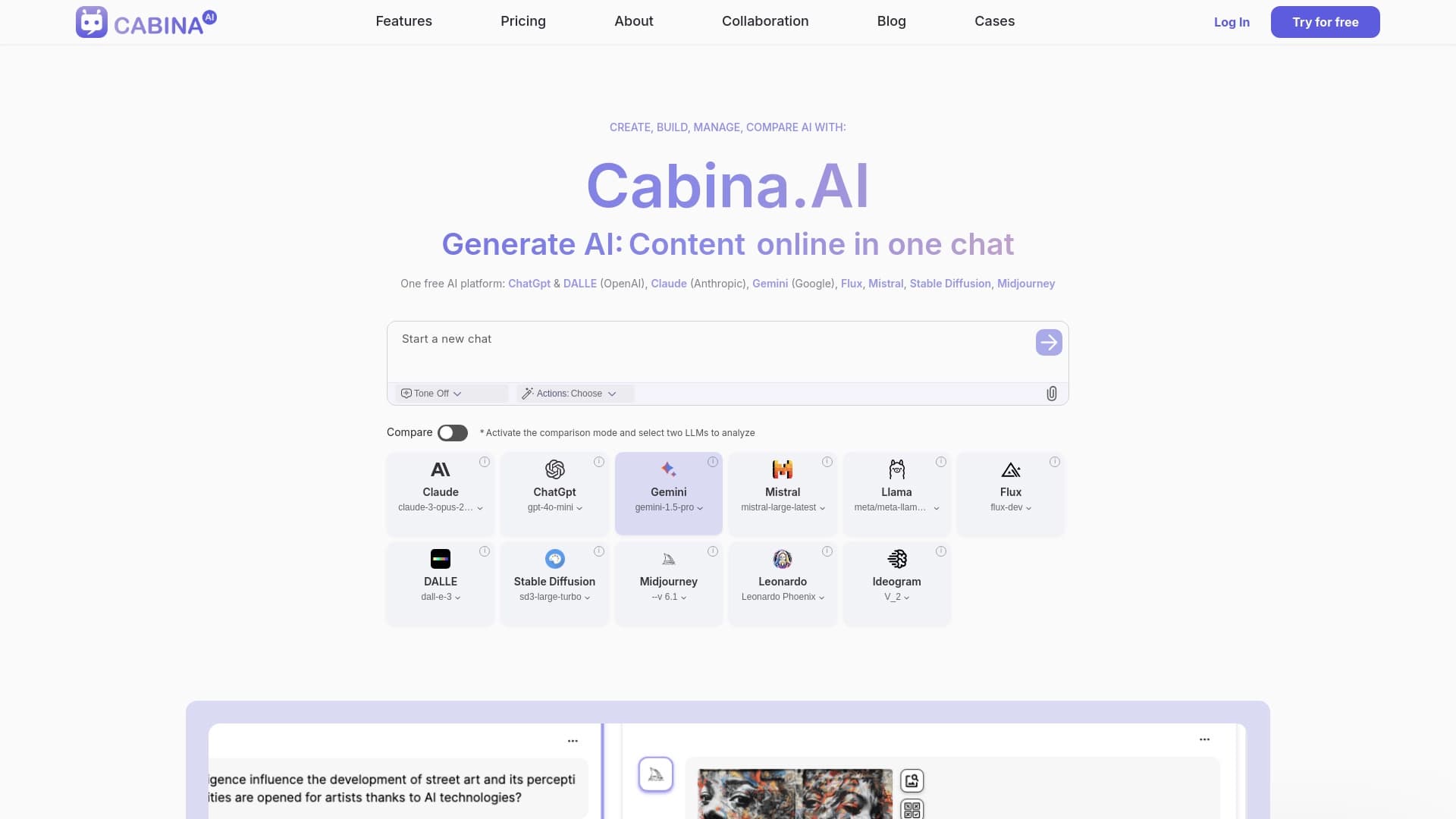
Cabina AI is a unified platform for working with various generative neural networks, enabling you to create texts, images, and videos.


Platform for creating multi-agent AI systems and chatbots to automate customer support and lead generation.


Online Image Editor AI-based preservation of character style and processing Text commands.

TypeScript library that lets you use GPT-4 as a runtime for functions described by comments.
A multilingual chatbot powered by GPT-4 and Gemini for writing texts, analyzing data, and solving tasks.

Platform aggregate grantor access to popular AI models and a variety of specialized AI-agents subscription.