Choosing between ChatGPT and DeepSeek today is like having two excellent tools designed for similar tasks but built on completely different philosophies. Both services position themselves as powerful language models capable of holding conversations, generating texts, writing code, and analyzing data. However, beneath this superficial similarity lie fundamental differences in development approaches, pricing, and market positioning. Let's take a closer look at what each platform offers, which one suits whom, and what to consider when making your choice.
Origin and Development Philosophy
ChatGPT is a product of OpenAI, an American research giant that set the modern trend toward the mass adoption of generative neural networks. The model was trained on enormous datasets and went through several iterations of improvement, backed by major investors. This shapes its security policies, content filtering, and drive toward versatility.
DeepSeek, on the other hand, is developed by a Chinese company that entered the international market relatively recently but has already managed to attract users' attention. The product's key feature is its emphasis on openness (open model weights, the ability to deploy locally) and affordability. DeepSeek's positioning revolves around engineering efficiency: at lower computational costs, the model delivers results comparable to its Western counterparts.
Models and Use Cases
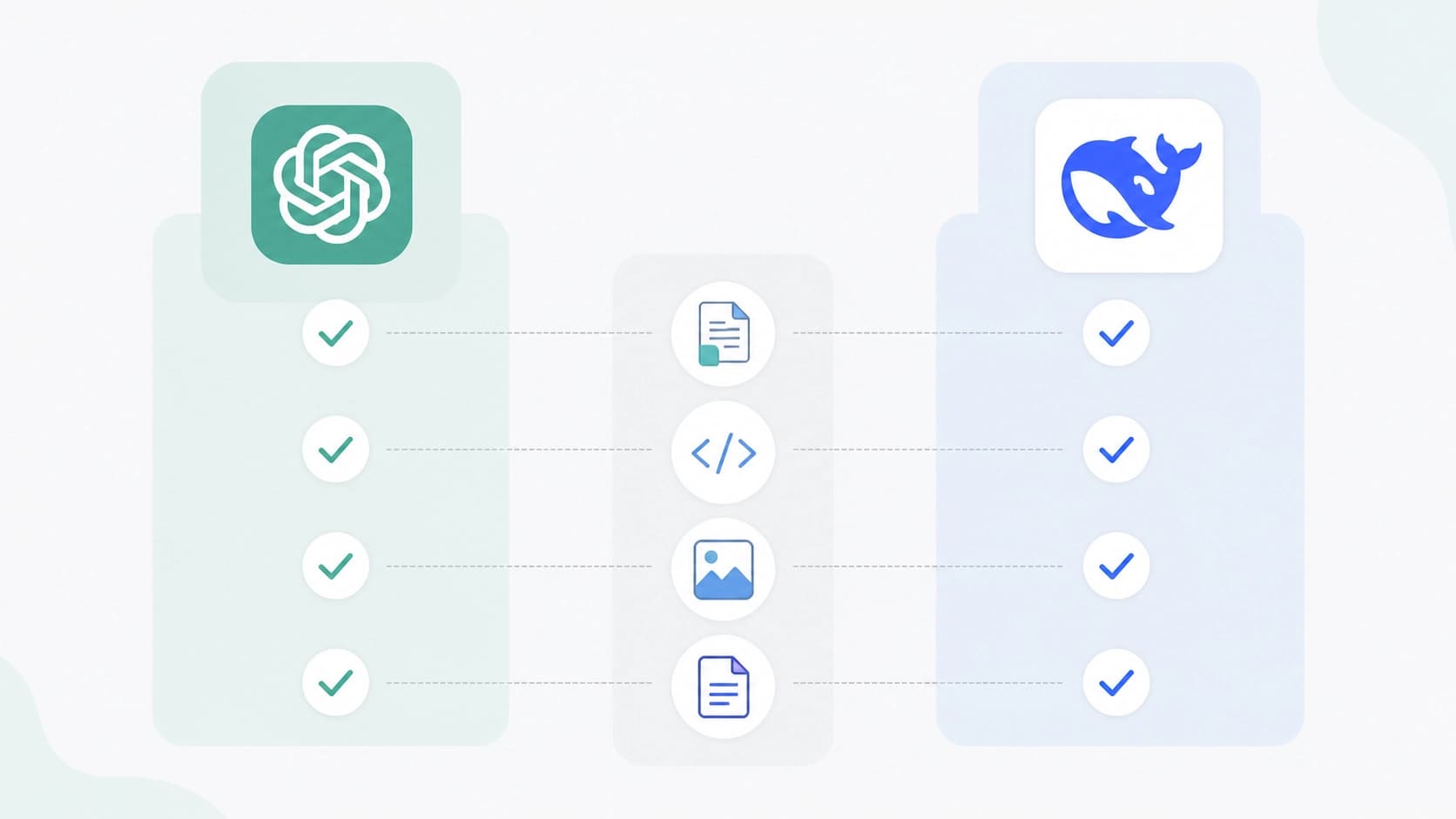
In terms of end-user functionality, both platforms offer the following capabilities:
- Generating and editing texts (articles, scripts, business correspondence).
- Writing code, finding bugs, refactoring.
- Answering questions across a wide range of knowledge domains.
- Translating texts, including technical documentation.
- Analyzing documents (uploading files via the interface or API).
However, there are also important differences.
Multimodality and Data Processing
In its current versions, ChatGPT offers multimodal input: the model can "see" images, analyze their content, and even work with certain file types. With DeepSeek, the situation is different: the model has no built-in "vision" capability, so working with images requires third-party tools or OCR systems. This is particularly important for marketers or designers who are used to uploading screenshots directly into the chat.
Working with Files
As for uploading documents (PDF, Word, Excel), both services at this early stage offer only extraction of textual information. Complex analysis of tables, charts, or graphs is, unfortunately, not a strong suit of either model in the standard web interface.
 Response Quality and Model "Personality"
In practice, users often note differences in response style. ChatGPT leans toward formal and, at times, overly "polite" wording. It strives to give detailed, structured answers, often with caveats and careful explanations. If you need text that won't raise questions from your boss or client, ChatGPT is a good choice.
DeepSeek, according to many users, responds more directly and concisely. In some scenarios (especially in math and logic benchmarks), the model achieves high results, making it appealing to programmers, data analysts, and researchers. However, for marketing copy or creative tasks, it may lack the kind of literary padding many have grown accustomed to.
An important nuance is the capacity for self-reflection. ChatGPT often reflects, warning about potential inaccuracies, while DeepSeek is more confident in its responses and doesn't waste time on extra disclaimers, which can sometimes lead to overly categorical—though not always accurate—statements.
Pricing and Availability
This is perhaps the most significant difference of all, one that can be decisive.
ChatGPT originally grew on a freemium model. The basic model versions are free but come with limits on the number of requests and response speed. Access to more powerful and up-to-date models, as well as priority processing speed during peak hours, requires a monthly fee. There are also separate plans for teams and enterprise clients, offering a broader set of security settings and management features.
 DeepSeek takes a far more democratic approach. The core functionality in the web chat and app is free, which is a powerful competitive advantage. Even API access, according to numerous reviews, is priced significantly lower than most Western competitors' offerings, with comparable quality in code and text generation. This makes DeepSeek a very attractive option for developers, startups, and students who need an affordable AI assistant without a monthly subscription.
Language Support and Localization
Despite the international nature of both services, it's worth considering the specifics of their language support. ChatGPT has historically been better adapted to English, though Russian is also supported at a decent level.
With DeepSeek, the situation is twofold: as a Chinese product, the model handles Chinese superbly, which is a clear advantage. For Russian-speaking users, this means the model translates from Russian to Chinese more accurately than ChatGPT. However, when working with highly specialized Russian terminology, errors can occur, whereas English technical documentation is handled almost flawlessly.
Use Cases: What to Choose
Understanding each model's strengths and weaknesses makes it possible to identify optimal use scenarios.
When to Choose ChatGPT
- For marketing and content: texts, social media posts, scripts—the model has a better feel for tone of voice and can create "lively" material.
- For business communications: emails, presentations, summaries—formal style and structure are a plus here.
- For image analysis: if you need an instant answer about an image without third-party services, this is a decisive argument.
- For corporate projects: a well-designed API, a track record in security, and the reputation of a reliable Western product are often deciding factors.
When to Choose DeepSeek
- For development and coding: many programmers note that DeepSeek excels at generating functions, finding bugs, and explaining complex algorithms, without wasting time on long preambles.
- For working with Chinese: translation, content localization, communication with Chinese partners.
- For a limited budget: if you need a full-fledged AI assistant without monthly payments, DeepSeek is the best option.
- For self-hosted deployment: the open architecture allows you to run the model locally, which is critical for those concerned about data privacy.
 Practical Steps: How to Choose the Right Tool
If you're just getting started with AI assistants, follow this simple algorithm.
- Identify your priority task. Ask yourself: what will you need an assistant for most often—writing texts or working with code and math problems? 80% of success depends on this.
- Try the free versions of both services for a couple of days. Compare their answers to the same questions. Pay attention not only to the content but also to the form: speed, verbosity, confidence.
- Run a real-work test. Take an actual document or piece of code from your job and ask the model to improve it. Compare the quality of the edits.
- Estimate the costs. If you need an API for integration into your own service, calculate the price per 1,000 tokens. If you work through the interface, consider how much time you're willing to spend waiting in the free version.
- Consider security concerns. For large corporations, data storage terms and the developer's jurisdiction may matter. For personal use, this point is less critical.
Final Conclusions
The choice between ChatGPT and DeepSeek isn't about picking the "best" or the "worst." It's about choosing the right tool for your specific task, budget, and security requirements.
ChatGPT remains a versatile and more "eco-friendly" solution for business and creative work. Its strengths are its ecosystem, reliability, and partnership terms that Western companies find familiar.
DeepSeek is a challenge to the trend and a benchmark of engineering ingenuity. It offers high-quality code and analytics for the price of a free hot dog. For enthusiasts, developers, and students, it's a great opportunity to access world-class intelligence without overpaying.
Ultimately, you can use both services in parallel without a twinge of guilt: deep analytics in DeepSeek, and polished presentations in ChatGPT. Flexibility in use is the main secret to working effectively with modern neural networks.