
Character AI: Should You Switch to the Paid c.ai+ Plan?
We break down how the free version of Character AI differs from the Premium subscription: speed, limits, additional settings, and for whom the $10 per month fee is justified.
Character AI has long become one of the most popular services for chatting with neural networks, but as the load grows, the free version increasingly makes you wait for responses and put up with limitations. The paid c.ai+ subscription promises to solve these problems, but is it worth the money? Let's look at the differences and try to understand who really needs premium.
What the free plan offers
Free access to Character AI is a full-fledged way to get to know the platform and chat with characters without spending a penny. True, there are a number of nuances that become noticeable with active use.
Key features of the free version:
- creating up to five new characters per day — for most casual scenarios this is usually enough;
- basic customization of appearance and personality traits, including background and description;
- unlimited time chatting with already created bots (though with some caveats);
- access to the shared character library, but without some exclusive and fresh options.
The main drawback of the free plan is the message limit. When you hit the cap, you have to wait. This is especially noticeable during peak hours: responses can be delayed, and dialogue quality sometimes "dips" because server resources are allocated in favor of paying users. In addition, new features and updates reach the free version with a delay — subscribers test them first.
For light, occasional chatting, this mode is quite acceptable. But if you visit the service every day and spend a long time talking to your favorite character, the irritation from constant waiting will start to build up.
Benefits of the c.ai+ subscription
The c.ai+ plan costs $9.99 per month — an amount comparable to streaming service subscriptions. What does the service offer for this money?
- Priority access to servers. Even when the entire platform is overloaded, subscribers continue to get responses without noticeable delays.
- Noticeably higher response generation speed — the conversation becomes almost lifelike, without "thinking" pauses.
- Early access to new features. While the free version waits for updates, premium users get to try new things first.
- Removal of the daily limit on character creation. If you need many different characters for stories or experiments, this is a big help.
- Expanded customization: more parameters for adjusting personality, background, and details than in the base version.
- More stable conversation quality — the neural network runs in an optimized mode for paying users, so dialogues less often "drift" or lose logic.
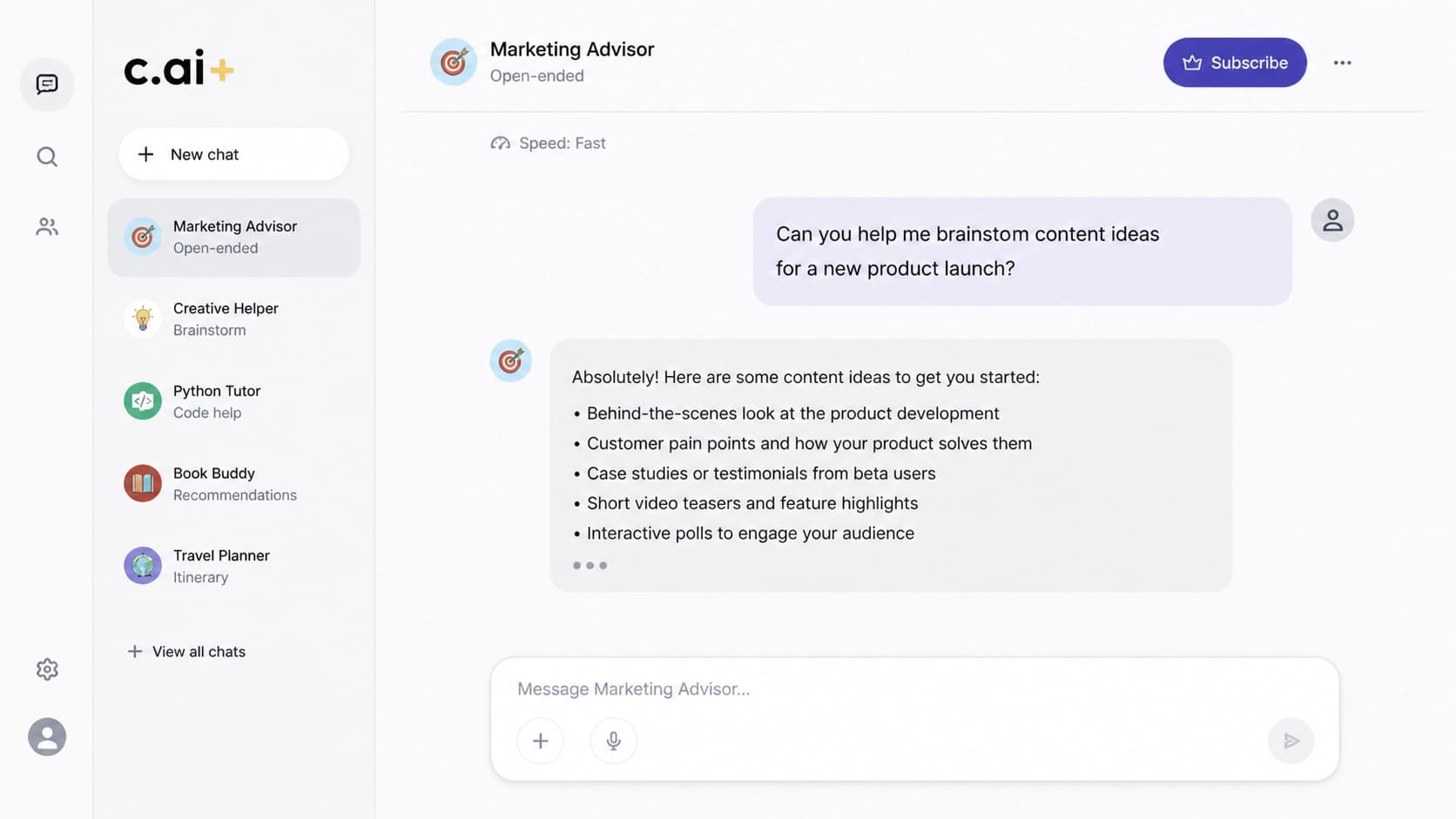
In essence, the subscription removes all the "rough edges" that get in the way of full immersion in conversation. A wider library of available characters and detailed settings let you get exactly the experience you want, not the one left over after the free version's restrictions.
Comparison and conclusions: who the paid plan suits
If we reduce the differences to a simple formula, it goes like this: the free plan is a chance to try the service and use it a little at a time, while the paid plan lets you get the most out of it without compromises.
| Criterion | Free | c.ai+ |
|---|---|---|
| Response speed | Slower, especially at peak | Fast and stable |
| Character creation | Up to 5 per day | No limit |
| New features | Delayed | Early access |
| Customization | Basic | Expanded |
| Queue under load | Limited | Priority access |
Who is premium for? First of all, those who use Character AI regularly — for example, for role-playing games, creative projects, or simply as an "interlocutor" every evening. If you find that a dialogue gets cut off due to the message limit or the response speed annoys you, $9.99 per month is quite justified.
On the other hand, overpaying doesn't make sense if you only log in occasionally once every week or two. The free version offers enough to keep your interest and let you enjoy chatting. It's also worth remembering that you can subscribe for a month and test it out — if it doesn't drastically change your experience, you can always go back to the free plan.
The bottom line is simple: c.ai+ is not a magic button that turns a weak neural network into a genius. It's a way to remove technical limitations and make interacting with an already good AI tool as comfortable as possible. Decide how much this comfort matters to you, and choose the option that fits.
Frequently asked questions
Related materials
All materials
Chern–Simons Reservoir Memory: Autonomous Connectivity Dynamics and Density Transport
The article explores how a reservoir preserves the history of input signals both in its density distribution and in its geometric degrees of freedom. A comparison of four mechanisms shows that current creates a separate connected component that alters the subsequent density response, while accounting for all measured features yields a small improvement in decoding pulse order.
10 November 2026
Diversity in the Input, Not in the Reasoning: Comparing Test-Time Augmentation Methods for LLMs
The study compares sources of variation in LLM inference—query paraphrasing, spelling changes, and image transformations—at an equal number of calls. Across six benchmarks, preserving meaning yielded the greatest improvement in accuracy, while character-level noise and simultaneous perturbations of two modalities were less useful.
8 November 2026
Neptuna: Comparing ML Architectures for Compressible Multiphase Flows with Discontinuities
Introducing Neptuna, a large-scale benchmark with 3 TB of computations for bubble collapse and droplet breakup under shock waves, evaluating convolutional, spectral, transformer, and pretrained PDE models. The takeaway: there’s no universal leader, while composite loss functions and SoftAdapt help better preserve interfacial boundaries and reproduce the spectrum more accurately.
6 November 2026