

Scenario
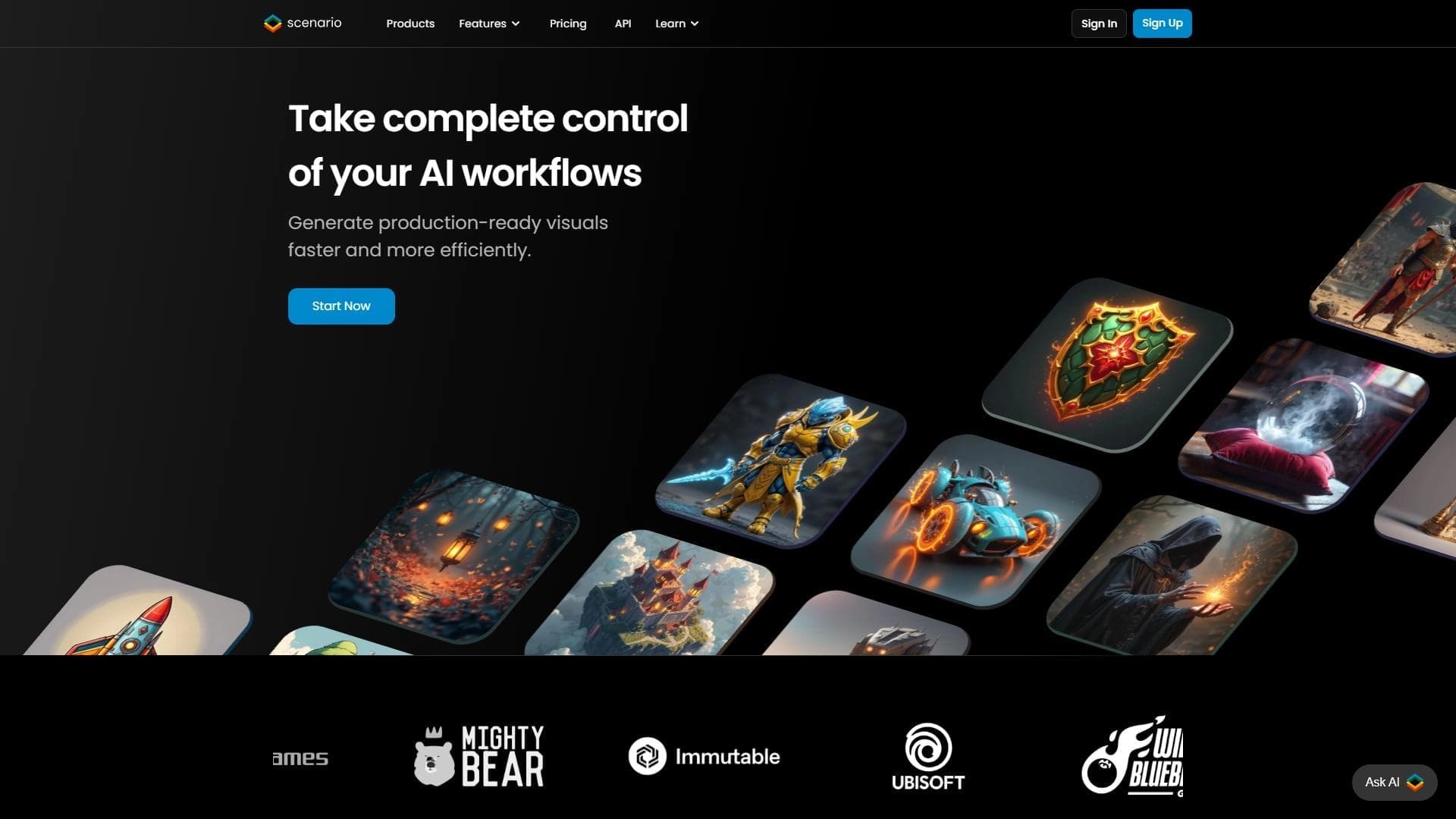
AI-based platform for generating game assets — characters, objects, and environments — in a unified style.
Overview
Scenario
Scenario AI Description
Scenario is an artificial intelligence-based platform designed for generating game assets: characters, objects, and environments. The service's key feature is the ability to train models on your own data to produce unique visuals consistent with a single artistic style.
The platform combines two areas of work. First, it generates 2D images for game projects. Second, it offers browser-based 3D modeling, where objects are assembled piece by piece, like building blocks: each element is created separately and then composed into the final scene. The service aims to integrate into existing game studio workflows and automate routine tasks, accelerating prototyping. At the same time, it's important to understand: high-quality results require good training data, and the tool itself does not replace the creative process—it only assists in it.
Scenario Characteristics
| Characteristic | Value |
|---|---|
| Categories | Game development, Image generation, 3D model generation, For developers |
| Type | AI-powered platform for generating game assets |
| Platform | Browser (online, web service) |
| Distribution model | Freemium |
| Website | www.scenario.com |
Who is Scenario AI suitable for?
Game developers
The tool is designed primarily for game developers who need to quickly produce visual content—characters, objects, and environments—without losing a consistent style. The platform helps speed up prototyping and reduce asset production time.
Artists and creative teams
Digital artists and creative teams use Scenario to experiment with artistic styles and achieve precise reproduction of a chosen direction. The ability to train models on your own data makes the service useful for teams that want to maintain control over their visuals.
How to use Scenario AI?
Working in the browser
Scenario works entirely through the browser—just open a tab and you can get started. No heavy software installation is required, and the service is accessible from any device with internet access.
The building-block principle
For 3D modeling, an intuitive approach is used: first, individual parts are created (for example, a head, body, or environment), and then they are assembled into the final scene by dragging and dropping elements. The interface is designed so that even a beginner can get the hang of it in about half an hour.
Customization and training
To obtain unique visuals, users can train models on their own data. They can also adjust the appearance and generation parameters, creating custom AI workflows tailored to a specific studio's needs.
Key features of Scenario
Generating assets in a consistent style
The platform allows users to create objects, characters, and environments all rendered in a single artistic style. This is a key feature that helps teams maintain the visual coherence of a project.
Training models on your own data
Users can train AI models on their own materials, making it possible to produce unique assets that differ from standard visuals.
Fragment-based 3D generation
3D objects are created from separate parts, which are then assembled into a whole. You can replace a single element (for example, a character's nose) without rebuilding the entire model, saving time. You can also experiment with styles for each fragment—for example, a cartoon head and a realistic body.
Integration and automation
The service supports custom AI workflows and integrates into game studio pipelines, automating routine content production tasks. Lighting and proportions between parts are automatically adjusted to avoid seams and mismatches, and previews are available in real time.
Benefits of Scenario
Time savings
The service significantly reduces asset development time. In 3D mode, you can fix only the unsuccessful element rather than regenerating the entire model, which accelerates iterations even in complex projects.
Precision and a consistent style
The platform ensures accurate reproduction of the chosen artistic style, which is important for teams that need control over visual quality and project coherence.
Accessibility and simplicity
No software installation is required—everything runs in the browser, keeping your computer uncluttered. The interface is intuitive and suitable for beginners. The system smoothly combines differently styled parts into a single object.
Drawbacks of Scenario
Data requirements
High-quality results require good training data. If the data is insufficient or low quality, the final visuals may not live up to expectations.
Learning curve
The service has a certain learning curve for new users—to achieve good results, you need to get comfortable with the platform and its settings.
Dependence on the neural network
With heavy usage, there is a risk of becoming dependent on the neural network in the workflow. In addition, the tool does not replace the creative process—it only automates routine tasks, so human creative input remains essential.
What problems does Scenario solve?
Fast creation of game assets
The platform speeds up the production of characters, objects, and environments, allowing teams to obtain ready-made visual content faster than with traditional approaches.
Maintaining a consistent style
Scenario helps maintain a consistent visual style across the entire project, which is critical for a cohesive game experience.
Automation and prototyping
The service automates routine content production tasks and accelerates prototyping and development. In 3D mode, you can quickly make changes to a single element of an object without full regeneration, and you can assemble complex compositions from parts created in different styles.
Scenario Pricing
Official pricing information varies depending on the source. The service follows a freemium model, meaning there is a free tier with the option of paid feature expansion. As for the 3D direction, the page does not mention a free tier or a specific price—for pricing details, it is recommended to contact the developers. Exact figures and pricing plan costs are not disclosed in the source data.
Scenario Terms of Use
The service works through the browser and requires a stable internet connection. To fully use the platform, including training models on your own data, users need to provide high-quality training materials. The tool is designed for integration into game studio workflows, so it is expected that users work on real projects and have sufficient skills to configure generation parameters.
Scenario Availability
Scenario is available online through the browser and works on any device with a browser and internet connection. The platform can be used across different devices without installing additional software. Interface languages and regional restrictions are not specified in the source data.
How Scenario differs from alternatives
The main difference of Scenario is its combination of 2D asset generation with browser-based 3D modeling based on a building-block principle. While many alternatives, such as Pixelicious, are narrow tools that convert images into pixel art in a single action, Scenario offers broader functionality: training models on your own data, creating custom workflows, and integrating into game development processes.
Another distinguishing feature is its approach to 3D modeling. The ability to generate and edit individual model fragments (down to replacing a character's nose) and automatically adjust lighting and proportions between parts sets Scenario apart from tools that require full regeneration on any change. This feature is comparable to solutions such as Pixal3D, MoRius-AI, Instaplay, Vibe Game Dev, GameNova, and Buildbox 4, but it is the combination of fragment-based assembly, consistent style, and training on custom data that makes the platform valuable to game developers.
Conclusion
Scenario is a practical AI-based platform for game developers and artists that accelerates the creation of game assets in a consistent style and simplifies browser-based 3D modeling using a building-block principle. The service saves time, automates routine tasks, and provides control over visuals, but it requires high-quality training data and does not replace the creative process. The tool suits teams looking to speed up production while preserving the integrity of their projects' artistic style.
Frequently asked questions
See also


A platform for creating interactive stories with virtual characters that have emotions, memory, and goals, without the need for programming.

Platform for creating conversational AI characters integrated into games and virtual worlds.

Platform for generating game textures using the Stable Diffusion algorithm.
No-code platform for creating AI-powered 3D character animations.

3D model generator combining AI with a parametric engine for creating and customizing objects right in the browser.

Generative model that creates interactive video in real time, where the user can influence what happens through text commands.

AI-based platform for creating intelligent NPCs and game worlds with speech synthesis support.

An online platform that turns text prompts into websites, games, and interactive applications right in the browser.