

OpenAI
A company developing advanced artificial intelligence models for generating text, images, and code, as well as for solving complex problems.
Overview
OpenAI
About OpenAI
OpenAI is a research company that develops advanced artificial intelligence models for a wide range of tasks: from text and image generation to programming and complex analytical computations. The company creates a family of multimodal models that includes both flagship solutions with a context of up to 1 million tokens (GPT-5, GPT-5.5, GPT-4.1) and compact cost-effective versions (GPT-4o mini, o4-mini).
OpenAI models support image generation and editing (GPT Image 1, GPT Image 1.5), programming (GPT-5 Codex, GPT-5.2 Codex), deep reasoning (o1, o3, o3-pro), and agentic tasks. Access to the technologies is provided via an API with support for function calling, code execution, web search, and fine-tuning. The company continues to release new versions, regularly updating its model lineup: from early models like GPT-3.5 Turbo and GPT-4 to the latest GPT-5.4 Pro and GPT-5.5.
Key Development Areas
OpenAI covers several key areas: general-purpose language models (GPT series), deep reasoning models (o series), specialized programming models (Codex), image generation models (GPT Image), as well as open models under the Apache-2.0 license, such as GPT OSS 20B High and GPT OSS 120B High. This makes the OpenAI ecosystem one of the most versatile on the AI tools market.
OpenAI Specifications
| Characteristic | Value |
|---|---|
| Type | AI Research Tool, Large Language Models (LLMs), Multimodal Models |
| Developer | OpenAI |
| Platforms | Web, Android, iOS, Linux, Mac, Windows |
| Monthly Traffic | 190.4M |
| Model Context | from 16.4K to 1.0M tokens |
| Supported Features | Function Calling, Structured Output, Code Execution, Web Search, Batch Inference, Fine-tuning |
| License | Proprietary (main models), Apache-2.0 (open models) |
| Date Added to Catalog | May 04 2024 |
Who Is OpenAI Suitable For?
Developers and Programmers
OpenAI gives developers access to powerful models via an API, allowing them to integrate AI features into their own applications. The Codex and GPT-5 Codex models are specifically optimized for programming tasks, agentic scenarios, and working with large volumes of code. Support for Function Calling and Code Execution makes it possible to automate complex development processes.
Businesses and Entrepreneurs
Companies can use OpenAI to automate customer support, generate content, build marketing strategies, and analyze data. The models provide the scalability and performance needed for commercial use — from affordable solutions based on GPT-4o mini to flagship models for complex business tasks.
Researchers and Educators
Academic researchers use OpenAI for scientific computations, data analysis, and deep reasoning. The o-series models (o1, o3, o3-pro) deliver strong results on mathematical benchmarks and logical tasks, making them useful for research work and educational purposes.
Content Creators
Generating text, images, and multimedia content is one of the key tasks suited to OpenAI models. GPT Image 1 and GPT Image 1.5 allow users to create, edit, and retouch images with high-quality instruction following and improved typography.
How to Use OpenAI?
Registration and Access
To get started, you need to register on the OpenAI website. After creating an account, the user receives an API key that is used to authenticate requests to the models. Access to the interface is available through the web platform as well as through official applications for Android and iOS.
API Integration
The OpenAI API allows you to integrate AI features into your own applications on any platform (Web, Linux, Mac, Windows). After obtaining an API key, developers can send requests to the models using the official documentation at platform.openai.com. All key features are supported: Function Calling, Structured Output, Code Execution, Web Search, Batch Inference, and Fine-tuning.
Monitoring and Management
API usage can be monitored and managed through the personal dashboard in your OpenAI account. The dashboard lets you control token consumption, set limits, and analyze usage statistics. Some models are also available through third-party integrations and platforms.
Key Features of OpenAI
Natural Language Processing
OpenAI models support natural language processing at a high level: from basic text generation to complex dialogues, instruction following, and adaptive reasoning. GPT-5.1 Instant, for example, delivers more conversational interaction, improved user understanding, and reduced jargon compared to its predecessors.
Image Generation and Editing
GPT Image 1 (released in December 2024) and GPT Image 1.5 (June 2025) are image generation models built on a transformer architecture. They support creating, editing, retouching, and outpainting images with a maximum resolution of up to 2048×2048 pixels. The models are distinguished by excellent instruction following, text rendering, and knowledge of the real world.
Code Creation and Execution
The Codex family models (GPT-5 Codex, GPT-5.2 Codex) and GPT-5.3 Codex are optimized for agentic programming tasks. They support a context of up to 400K tokens, enhanced reasoning capabilities, and are available through the Responses API. The models achieve record results on programming benchmarks; for example, GPT-5.2 scores 55.6% on SWE-Bench Pro.
Data Analysis and Reasoning
The o-series models (o1, o3, o3-pro, o4-mini) are focused on deep logical reasoning, mathematical computations, and scientific analysis. o1-pro, for example, achieves 86% on AIME 2024 and 79% on GPQA Diamond. o3 sets new standards in mathematics, science, and visual thinking. These models use step-by-step reasoning (chain-of-thought) to improve answer accuracy.
Customizable API
The OpenAI API supports function calling, structured output, code execution, web search, batch inference, and fine-tuning. This allows models to be adapted to specific business tasks and workflows.
OpenAI Advantages
Improved Performance and Innovative Solutions
OpenAI models significantly outperform previous generations in terms of performance. GPT-4.1 surpasses GPT-4 Turbo across all key benchmarks while delivering higher processing speeds. GPT-5.5 demonstrates state-of-the-art results on Terminal-Bench 2.0, OSWorld-Verified, GDP
Frequently asked questions
Similar AI tools





See also
AI editor for creating, editing, and publishing content with templates and prompts.

Financial platform with an AI assistant for managing accounting, taxes, and budgets.
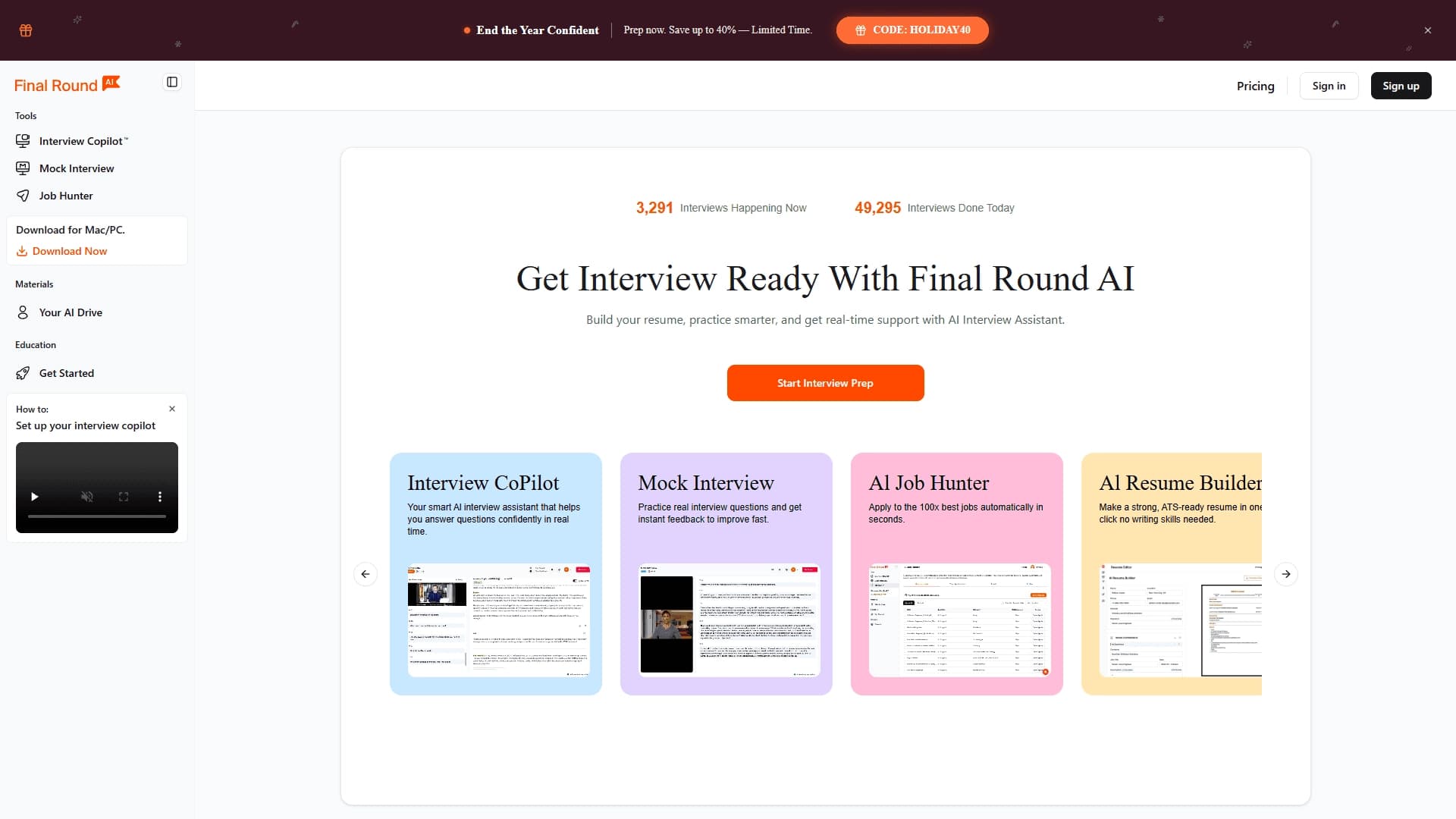
Platform for interview preparation with AI mock interviews and real-time support.
Enterprise language model platform focused on privacy and on-premise deployment.


AI assistant for creating short summaries of videos, PDF documents, and web pages.

AI email assistant that helps quickly draft messages, adapting to the user's style.
A platform for private and free communication with AI that generates text, images, and code through open neural network models.
A sales automation platform that combines customer prospecting, deal management, and AI-powered forecasting.