

Lutra AI
A platform for automating business processes and data processing with AI agents driven by natural language.
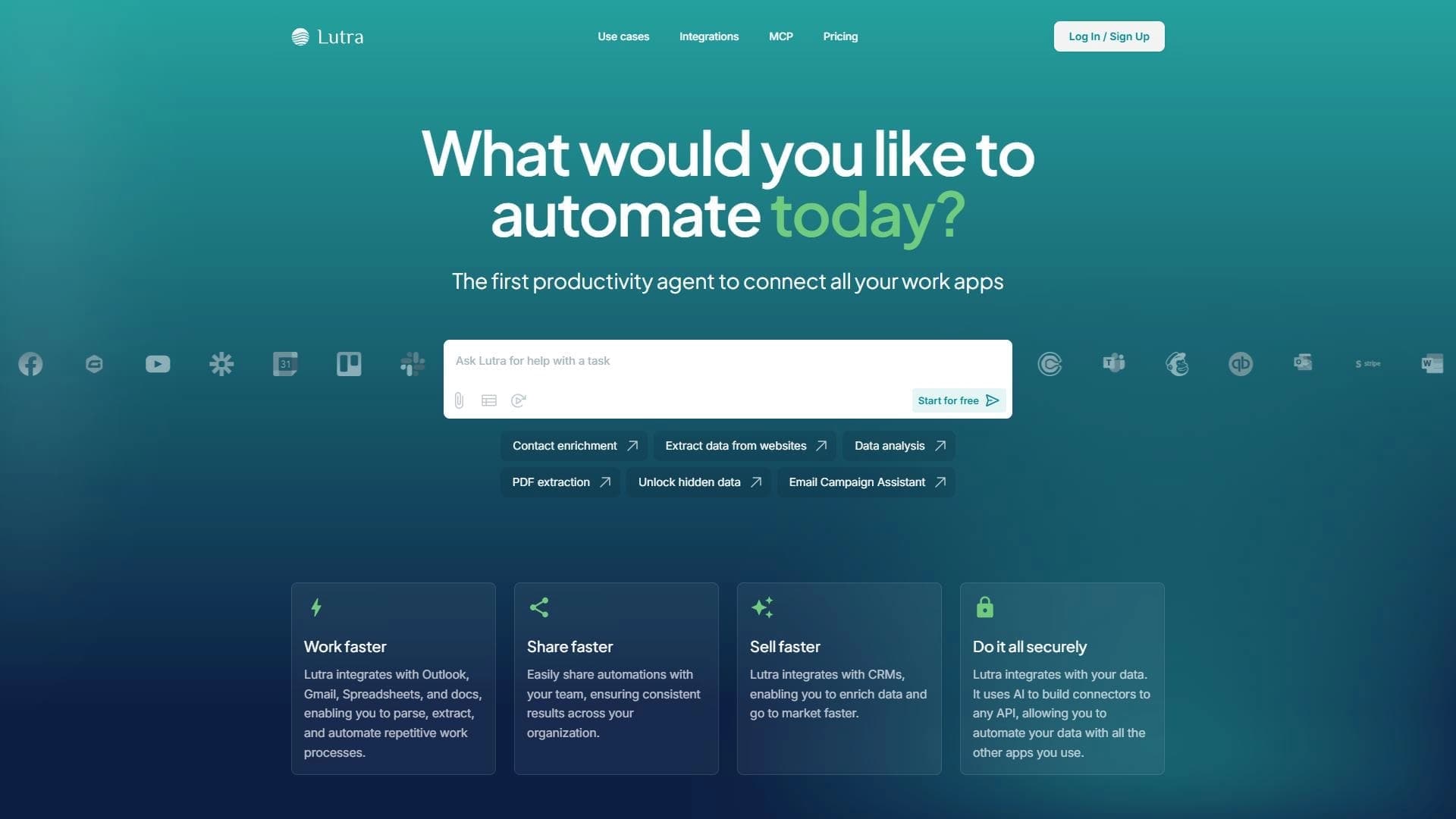
Overview
Lutra AI
Description of Lutra AI
Lutra AI is a platform that automates business processes and data processing with the help of AI agents. The key feature of the service is that the user does not need to understand programming: it is enough to describe the task in natural language, and the platform itself selects suitable templates and integrations to complete it.
The solution is positioned as an accessible tool for automation without writing code. The service takes over routine operations, speeds up information processing, and scales to different use cases — from individual specialists to entire teams. In essence, it is a bridge between the user and complex workflows that allows managing automation in simple words rather than technical settings.
Lutra AI characteristics
| Characteristic | Value |
|---|---|
| Type | Business process automation tool using AI agents |
| Category | No-code and low-code platforms, project management, APIs and integrations |
| Interface | Natural language |
| Programming required | No |
| Distribution model | Not specified |
Who is Lutra AI suitable for?
Professionals without a technical background
Lutra AI is primarily designed for specialists who need to quickly manage data and solve research tasks but do not have programming skills. The platform allows such users to automate processes without diving into the technical details of implementation.
Companies of different sizes
The tool suits organizations that want to set up automation of routine operations without involving developers. Thanks to its scalability, the service can be used both in small workgroups and in larger teams where coordinated work with data and processes is required.
Researchers and analysts
Since research tasks and data management are among the stated use cases, Lutra AI can be useful for those who regularly work with large volumes of information and need to speed up these processes.
How to use Lutra AI?
Formulating a task in natural language
Lutra AI's operating principle is based on simple interaction: the user describes the task in ordinary words, without special commands or syntax. It is the natural language interface that forms the basis of the entire platform and lowers the entry barrier for beginners.
Selection of templates and integrations
Once the task is formulated, the service independently analyzes it and offers suitable templates as well as integration options with external tools. The user just needs to choose the right option and launch the automation process.
Launching and configuring processes
Thanks to the lack of need for programming, launching and configuring workflows does not require technical skills. The entire automation management process is built around selecting solutions offered by the service rather than writing code.
Main functions of Lutra AI
Automation of complex tasks without code
The platform allows automating non-trivial processes without the user needing to write program code. AI agents take on task execution based on natural language descriptions.
Integration with popular services
Lutra AI can connect to common external tools and services. Integrations play a key role in ensuring that automated processes work in conjunction with solutions already used in the team.
Scalability for teams of different sizes
The service is designed for both individual users and entire teams. Scalability distinguishes it from simple standalone utilities and allows the platform to be used in collaborative workflows.
Lutra AI advantages
Low entry barrier
The main advantage of Lutra AI is that no technical skills are required. Any user without programming experience can start automating their processes by simply describing the task in words.
Ease of launch and configuration
Launching and configuring processes does not require deep technical knowledge. This makes the platform accessible to a wide range of specialists and companies that are not ready to invest in hiring developers.
Quick start for beginners
The natural language interface significantly simplifies the first encounter with the service. Instead of studying documentation and syntax, the user immediately moves on to formulating real tasks.
Lutra AI disadvantages
Limitations on custom integrations
The platform is not suitable for tasks requiring deep custom integrations. If a company needs fine-tuning for unique internal systems, additional development beyond the standard capabilities of the service will likely be required.
Difficult learning stage for new users
Despite the overall simplicity of the concept, the initial learning stage can be challenging for new users. Getting used to the platform's logic and understanding how to formulate tasks correctly can take some time.
What tasks does Lutra AI solve
Automation of business processes
The platform is designed to automate regular business processes, freeing employees from routine operations and allowing them to focus on more significant tasks.
Creating and configuring workflows
The service helps design and configure workflows without writing code. The user builds automation from the proposed templates and integrations for their specific goals.
Data management and research tasks
Lutra AI is suitable for working with data and performing research tasks. The platform speeds up information processing, which is especially relevant for specialists who regularly deal with large volumes of data.
Lutra AI pricing
At the moment, the available source data does not contain information about the cost of using Lutra AI. Exact rates, pricing structure, and payment terms are not disclosed, so when planning a budget, it is recommended to check current terms directly on the official website of the service.
Lutra AI terms of use
Detailed terms of use for the platform, including the distribution model and license agreements, are not provided in the source data. This information may be important for organizations planning to adopt the service, so it should be clarified with the official platform operator before starting work.
Lutra AI availability
Information about the geographic availability of the service, supported languages, and regional restrictions is absent from the source data. The possibility of using Lutra AI in a specific region and in a certain language should be checked on the official platform resource, as these parameters may vary depending on the operator's settings.
How Lutra AI differs from alternatives
The key difference between Lutra AI and competing solutions is its natural language interface. While many automation platforms require users to have a certain level of technical training, Lutra AI allows describing tasks in ordinary words. This is what significantly lowers the entry barrier for people without programming experience and makes automation accessible to a wider audience, from individual specialists to entire teams.
Conclusion
Lutra AI is a convenient solution for automating business processes and working with data, aimed primarily at users without programming skills. The main value of the service is its natural language interface, which lowers the entry barrier and allows quickly launching automation through templates and integrations. At the same time, the platform has limitations: it is not designed for deep custom integrations and may require time for initial learning, while information about prices, terms of use, and availability in certain regions remains open and requires clarification from the official operator. Overall, Lutra AI is a promising tool for those who want to automate routine tasks without involving developers.
Frequently asked questions

See also
A sales automation platform that combines customer prospecting, deal management, and AI-powered forecasting.
AI editor for creating, editing, and publishing content with templates and prompts.

Financial platform with an AI assistant for managing accounting, taxes, and budgets.
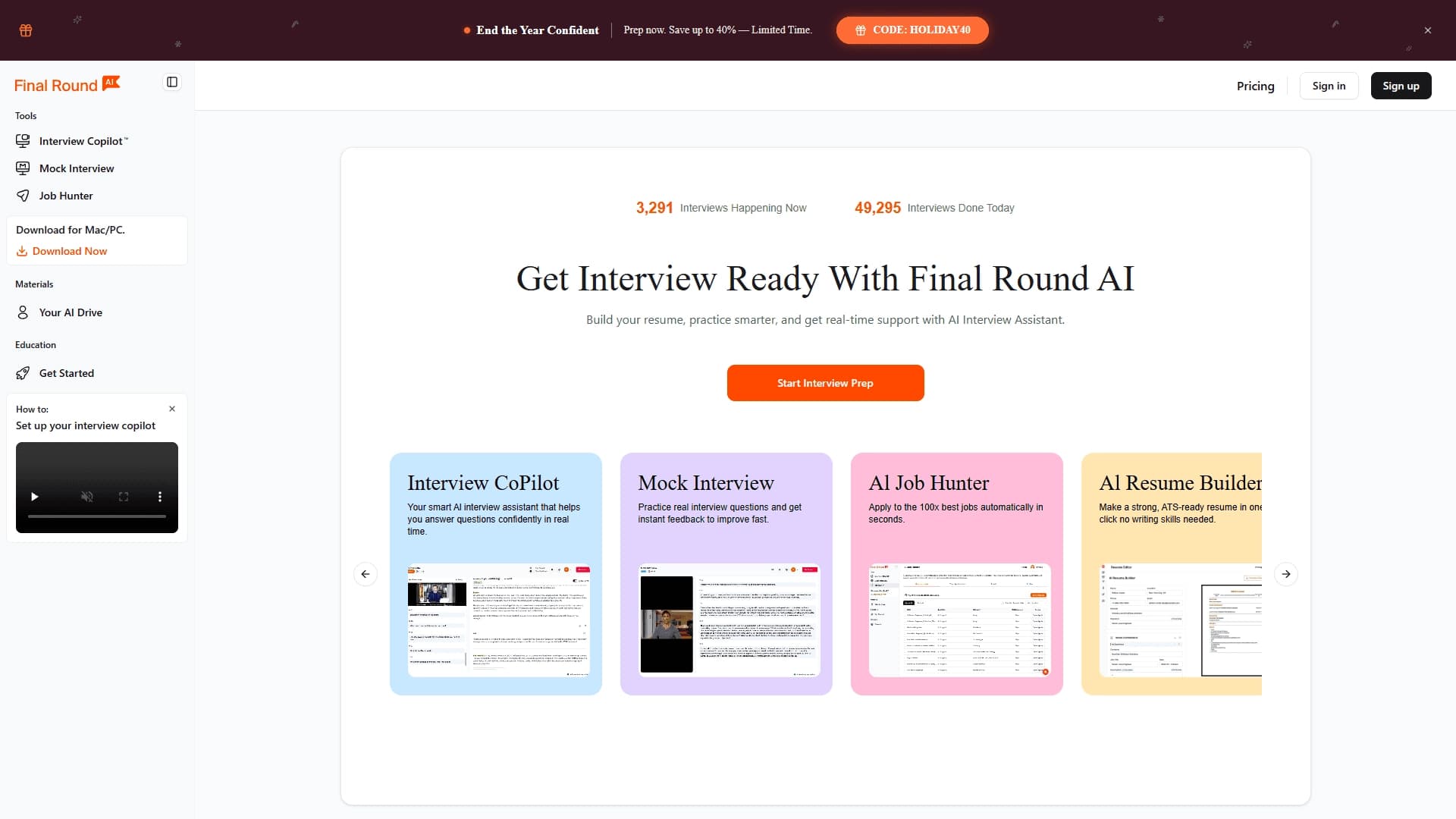
Platform for interview preparation with AI mock interviews and real-time support.
Enterprise language model platform focused on privacy and on-premise deployment.


AI assistant for creating short summaries of videos, PDF documents, and web pages.

AI email assistant that helps quickly draft messages, adapting to the user's style.

A workflow automation platform that connects thousands of apps without requiring coding.