
Wispr closed a $280M round and moved beyond dictation: now AI meeting notes
Wispr startup raised $280 million at a $2 billion valuation and will direct the funds toward developing tools for work meetings. The company also introduced a new speech recognition model, Canto, and is preparing to compete with prominent players in the AI assistant market.
Key round and plans
On Monday, August 17, Wispr, known for its AI voice input tool, announced the closing of a $280 million Series B round. The investment round was led by Menlo Ventures, and the startup's valuation reached $2 billion. According to the company, the raised funds will go toward expanding its presence and entering new directions — primarily automatic meeting notes, where Wispr has already released its own product.
With the new round, Wispr's total funding amounts to $361 million. The company closed its previous round less than ten months ago, which points to accelerating growth and strong investor interest. In the current round, already familiar funds doubled their investments: Notable Capital, NEA, Neo Ventures, 8VC, and MVP Ventures. They were joined by new investors, including Acrew, Forerunner, Goodwater, Peak XV, Together Fund, and PLUS Capital.

Dictation: competition and quality
Wispr's main product — the dictation app Wispr Flow — remains an important part of the business, but it is in this market that the company faces growing competition. Several apps at once — Willow, Monologue, Aqua, Superwhisper — offer similar features, while free and cheaper solutions for prosumers add further pricing pressure.
Against this backdrop, Wispr announced the launch of a new speech recognition model called Canto. The move is no coincidence: over the past few weeks, users have complained about deteriorating dictation quality in Wispr Flow. The company promises that Canto will reduce the error rate from 30% to under 10%, which should restore audience trust and strengthen its position in the competitive segment.
The product's reach is also expanding: since November, Wispr has released a dictation app for Android and strengthened go-to-market teams in regions such as India and the UK. In addition, the company has begun partnerships with hardware device manufacturers — for example, with the Oasis ring — so users can dictate on devices without speaking aloud. This looks like a step toward more natural voice interaction scenarios.
Meeting notes: a new direction
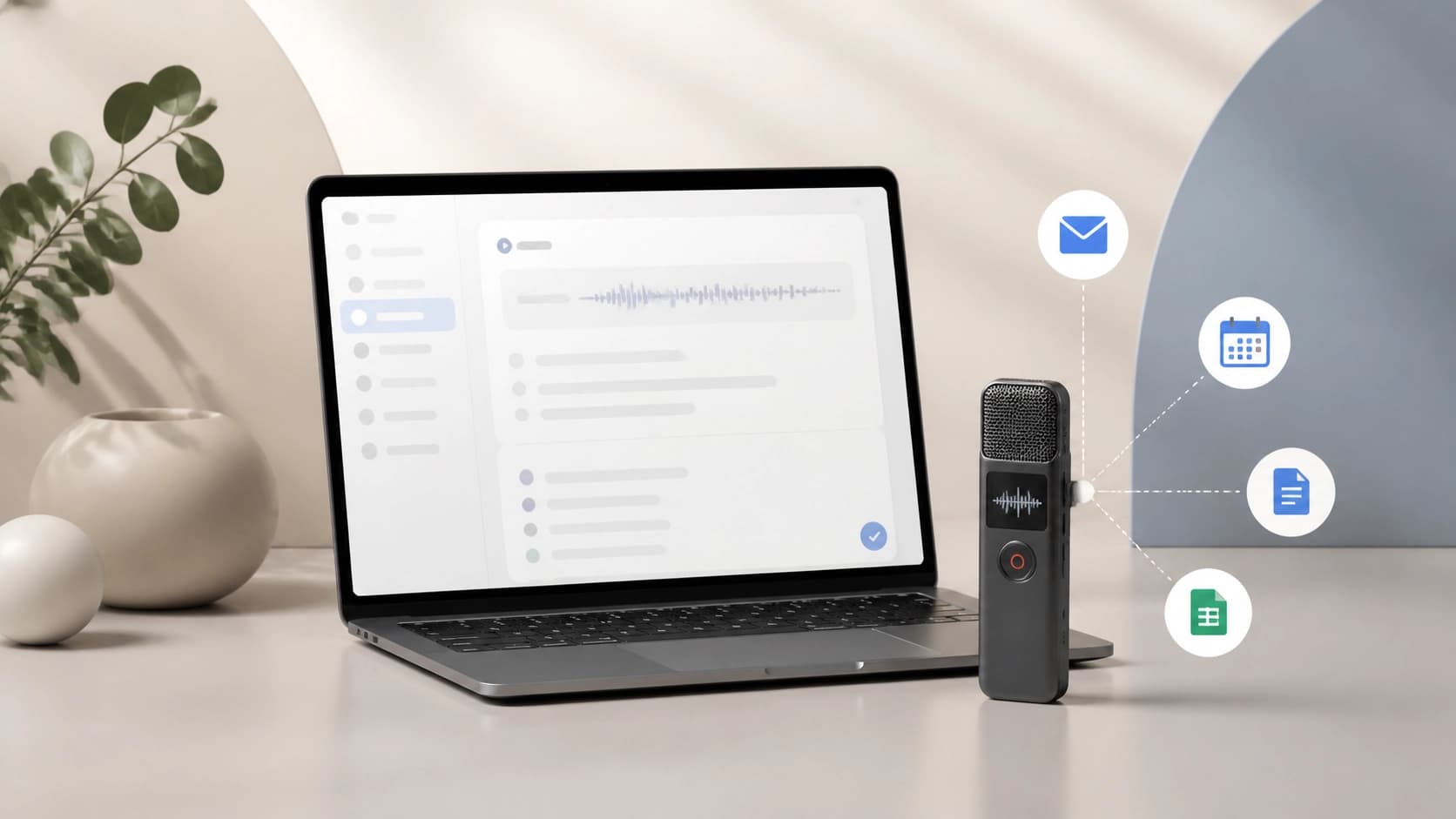
Expanding beyond dictation has materialized in a separate tool for taking notes during meetings. With it, Wispr intends to compete with services such as Granola, Fireflies, and Read AI. The new product can generate summaries and highlight action items, and in the future — integrate with other tools, automatically creating updates, documents, or email drafts based on the conversation's content.
This is a natural evolution for a company that works with voice: if dictation helps capture thoughts on one's own, meeting notes solve the problem of collective interaction. The market for such services is already fairly crowded, so Wispr will have to prove the advantages of its approach — perhaps through deeper integration with existing workflows and more accurate speech recognition.
New interfaces and the future
Last month, Wispr also announced the creation of Wispr Interface Labs — a research division that will explore new human-computer interaction interfaces. The lab will be led by Ariya Rastrow, one of the early contributors to the Amazon Alexa voice assistant.
This step shows that the company is looking beyond current products and views voice as part of a broader interface paradigm. Wispr may want to become a key player not just in dictation, but in an entire class of solutions where people interact with devices in natural language. The raised funds give the company resources for such long-term experiments, while fresh products in the meetings space offer a chance to demonstrate practical value today.
Frequently asked questions
Related materials
All materials
Toollery: Choose tools for LLM agents from tens of thousands of options without fine-tuning
Toollery builds a search index from descriptions of skills and tools, then passes the model only a limited set of candidates for each query. In experiments with libraries containing tens of thousands of functions, the approach helps maintain selection quality at a fixed top-K, although the overall effect depends on the workload profile and the provider’s caching.
11 November 2026
WILSON: combining magnifications and patient slides for pathomorphological analysis and report generation
The preprint introduces WILSON, a vision-language model that encodes images of whole slides and series of slides from a single patient at different magnifications, rather than just a single “best” slide. Without task-specific fine-tuning, it outperforms specialized and larger slide models on a range of metrics while requiring substantially less compute, and its diagnostic descriptions received higher ratings from pathologists.
11 November 2026
Canonical Polynomial Invariants for Diagnosing RL Simulator Failures: Where Are They Actually Useful?
The study examines whether incorporating physical laws into learnable dynamics models is justified: invariants extracted from trajectories and reduced to canonical form using Gröbner bases yield modest forecasting gains, but prove powerful for diagnostics, enabling the localization of violated constraints and identification of specific erroneous parameters.
10 November 2026