
Cisco Talos discovered Windows malware that coordinates actions among multiple AIs
The CAIRN framework helped identify CLOSEDQUORUM, a program for stealing credentials and cryptocurrency that engages multiple AI services to choose its next steps without an operator. Researchers have yet to determine who created it or whether it has been used in attacks.
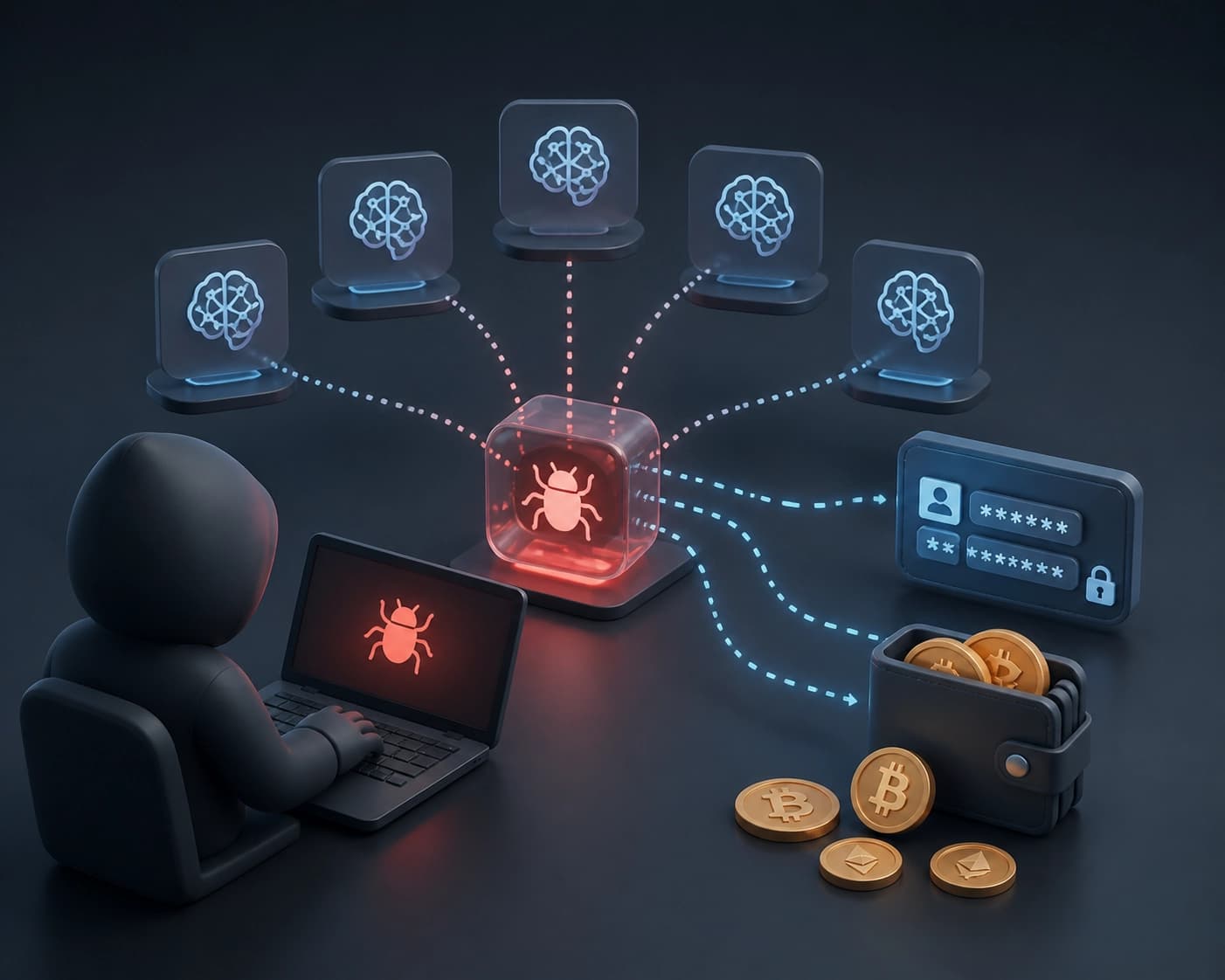
What Cisco Talos discovered
Cisco Talos introduced CAIRN, an open framework — Cognitive Artifact Intelligence Research Network. It looks for signs of AI integration in metadata, classifies malware samples, and assigns them unique identifiers.
CAIRN then analyzes samples in the context of its library and groups them by shared characteristics. Using the framework, researchers discovered the Windows malware CLOSEDQUORUM.
How CLOSEDQUORUM coordinates its actions
CLOSEDQUORUM uses an autonomous command-and-control infrastructure. The program queries DeepSeek, Qwen, Mistral, and Google Gemini to coordinate its next actions.
If one AI service is unavailable, the malware queries the others. The system does not involve human participation.
- Several AI services contribute to the decision-making process.
- One service being unavailable does not stop the system from querying the others.
- The system autonomously decides what to do next.

Purpose and confirmed links
CLOSEDQUORUM is designed to steal credentials and cryptocurrency. Researchers found some links between the program and cybercrime forums focused on credit card fraud.
These links have been documented since 2025. Researchers could not confirm who created the program or whether it was used in real-world attacks.
What else CAIRN uncovered
Over the past few months, Cisco Talos researcher Ryan Fetterman has discovered around 20 additional examples of AI malware using CAIRN.
The confirmed findings describe CLOSEDQUORUM’s purpose and how it coordinates its actions. The program’s authorship and use in real-world attacks remain unconfirmed.
Frequently asked questions
Related materials
All materials
Step-by-Step Evaluation of GUI Agents for Dashboard Analysis: The DashAct Benchmark
Introducing DashAct, a benchmark of 348 human-verified trajectories that breaks down GUI agents’ work with interactive dashboards into three stages and four visual conditions. The results reveal persistent issues with action prediction and visual target grounding, as well as agents’ reliance on contextual and spatial support.
11 November 2026
WILSON: combining magnifications and patient slides for pathomorphological analysis and report generation
The preprint introduces WILSON, a vision-language model that encodes images of whole slides and series of slides from a single patient at different magnifications, rather than just a single “best” slide. Without task-specific fine-tuning, it outperforms specialized and larger slide models on a range of metrics while requiring substantially less compute, and its diagnostic descriptions received higher ratings from pathologists.
11 November 2026
Canonical Polynomial Invariants for Diagnosing RL Simulator Failures: Where Are They Actually Useful?
The study examines whether incorporating physical laws into learnable dynamics models is justified: invariants extracted from trajectories and reduced to canonical form using Gröbner bases yield modest forecasting gains, but prove powerful for diagnostics, enabling the localization of violated constraints and identification of specific erroneous parameters.
10 November 2026