
Learn and grow: how agent-oriented learning saves robots from endless retraining
New Teach-and-Grow architecture collects successful demonstrations into reusable skill blocks, enabling robots to master unfamiliar tasks without retuning the model for each case. On the LIBERO benchmark, the approach achieves record results, and the authors associate it with the future of scalable robot learning.
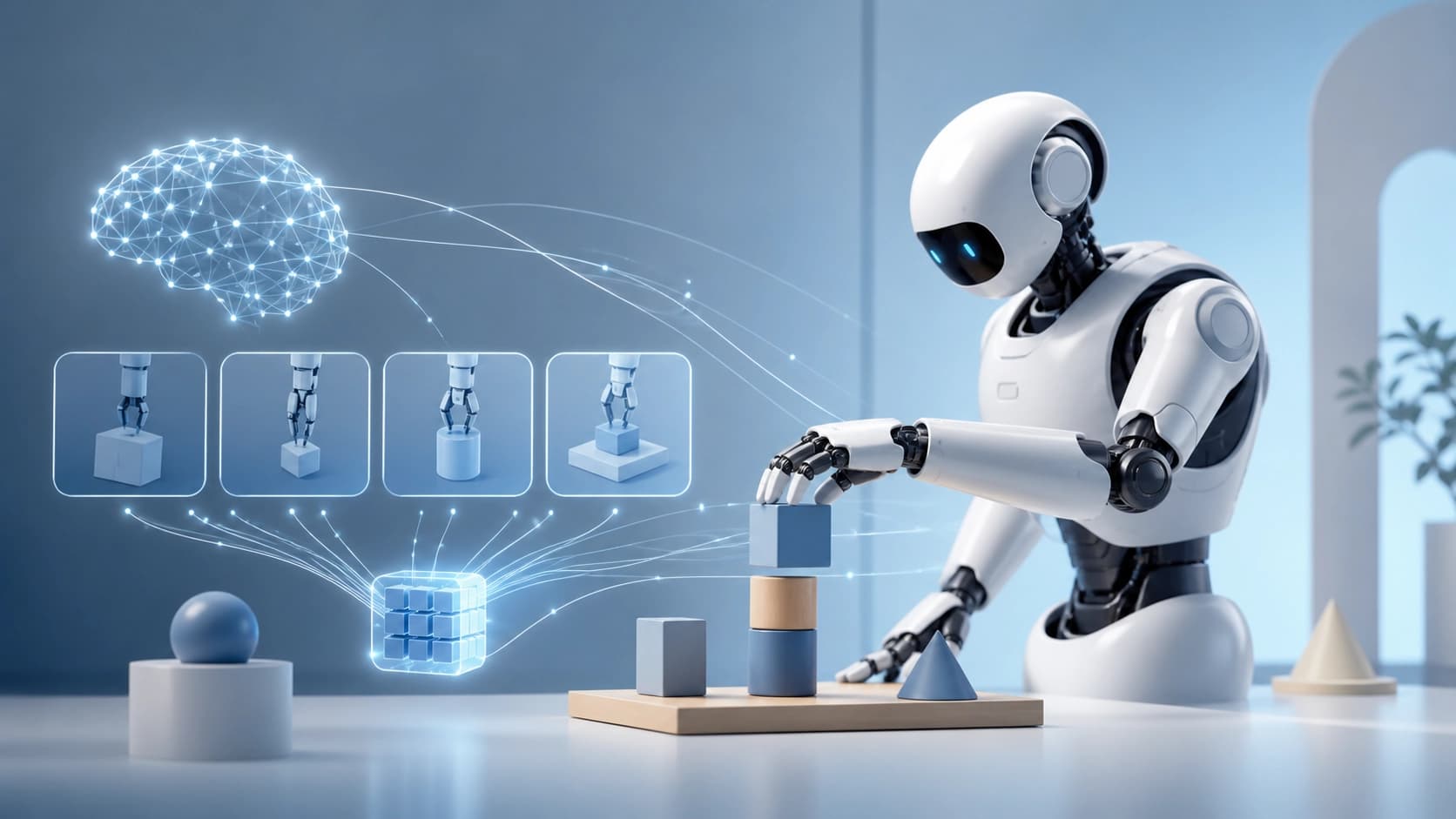
Routine retraining is a dead end for robotics
Modern robots built on end-to-end "vision-language-action" (VLA) models and world-action models are impressive as long as they operate in familiar environments. But as soon as the scene changes — new lighting, a different layout, an unfamiliar object — the model starts making mistakes. To restore a skill, you have to collect fresh data, retrain the policy, and run regression tests. This cycle is called the "retraining tax": every change in the environment requires another round of costly manual work.
What makes robotics unique is that data cannot simply be downloaded from the internet. Physical experience has to be obtained by operating real machines — slowly and expensively. That is why the "collect lots of data — train — collect even more" approach does not scale well.
An agent instead of a policy: the idea behind Teach-and-Grow Learning
A group of researchers (Chang Nie, Zhe Liu, Hesheng Wang) proposed the Teach-and-Grow Learning (TGL) architecture, which shifts the focus from retraining to reusing experience. Instead of retraining a model from scratch for every new task, TGL builds a skill library — reusable behaviors for typical subgoals.
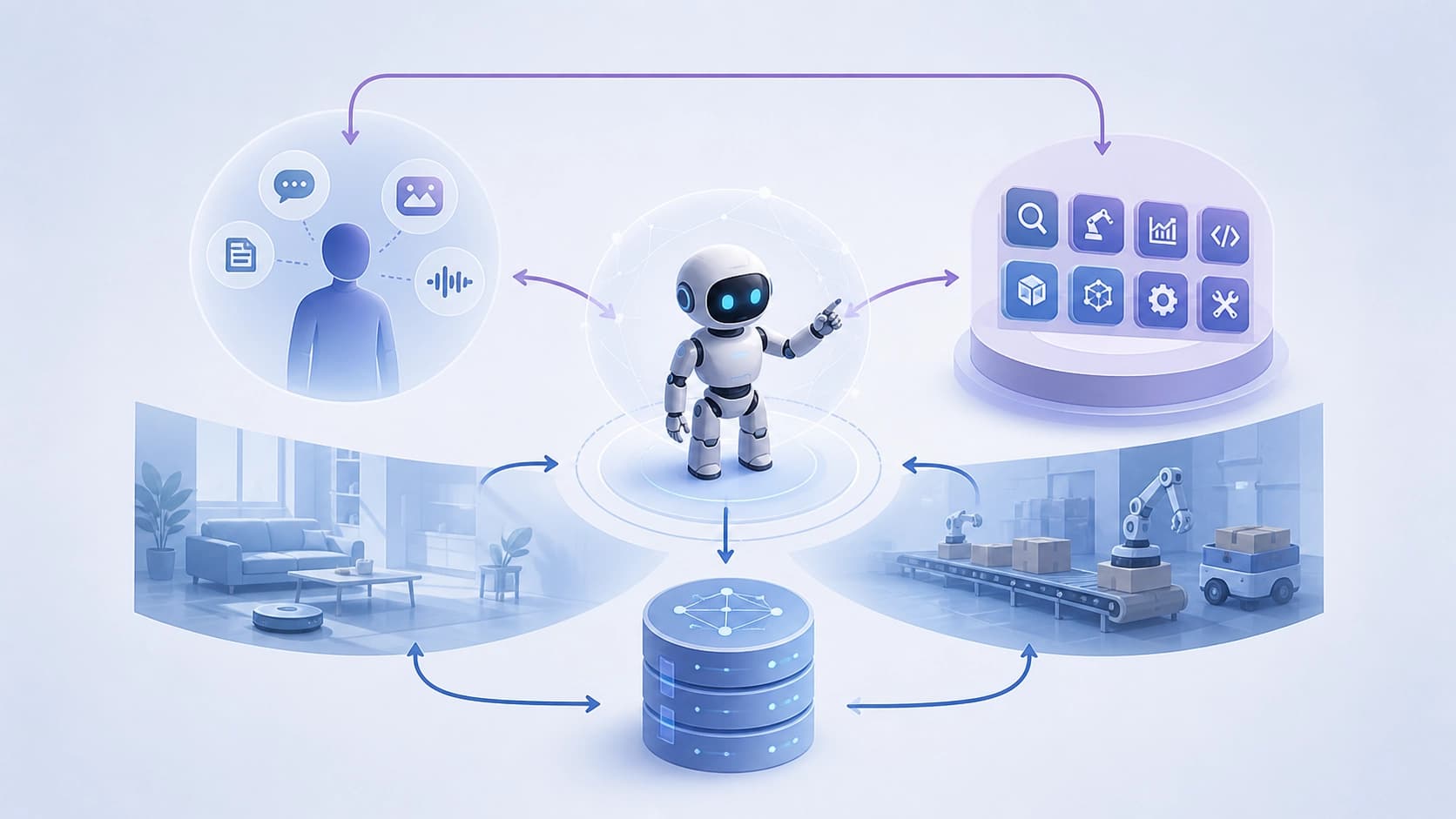
It all starts with a few successful demonstrations. A multimodal agent breaks them down into logically complete units — Skill Blocks. Each block handles a specific meaningful step: pick up an object, move it, place it, open a lid. These blocks are stored in the Skill Library as executable programs.
When the robot encounters a new scene, the agent does not run a pre-learned sequence; instead, it reasons: which skills are relevant here, how to combine them, which tool to apply — a trained one or one calculated geometrically. It then executes the plan, observes the physical outcome, and, if the behavior deviates from the intention, corrects the trajectory. All successes, failures, and corrections are recorded in a structured Experience Memory that helps the agent make decisions next time.
Why this works: learning as a continuous process
The key difference between TGL and classical approaches is its attitude toward deployment. Usually, learning is considered complete once the model goes "into production." In TGL, deployment itself becomes a period of continued learning: every completed task makes the next one easier, because the agent accumulates reusable blocks and knowledge about when they apply. There is no need to learn a new policy for a specific task — it is enough to combine existing skills and adjust execution if necessary.
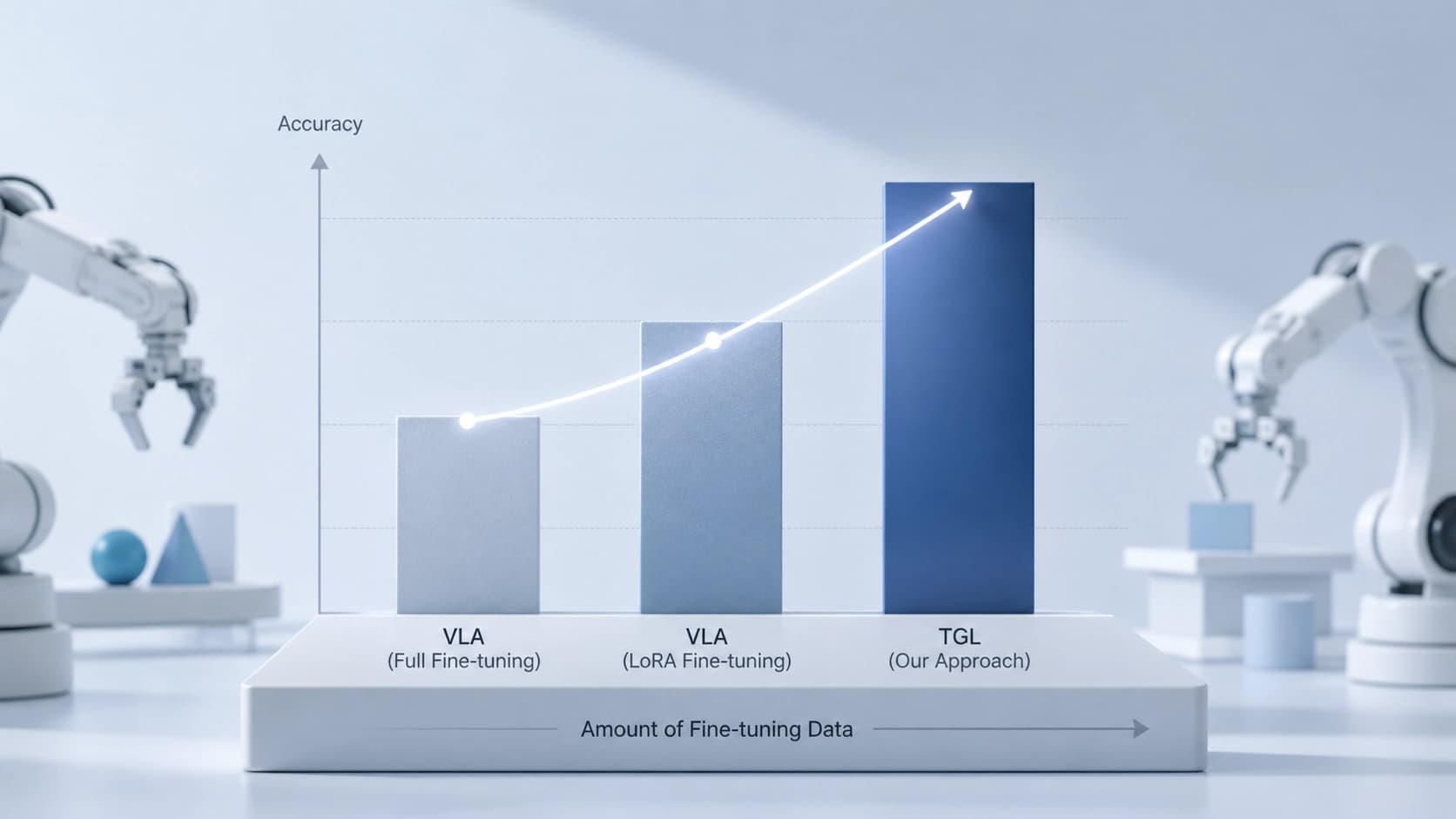
The researchers put forward a scaling hypothesis: if X is the volume of effective reusable experience, then the error on future tasks and the need for additional training decrease according to a power law, approaching an irreducible minimum. In other words, the more useful skills are accumulated, the cheaper it becomes to master new capabilities.
What the experiments showed
Evaluation on the LIBERO benchmark produced state-of-the-art results. Controlled studies confirmed three important properties:
- skill induction — the agent can extract generalizable blocks from demonstrations rather than merely memorizing trajectories;
- robust reuse — skills work in new scenes without retraining;
- agent-driven adaptation — the robot itself detects deviations and changes its behavior in real time.
Instead of a conclusion
Teach-and-Grow Learning is a step toward robots that "grow" with experience instead of endlessly retraining from scratch. This architecture is especially promising for industry and service robotics, where the environment is constantly changing and every minute of equipment downtime costs money. If the power-law scaling hypothesis holds, the cost of deploying new robotic tasks could drop by orders of magnitude — and then adaptive machines will cease to be a rarity.
Frequently asked questions
Related materials
All materials
Step-by-Step Evaluation of GUI Agents for Dashboard Analysis: The DashAct Benchmark
Introducing DashAct, a benchmark of 348 human-verified trajectories that breaks down GUI agents’ work with interactive dashboards into three stages and four visual conditions. The results reveal persistent issues with action prediction and visual target grounding, as well as agents’ reliance on contextual and spatial support.
11 November 2026
WILSON: combining magnifications and patient slides for pathomorphological analysis and report generation
The preprint introduces WILSON, a vision-language model that encodes images of whole slides and series of slides from a single patient at different magnifications, rather than just a single “best” slide. Without task-specific fine-tuning, it outperforms specialized and larger slide models on a range of metrics while requiring substantially less compute, and its diagnostic descriptions received higher ratings from pathologists.
11 November 2026
Canonical Polynomial Invariants for Diagnosing RL Simulator Failures: Where Are They Actually Useful?
The study examines whether incorporating physical laws into learnable dynamics models is justified: invariants extracted from trajectories and reduced to canonical form using Gröbner bases yield modest forecasting gains, but prove powerful for diagnostics, enabling the localization of violated constraints and identification of specific erroneous parameters.
10 November 2026