
SUNO or Udio: which AI music generator is right for you?
We compare two popular track creation services: one is focused on simplicity and speed, the other on interactive style customization and collaboration. We show in which scenarios each of them shines best.

Briefly about the main thing
When to turn a text description into a ready-made track They're usually called two names. SUNO and Udio. The first bets on simplicity. You write what you want and you get the whole song. melody and arrangement. The second is interactive work with styles and collaborative creativity. Both services are available to beginners but sensation The process and the final result are very different.
How tracks are generated
The main difference between platforms is the very philosophy of generation . One turns words into a finished song. The other one provides the material for assembly.
SUNO It works on the principle of “one clue – the finished song”. ? Put in a prompt like a happy summer day - and the service itself collects the composition text music vocals. It's a bit of an idea. single-track which You can listen and use it right away.
Udio propose another way Choose the genre and style first Gradually “compose” the composition. shuffling individual elements. For example, , request in spirit jazz return smooth instrumental track - and Then you can influence him. development. It's more of a sound maker. than the generator zero ?
Fresh. survey SUNO V4.5 (Verified by AIPURE), but when choosing between services, the version number is secondary. The main thing is the approach eh he The platforms are fundamentally different.
Interface and entry threshold
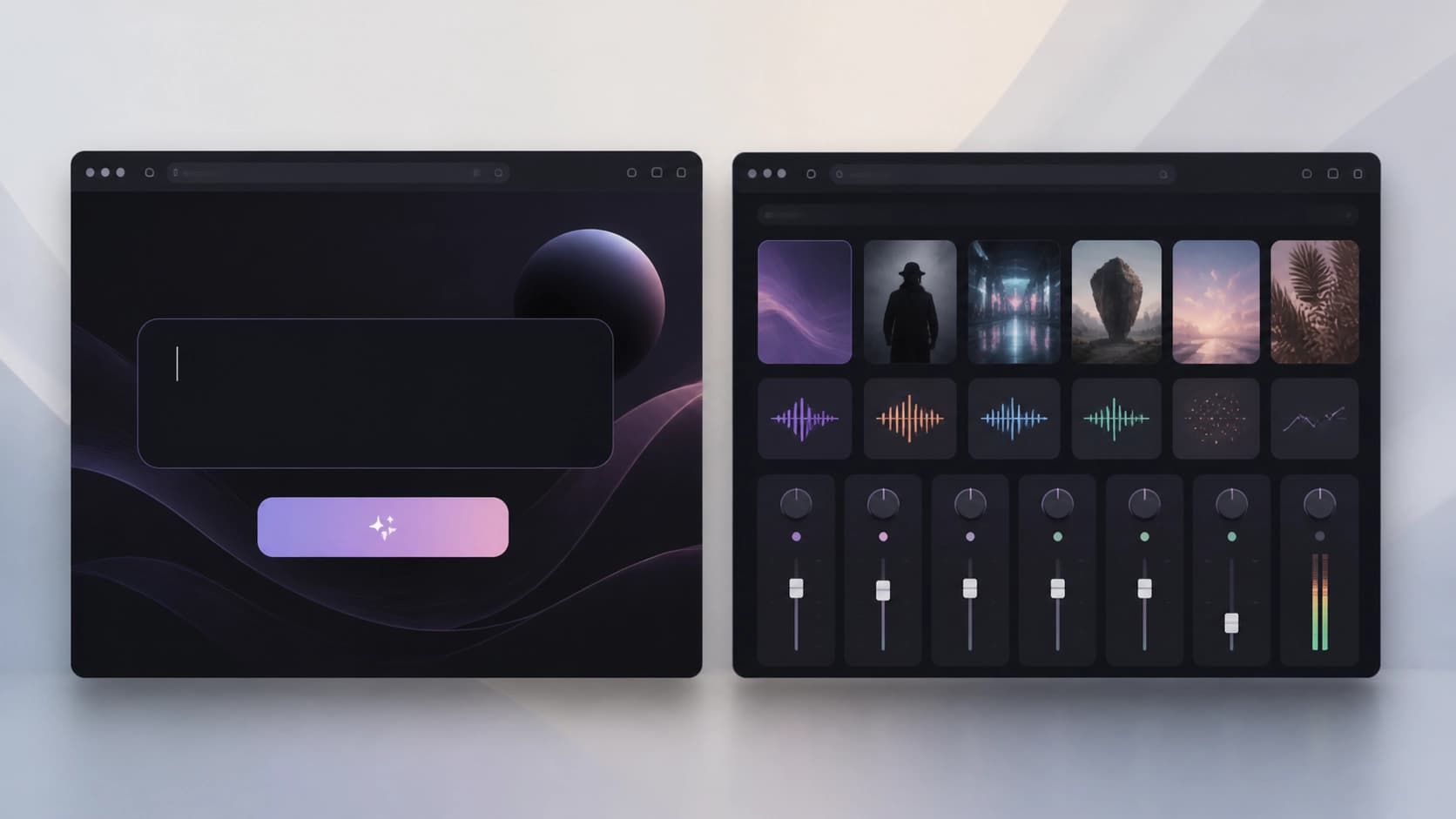
Here. SUNO win first-minute interface is simple logically And it guides the user in steps. Music education It is not necessary – it is embedded in the very concept of service. . Text in. press the button We got the result. Great. variant Anyone who wants to hear an idea, not tinker with the settings.
Udio looks interactive : screen allows mixing musicality switch over between experiment styled . Such takeaway but It requires more engagement and at least a rough understanding of what You want to hear it.
Collaboration : solo work or team production
If music is your personal space, there are almost no restrictions. SUNO designed for individual song creation joint work is not provided . It's perfect. quickie personal experiment when don't agree decision No one.
Udio initially focused collaboration . Several participants can work on a single track. what especially valuable for groups and creative collectively Where everyone adds their share. If you’re planning on team-building music, Udio looks like a natural choice.
Sound quality
SUNO giveaway high-quality suitable for professionalization : they meet industry standards . The finished track can be brought to the release or used in flat-out Upgrades.
Udio It also provides high quality, but subtle Because the result depends on the user’s actions The final composition may vary considerably from insertion . It's not a flaw. eh peculiarity More control means more variation.
So, choose
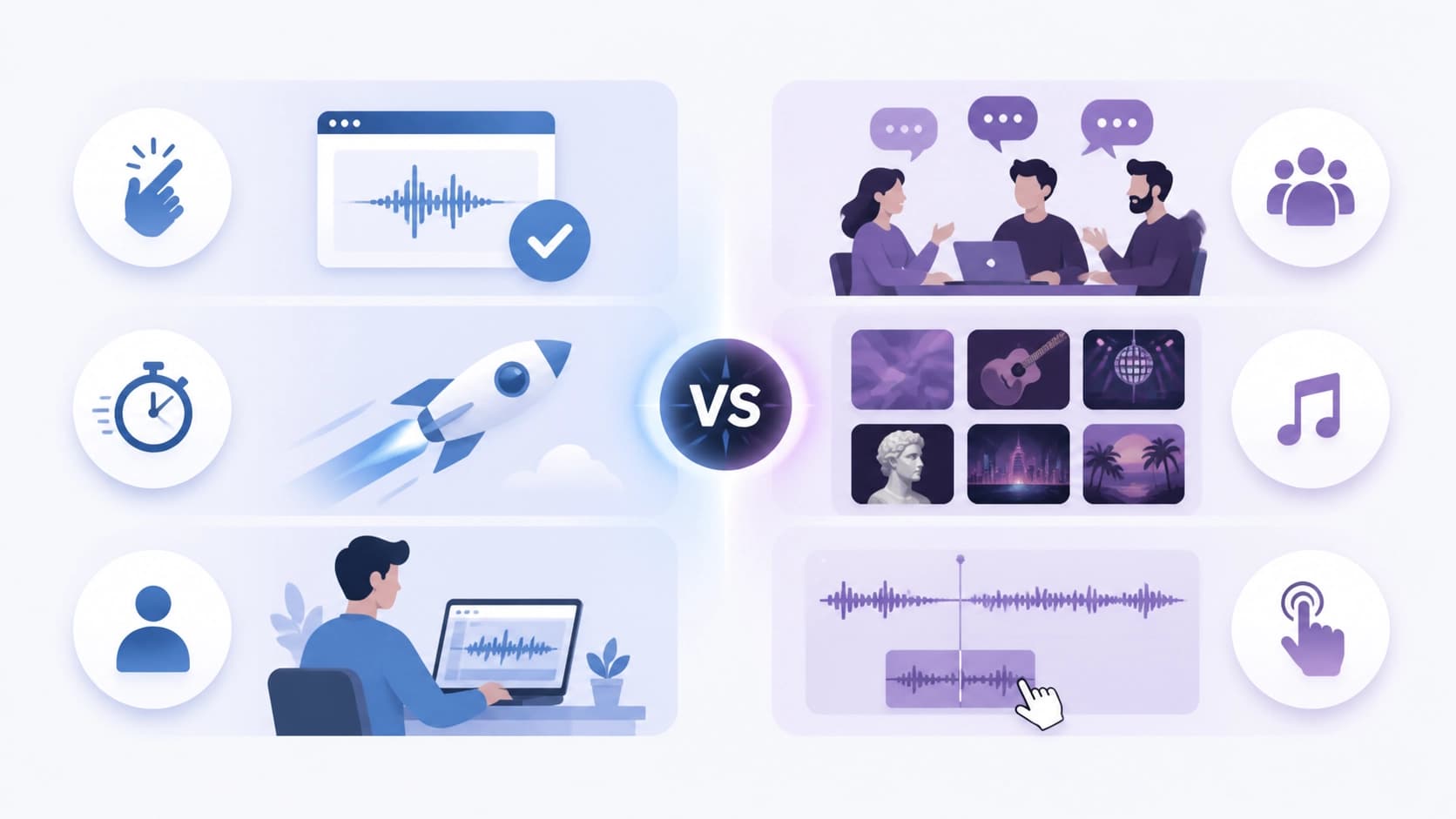
It all comes together. simple-minded what for you More important, speed and simplicity or collaborative creativity and style control?
Choose. SUNOif ...
- Want to quickly get a finished song on the text prompt;
- You do not plan to understand the technical details;
- work in alone and appreciate the instant result.
Choose. Udioif ...
- love to explore styles and genres interactively;
- working in a group or on joint projects;
- create complex compositions where every element is important.
Anyway, No one wants to try both instruments. start on rapid generation in SUNO, and deepen In experiments at Udio. Practice will tell Which approach is closer to you?
Frequently asked questions
Related materials
All materials
OpenCollab: programmable agent coordination, controlled execution environment, and policy compliance metric
The framework brings together the specification of agent interaction structures, a shared environment for experiments, and detailed event tracing, while the newly introduced Adherence metric reflects how closely actual execution follows the declared schema. In benchmarks, the Duo configuration achieves a new state of the art, while the single-agent variant uses the fewest tokens.
11 November 2026
Chern–Simons Reservoir Memory: Autonomous Connectivity Dynamics and Density Transport
The article explores how a reservoir preserves the history of input signals both in its density distribution and in its geometric degrees of freedom. A comparison of four mechanisms shows that current creates a separate connected component that alters the subsequent density response, while accounting for all measured features yields a small improvement in decoding pulse order.
10 November 2026
Diversity in the Input, Not in the Reasoning: Comparing Test-Time Augmentation Methods for LLMs
The study compares sources of variation in LLM inference—query paraphrasing, spelling changes, and image transformations—at an equal number of calls. Across six benchmarks, preserving meaning yielded the greatest improvement in accuracy, while character-level noise and simultaneous perturbations of two modalities were less useful.
8 November 2026