
SMITH: the model writes its own tools — and learns to use them in a single training loop
Researchers from Taiwan proposed a reinforcement learning approach in which the skill of creating a tool and the skill of calling it are trained within a single policy, rather than in two separate models. After such training, a compact 4B model outperformed much larger counterparts on held-out tests, including table and image tasks that were not part of the training.
The problem: a toolkit runs into the limits of human labor
Talk of a "model with tools" usually means the same thing: there are pre-defined functions and APIs, someone designed, documented, and maintains them. The model merely chooses what to call. It turns out that the ceiling on an agent's capabilities is set not by its abilities but by how many integrations the development team has managed to write.
People try to get around this with automatic tool creation: the model is asked to invent a function on the fly. But there's a subtlety here. The one who writes the tool and the one who uses it are essentially different entities: a frozen language model is simply nudged by a prompt at inference time. There is no feedback channel between author and consumer. As a result, no one checks the most important thing: can the model that generated a function schema actually call that schema correctly? A schema can look neat and still be indigestible for the very same agent.

SMITH: one policy for two roles
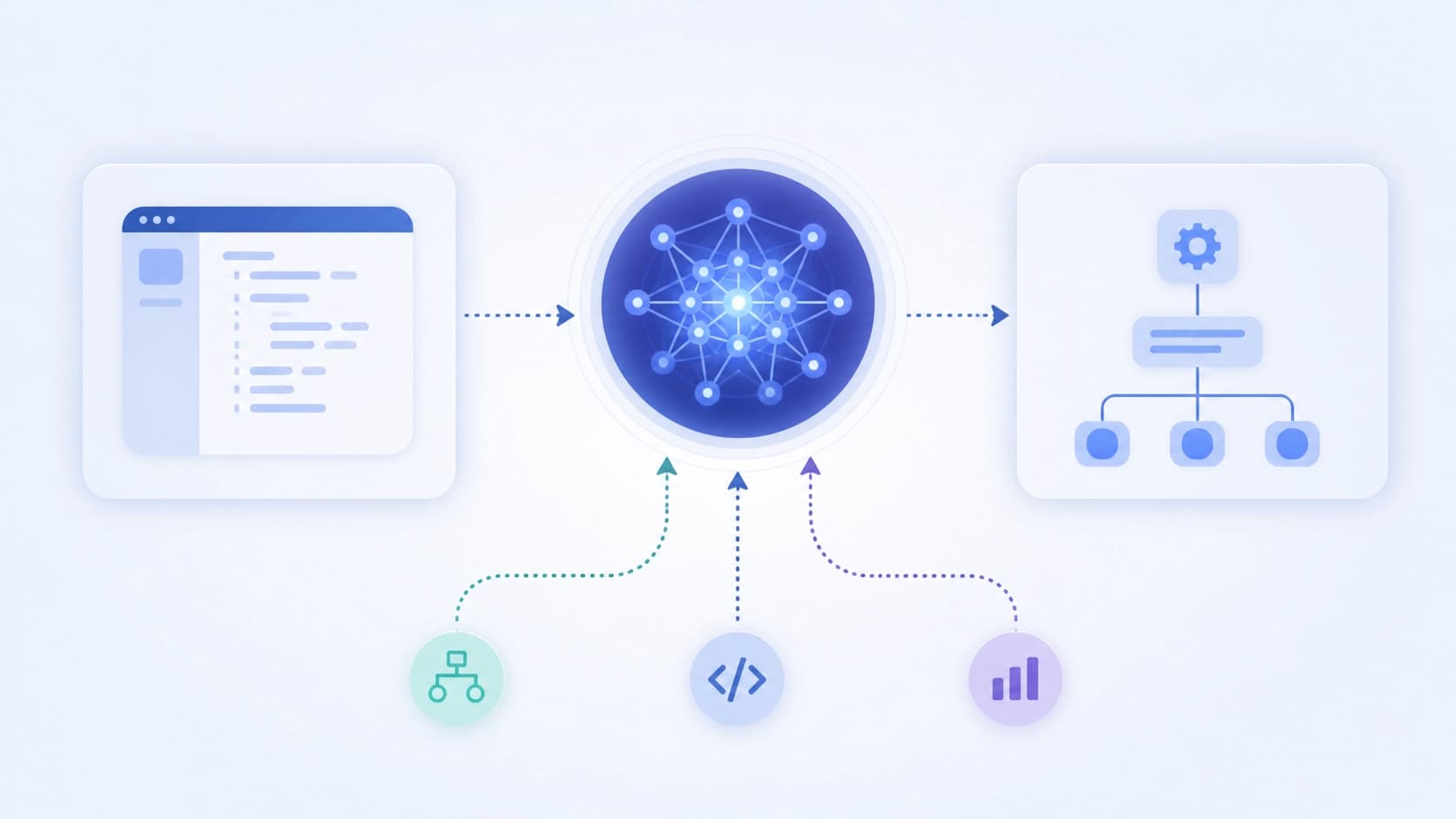
The arXiv preprint 2608.24571 (cs.AI and cs.SE categories) describes an approach called SMITH — Schema-grounded Multi-task Iterative Tool Honing. It is reinforcement learning where tool creation and tool use are optimized jointly, within a single policy. Not two separate modules and not a chain of prompts, but one model in which both roles are trained simultaneously.
Two task types in a single rollout
Each training run is either a building task or a usage task:
- Building. The model receives several examples and must write a working tool from them: devise a signature, implement the logic.
- Usage. The model receives a held-out question and a pool of existing tools, from which it must select and call the appropriate one.
The pool is not static: it is replenished with what the model itself wrote during the building step. This closes the loop — what was written is immediately tested for usability rather than sitting idle in a separate repository.
The reward is decomposed along three axes
The key detail is not a single overall score but three independent reward axes: schema, code, and result. Each catches its own type of failure. A tool can be described in such a way that it cannot be called; the code may fail to run; the code may run and produce an incorrect answer. These are three different breakdowns, and each yields its own gradient. Mixing them into a single number would mean losing information about what exactly went wrong.
What the experiments showed
The main result is this: a Qwen3 model of size 4B, trained with SMITH on 13 procedural reasoning tasks where the answer is checked by an exact verifier, achieves 79.8 macro-average accuracy on held-out tasks. This is the best figure among all the methods the authors compared. Moreover, it is higher than that of Qwen3-30B-A3B — a noticeably larger model that acted as a tool writer without any training.
Transfer also looks convincing. On TabMWP-Hard the trained model scores 40.4, and on GQA — a task from a different subject area — 42.6, which is 7.6 points more than the best inference-time baseline with the same backbone. It is telling that the training included neither visual nor tabular data: tools honed on textual procedural tasks proved useful there as well.
There is a third finding, too. Tools written by the 4B model raised the quality of LFM-2.5-350M and of the large model mentioned above on the same reasoning tasks. That is, the tool library is valuable in itself — separately from whoever invented it.

Why this matters more than one more row in a table
Here the direction of dependency changes. Usually the size of a model determines what it can do. SMITH shows a different scenario: a small model becomes a tool factory, and the gains from its work extend to models of a different size and a different architecture. The library turns out to be a portable artifact rather than a detail of a specific agent.
Next is role consistency. Training penalizes schemas the model itself cannot call and rewards those that actually work in its hands. The writer and the user stop being strangers communicating through a poorly aligned contract.
The separate reward axes also provide diagnostics. You can see exactly where the pipeline breaks: at the level of the interface description, at the level of implementation, or at the level of reasoning about the result. This is more useful than a single aggregated number from which it is impossible to understand the cause of a failure.
Limitations and where to look next
The main condition of the approach is the availability of an exact verifier. The thirteen procedural reasoning tasks are good because the correctness of the answer is checked automatically and unambiguously. Where the correct answer cannot be verified formally, reinforcement learning in this form cannot be run. This means that open-ended, creative, or contested domains remain outside the scheme for now.
The second question is the robustness of the created tools. It is one thing to call a function on a held-out question from the same distribution, and another to live with a library for months while the input data drifts. The preprint does not address this, and it is a natural next step.
Nevertheless, the logic of "a model writes tools for itself and immediately learns to use them" looks like a more coherent alternative to the usual prompting of a frozen model. If it holds up across a broader range of domains, the question of "how many APIs have we managed to write by hand" will gradually cease to be a limiting factor for agents.
Frequently asked questions
Related materials
All materials
AURA-Eval: How to Check Whether an LLM Agent Recognized a Risk and Changed Its Next Step
The framework evaluates LLM agents’ behavior not by their final verdict, but by how they respond to risk at key decision points: tool-call trajectories are interrupted, after which the model must continue reasoning and acting, while a panel of LLM judges assesses risk detection, the nature of the step, and its safety. Across 1,249 tasks drawn from 157 R-Judge trajectories, unsafe actions become more frequent among 20 models when no safe path is available, and removing oversight before execution turns 52.3% of initially safe cases into unsafe ones.
10 November 2026
Chern–Simons Reservoir Memory: Autonomous Connectivity Dynamics and Density Transport
The article explores how a reservoir preserves the history of input signals both in its density distribution and in its geometric degrees of freedom. A comparison of four mechanisms shows that current creates a separate connected component that alters the subsequent density response, while accounting for all measured features yields a small improvement in decoding pulse order.
10 November 2026
STAR: Adaptive Normalization of Temporal Context and Service Graphs for End-to-End Incident Management
The STAR framework trains representations from metrics, logs, and traces, using learnable normalization that accounts for multiscale temporal dynamics and dependency structures between services. On two real-world datasets, this pipeline delivers consistent improvements in anomaly detection, failure ranking, and root cause analysis over state-of-the-art baselines.
10 November 2026