
Self-distillation restores lost LLM performance: how hidden space alignment combats forgetting and compression
The SDFT method proposed by the authors helps models recover capabilities after degradation caused by fine-tuning, quantization, or pruning. Using the CKA metric, researchers confirmed that performance recovery correlates with the alignment of the student's and teacher's internal manifolds.

A large language model rarely meets the user in its original form. Before deployment, it is fine-tuned for dialogues, compressed, quantized, and some weights are discarded. Each of these steps brings practical benefits, but almost always leaves a trace: the model may start reasoning worse, forget rare facts, or lose its sense of style. The question is whether skills can be restored without full retraining on massive datasets.
Why quality suffers after fine-tuning and compression
Catastrophic forgetting usually accompanies Supervised Fine-Tuning (SFT). The model is adapted to a new response format, and the weight update unintentionally overwrites part of the old knowledge. Quantization and pruning work differently: they save memory and speed up inference, but replace precise computations with approximate ones and disable some connections. As a result, not only the model's behavior is deformed, but also its internal representation of knowledge.
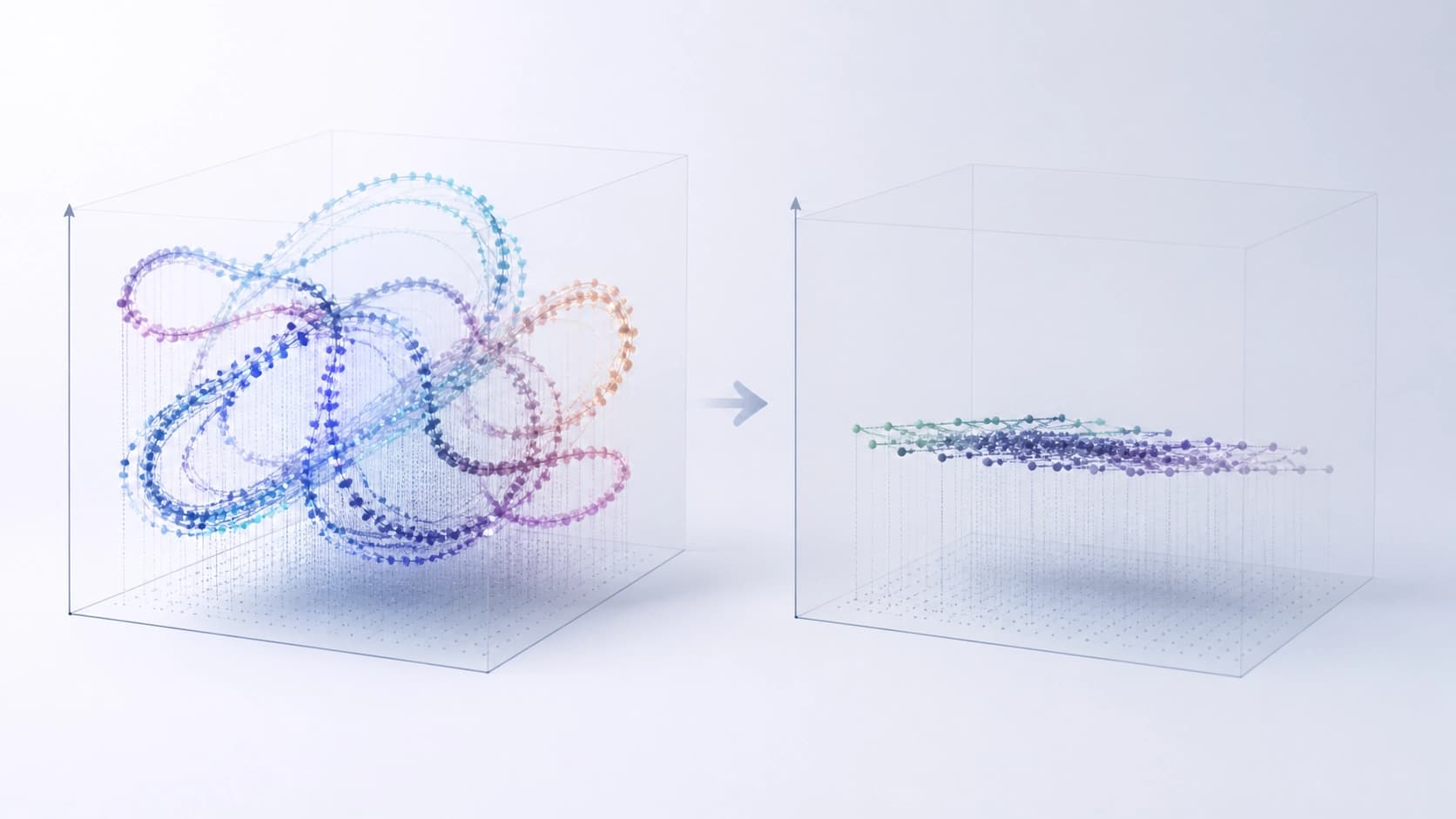
External symptoms can vary—from a loss of factual accuracy to monotonous responses. However, the cause is common: the structure of the latent space in which the model "thinks" no longer matches that of the original version.
Self-distillation instead of retraining
In the paper arXiv:2604.15794, researchers proposed the Self-Distillation Fine-Tuning (SDFT) framework. The idea is to use the model itself as a source of recovery. The damaged version acts as the student, while its "healthy" variant—saved before compression or SFT—serves as the teacher. During the fine-tuning stage, the student adjusts its responses and internal states to approximate the teacher.
This is not the classic transfer of knowledge from a large model to a small one. Here, the teacher and student are essentially the same architecture at different life stages. That is why the process is called self-distillation: the model does not learn anything fundamentally new but regains its lost internal consistency.
What aligning hidden manifolds shows
The authors assume that the generative capabilities of LLMs fundamentally rely on a high-dimensional manifold formed by hidden layers. Model quality is determined not by individual neurons, but by how activations are arranged in this space. One can imagine them as a point cloud: a well-trained model has a characteristic cloud structure, while compression or forgetting destroys it.
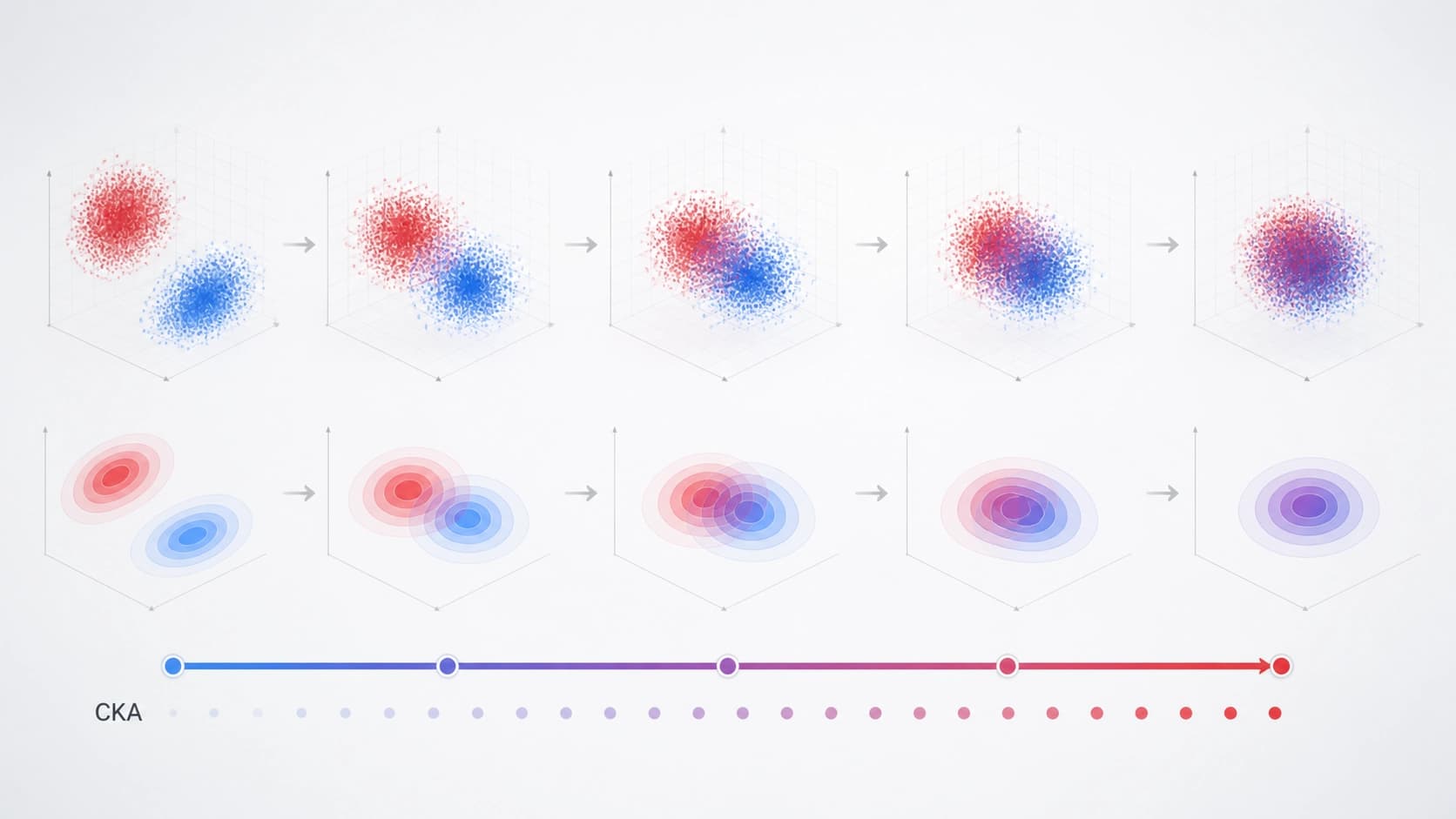
To measure recovery, the study uses Centered Kernel Alignment (CKA)—a metric of similarity between the teacher's and student's internal representations. CKA is convenient because it is invariant to orthogonal transformations and scaling. It does not penalize uniform rotations or stretches of coordinates, but captures precisely the change in activation configuration.
Experiments showed a strong correlation between performance recovery and an increase in CKA alignment. The closer the student's manifold is to the teacher's, the better the model regains lost skills. This confirms that self-distillation works not by chance, but because it aligns the geometric structure of the latent space.
Practical takeaway
The very idea of restoring a model through distillation is not new. The novelty of the approach lies in explaining why it works and in providing a way to verify that explanation. CKA could become a diagnostic tool: if alignment drops sharply after quantization or pruning, the model needs "repair." SDFT, in turn, makes it possible to perform this repair without returning to a full training cycle.
The work connects a practical performance recovery framework with the geometric theory of representations. This provides a clearer picture of what happens inside an LLM during compression and why self-distillation can restore lost capabilities.
Frequently asked questions
Related materials
All materials
Canonical Polynomial Invariants for Diagnosing RL Simulator Failures: Where Are They Actually Useful?
The study examines whether incorporating physical laws into learnable dynamics models is justified: invariants extracted from trajectories and reduced to canonical form using Gröbner bases yield modest forecasting gains, but prove powerful for diagnostics, enabling the localization of violated constraints and identification of specific erroneous parameters.
10 November 2026
AURA-Eval: How to Check Whether an LLM Agent Recognized a Risk and Changed Its Next Step
The framework evaluates LLM agents’ behavior not by their final verdict, but by how they respond to risk at key decision points: tool-call trajectories are interrupted, after which the model must continue reasoning and acting, while a panel of LLM judges assesses risk detection, the nature of the step, and its safety. Across 1,249 tasks drawn from 157 R-Judge trajectories, unsafe actions become more frequent among 20 models when no safe path is available, and removing oversight before execution turns 52.3% of initially safe cases into unsafe ones.
10 November 2026
Chern–Simons Reservoir Memory: Autonomous Connectivity Dynamics and Density Transport
The article explores how a reservoir preserves the history of input signals both in its density distribution and in its geometric degrees of freedom. A comparison of four mechanisms shows that current creates a separate connected component that alters the subsequent density response, while accounting for all measured features yields a small improvement in decoding pulse order.
10 November 2026