
Problem: Few tests, but the reward for them is everything
Reinforcement learning with verifiable rewards (RLVR) has become the primary way to bring language models up to a decent level in code generation. The scheme is simple: the model writes a solution, a special check runs it through tests, and the model is rewarded based on the result. Everything rests on one assumption — that the tests truly describe the task in full.
In practice, this assumption is almost always violated. The set of test cases is narrow, coverage is full of holes, and the model quickly finds not the task but a loophole: it fits the code to specific checks instead of learning to solve a class of similar problems. Then the familiar spiral kicks in — reward hacking, followed by policy degradation. The model loses general skills exactly to the extent that it succeeds in narrow trickery.
A rough analogy: an exam consisting of two questions. A student who has memorized the answers to those two questions gets an A but doesn't know the subject. And the longer such training goes on, the worse they get at everything else.

The RobustTests idea: errors as a test generator
Tests are usually devised starting from the problem statement: what inputs are possible, where the range boundaries are, what happens with empty input. Logical, but it's precisely this path that yields narrow coverage — the test author and the solution author look at the task from the same side and are equally blind to the same spots.
RobustTests flips the process. At the core of the framework is faulty-code-driven test case synthesis. This isn't about randomly broken code, but about "almost correct" solutions: those that differ from the correct one by a small change in logic — a flipped comparison sign, a wrong loop boundary, a missing branch. Each such solution almost works, and that's exactly why it's valuable.
Next, an input is found where the almost-correct code diverges from the reference. The input found becomes a test. Such a test has high diagnostic power: it doesn't just "check something," it distinguishes between two close behaviors — the one we want from the model and the one that looks plausible but is wrong.
The work is described in the arXiv preprint 2608.24135 (Yiwen Zhang and eight more authors, among them Xiaodong Yan, Zhenyu Huang, Deng Zhao and others; v1 — August 25, 2026, v2 — August 27, 2026, DOI 10.48550/arXiv.2608.24135, accepted to EMNLP 2026). The authors assign the material to two sections at once — cs.AI and cs.SE, which makes sense: it's about both model training and testing engineering.
Filtering: validator agents and clustering
Any automatic test synthesis easily turns into a garbage generator. Some of the invented inputs will be invalid, some will duplicate each other, some will check the same behavior from different angles. There's little useful signal from such a set and a lot of noise.
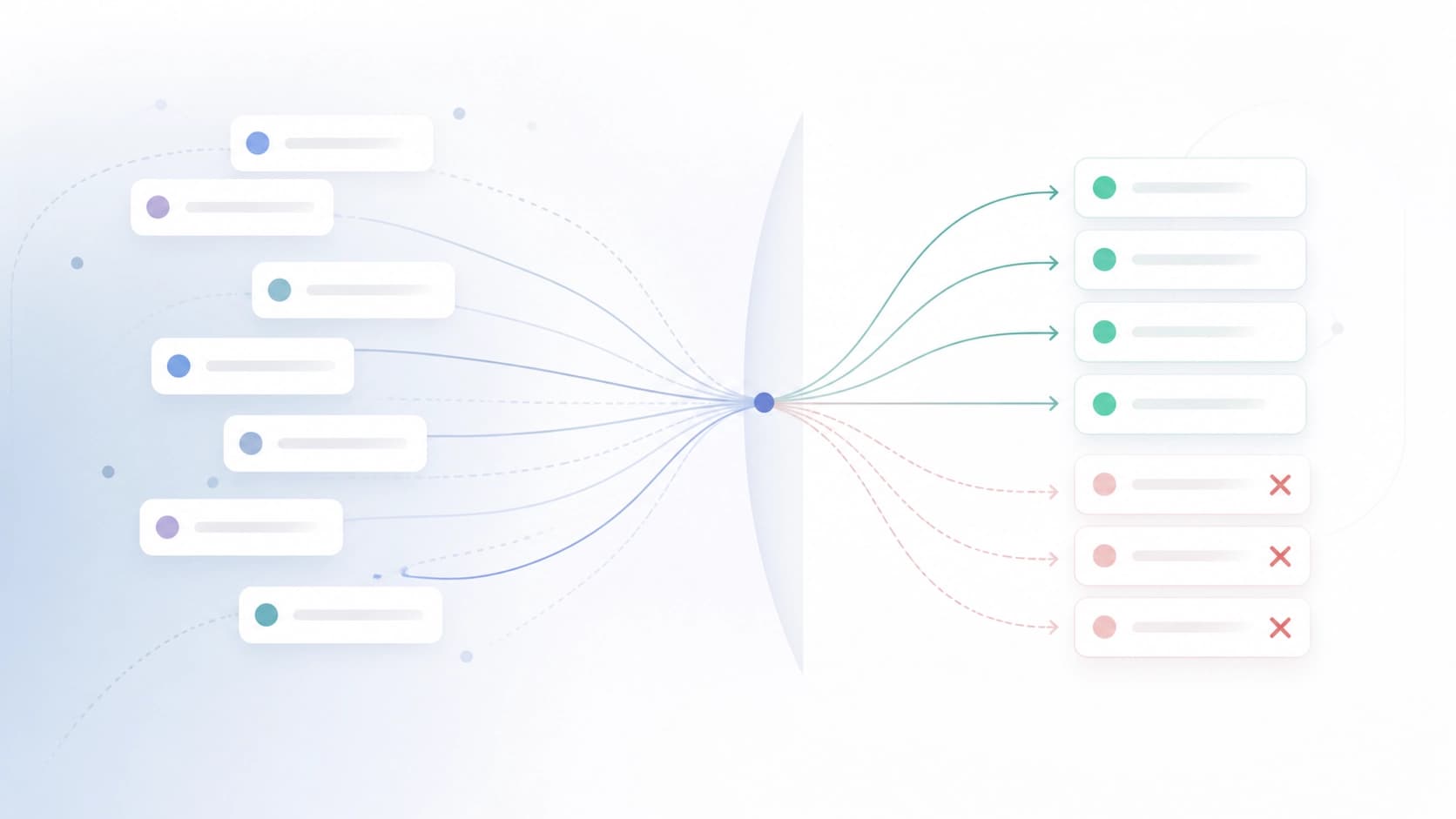
That's why the pipeline includes a second layer — validator agents that filter out incorrect and redundant test cases. Added to them is clustering by behavioral features: tests are grouped by which specific code behavior they distinguish, and duplicates within a group are collapsed. The result is a compact set where each element adds new information rather than repeating its neighbor.
Dense reward instead of a sparse signal
The second component of the framework concerns not the tests but how the reward is computed from them. The classic binary approach — "everything passed or nothing passed" — works poorly when there are many tests of varying difficulty: the model solves almost everything, stumbles on one edge case, and gets the same zero as a completely broken solution. The training signal cuts off, and there's almost nothing to learn from it.
RobustTests introduces a stepwise dense reward based on the share of passed checks — the pass rate. The model receives a partial signal and understands the direction of movement: not "failure," but "two tests out of thirty left." This solves two problems at once. First, it reduces the number of false negatives, when a correct solution is rejected because of an overly strict or simply erroneous test. Second, it makes training more stable: the reward stops being a rare event and turns into a scale.
It's worth emphasizing the link between these two ideas separately. A dense reward only makes sense when the tests truly distinguish different types of errors — otherwise you're just averaging noise. And test synthesis from almost-correct solutions without a dense reward will leave you with the same signal cutoff. The components work as a pair.
Dataset and results
On this pipeline, the authors assembled an extended version of the CodeContests+ dataset — with noticeably higher diagnostic utility: the test sets became more precise in indicating exactly which step of the solution the model gets wrong.
The main measurement is not the size of the dataset but the model's behavior after fine-tuning. RL training of Qwen3-32B using RobustTests yields an absolute gain of 3% on LiveCodeBench. The authors released the code and data publicly.
Some sobriety is in order here. Three percentage points on one benchmark from fine-tuning one model is not a revolution in the field but a careful improvement with a clear mechanism. The value of the work lies more in the methodology: it offers a reproducible recipe for squeezing more signal out of tests without manually expanding their number. The limitations are also obvious — transferring the result to other models, languages, and task types remains to be tested.

What's worth taking from this into your own practice
Even if you're not building an RL pipeline and are simply evaluating the quality of code generation, the logic carries over almost unchanged:
- Write tests from errors, not just from the problem statement. Take a solution that almost works and find an input where it breaks. Such a test is almost always more informative than a dozen devised "head-on."
- Measure the share of passed checks, not the fact of passing. A partial score provides a gradient in both training and quality analysis — you can see exactly where the model fails.
- Filter synthesized tests. Without validation and deduplication, an automatically generated set quickly turns into a dump of checks that resemble each other.
- Watch what the reward actually encourages. A dense scale reduces the pull toward workarounds but doesn't eliminate it: if the tests don't distinguish behavior, any reward will sooner or later be hacked.
The idea RobustTests carries is humanly simple: the best source of difficult tests is not the author's imagination but the system's own near-mistakes. What the model almost got right is the most honest indicator of where the line runs between "looks like a solution" and "a solution."