
Outliers No Longer Break Diffusion Models: How Researchers Taught Inverse Problem Solvers to Ignore Anomalies
The team of authors proposed an approach that first refines noisy measurements and then handles anomalous points through an iteratively reweighted least squares objective based on the Huber loss. Additionally, they replaced gradient descent with the conjugate gradient method to free the user from tuning the learning step.

Why outliers are a separate headache
Diffusion models have become a universal tool for inverse problems in recent years. The very formulation of such a problem is the reconstruction of an object from indirect, incomplete, or distorted data: denoising a frame, inpainting a missing fragment, upscaling, or reconstructing a tomography image from a reduced set of projections. The diffusion sampler here acts as a generative hint: it imagines what plausible images look like and gradually pulls the solution toward that representation while keeping it close to the measurements.
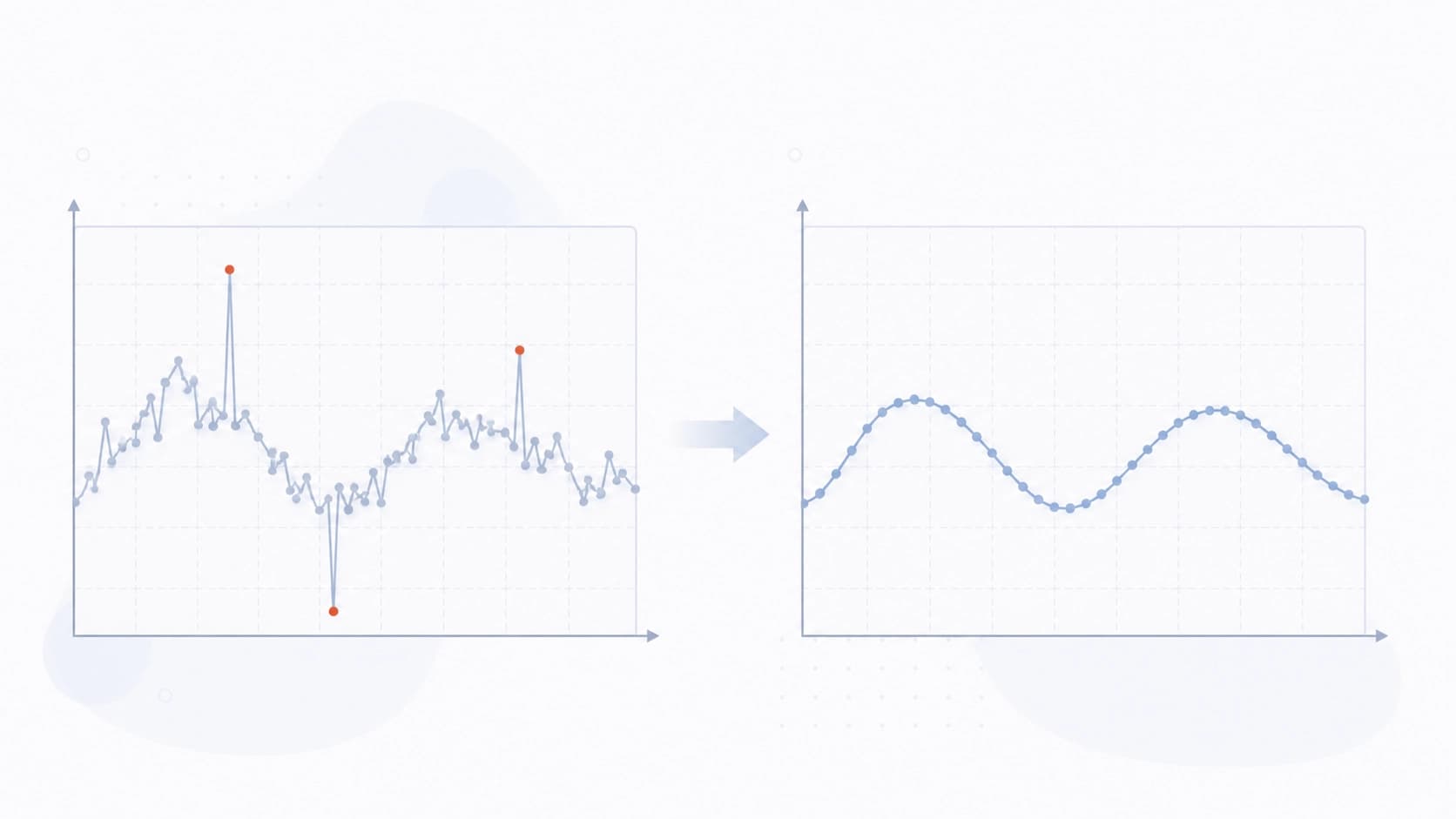
The problem is that real measurements are rarely sterile. A faulty sensor pixel, a corrupted data region, a glare, a flare, an error in a single channel — and an outlier appears in the array: a value that isn't just slightly noisy but outright lies. Conventional solvers treat such a point as an equal peer, and a single anomaly can ruin the entire reconstruction. The more the algorithm trusts the measurements, the greater the damage.
What the authors proposed
The paper "Outlier-Robust Diffusion Solvers for Inverse Problems" (arXiv:2605.09477, cs.CV and cs.AI categories) came from the pens of Yang Zheng, Jiahua Liu, Tongyao Pang, Wen Li, and Zhaoqiang Liu. The first version appeared on May 10, 2026, the updated one on August 25; the text was accepted to CVPR 2026, and the authors released the code via a link in the paper.
The logic of the solution is split into two stages. First, the measurement is cleaned up: noise is estimated explicitly, and this estimate is used to weaken its influence without confusing the useful signal with interference. Only then do they move on to tackling the anomalies themselves — on already-cleaned ground, this works more accurately.
An objective that dislikes anomalies
The key trick is to reformulate the problem as iteratively reweighted least squares, relying on the Huber loss function. The point: a quadratic penalty for a large deviation grows very quickly and therefore gives an outlier disproportionately large weight. Huber behaves differently — for small errors it is soft, like a square, but for large deviations it switches to linear growth, meaning it effectively stops inflating the contribution of a single "lying" point. Reweighting adds dynamics to this: the weights are recalculated as the solution progresses, and suspicious measurements gradually lose their say.
Two ways to solve the optimization
A robust objective requires its own solver. The authors propose a gradient descent variant — it finds the optimum approximately but drags along an unpleasant dependence on the learning rate: choosing it well isn't always possible, and a poor choice hurts stability.
That's why the paper offers a second path — a conjugate gradient method with a special update strategy. It avoids the painful step-size tuning and makes the procedure more practical.

What the experiments showed
The method was tested broadly: several image datasets, linear and nonlinear formulations, various measurement conditions. The conclusion from the experiments is twofold. First, the proposed solvers hold up where the data contains outliers — that is, they remain functional precisely in the scenario that breaks the competitors. Second, in most cases they also outperform recent diffusion model-based methods in reconstruction quality.
It's worth noting separately that this isn't about a single lucky task. The combination of different types of inverse problems and different levels of distortion shows that the improvement isn't tied to a single scenario but manifests systematically.
What this changes in practice
The value of the work lies in a shift of focus. Most of the effort in the field goes into making diffusion priors more accurate and faster; here, the authors remind us that the real world delivers data with defects, and a solver must account for that. The techniques they use aren't exotic: explicit noise estimation, a robust loss function, reweighting, conjugate gradients. The gain comes from their careful assembly into a single pipeline.
For applied scenarios — medical imaging, remote sensing, restoration of old photos and videos — this is an important shift. Where a single corrupted data fragment used to ruin the entire result, there is now a chance to obtain a correct reconstruction.
Bottom line
The problem the authors solve sounds almost mundane: teach a diffusion solver to ignore gross anomalies in measurements. But it's precisely such details that determine whether a method from a paper reaches real-world application. The combination of explicit noise estimation with a robust objective based on the Huber loss and two optimization variants is a clear and reproducible recipe, and acceptance to CVPR 2026 plus open code make it available for anyone to verify.
Frequently asked questions
Related materials
All materials
Step-by-Step Evaluation of GUI Agents for Dashboard Analysis: The DashAct Benchmark
Introducing DashAct, a benchmark of 348 human-verified trajectories that breaks down GUI agents’ work with interactive dashboards into three stages and four visual conditions. The results reveal persistent issues with action prediction and visual target grounding, as well as agents’ reliance on contextual and spatial support.
11 November 2026
WILSON: combining magnifications and patient slides for pathomorphological analysis and report generation
The preprint introduces WILSON, a vision-language model that encodes images of whole slides and series of slides from a single patient at different magnifications, rather than just a single “best” slide. Without task-specific fine-tuning, it outperforms specialized and larger slide models on a range of metrics while requiring substantially less compute, and its diagnostic descriptions received higher ratings from pathologists.
11 November 2026
Canonical Polynomial Invariants for Diagnosing RL Simulator Failures: Where Are They Actually Useful?
The study examines whether incorporating physical laws into learnable dynamics models is justified: invariants extracted from trajectories and reduced to canonical form using Gröbner bases yield modest forecasting gains, but prove powerful for diagnostics, enabling the localization of violated constraints and identification of specific erroneous parameters.
10 November 2026