
OpenAI promises its Jalapeño chip will be faster and more cost-efficient than competitors' solutions
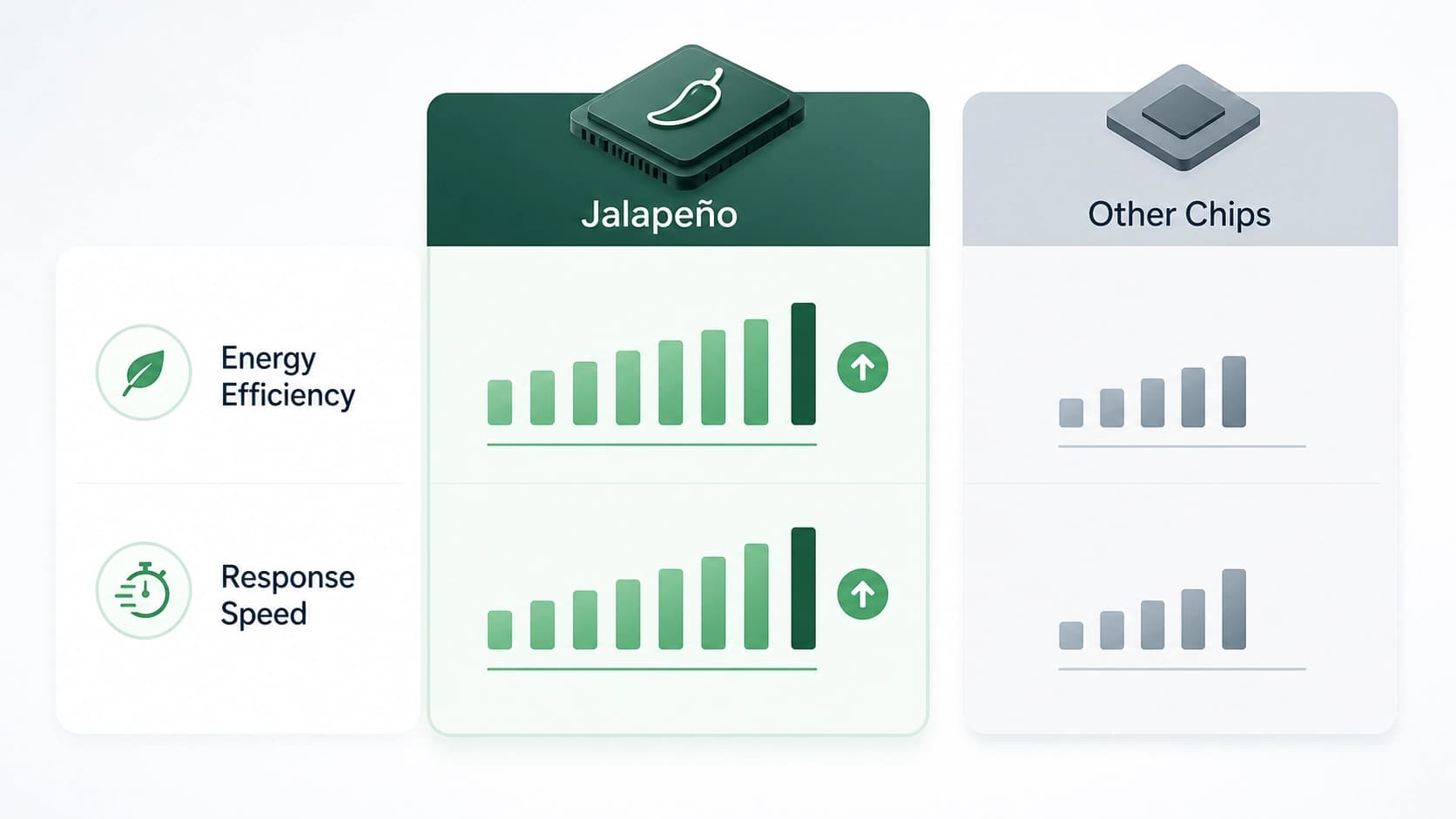
The company claims that its inference processor developed with Broadcom outperforms Nvidia accelerators in energy efficiency and response speed in tests on several AI models. They plan to deploy the chips in small volumes by the end of the year, but do not intend to fully replace their Nvidia fleet.

OpenAI bets on the Jalapeño chip: faster, more cost-effective, and almost ready for sale
When it comes to deploying large language models, engineers constantly have to strike a balance: either the system responds very quickly but struggles to handle the flow of requests, or it can process huge loads, but at the cost of noticeable delays. At OpenAI, they are confident they have found a solution that removes this contradiction. The company's own chip, named Jalapeño, according to its developers, demonstrates both low latency and high throughput. According to OpenAI's Vice President of Hardware, Richard Ho, the new product offers "the best of both worlds."
Jalapeño is not a general-purpose processor, but a custom application-specific integrated circuit (ASIC), created in partnership with Broadcom. The chip is tailored for a specific task — inference, that is, the direct execution of trained models to perform tasks and run agents. Announced back in June, it has now received its first official test results, which the company does not hesitate to call revolutionary.

What the performance tests showed
To evaluate the chip's capabilities, OpenAI used its own benchmark platform, InferenceX. The best recorded results on Nvidia's GB200 and GB300 superchips were used as a comparison baseline. The tests were conducted on three popular models: GPT-OSS 120B, DeepSeek R1, and Kimi K2.5 1T.
The company claims the results were impressive. Depending on the model, Jalapeño delivered 1.5–1.9 times more computations per watt than competitor systems. Simply put, this means that for every kilowatt of energy consumed, the new chip performs significantly more useful work. This is critically important in an era when electricity bills for data centers are becoming one of the main expense items.
Even more noticeable is the difference in response speed. End-to-end latency on the three tested models was 1.7–3.6 times lower compared to baseline systems on Nvidia chips. In practice, this translates into faster assistant responses, more responsive AI agent actions, and stable access to services even under peak loads. The faster a model processes a request, the less time the user has to stare at the "typing" indicator.
Strategy: not a replacement, but a complement
Despite such rosy figures, OpenAI does not intend to abandon its collaboration with Nvidia. Richard Ho emphasizes that the company's overall computing strategy involves using a wide range of partners, and Nvidia remains one of the key ones. Jalapeño will not replace the existing fleet of chips, but rather become an important element in scaling infrastructure.
The first generation of the chip is planned to be deployed in "small volumes" before the end of this year. Full-scale capacity expansion will begin in 2027. The company deliberately does not disclose the exact number of chips it plans to deploy next year. Meanwhile, work is already underway on the second and third generations of Jalapeño, which indicates the long-term nature of this direction — unlike many experiments that never reach the practical stage.
The success of this project could significantly reduce the dependence of large AI model operators on a limited number of chip suppliers. Custom ASICs allow for a more precise alignment of the architecture with OpenAI's specific algorithms and workloads, saving resources and accelerating the time-to-market for new products.

Frequently asked questions
Related materials
All materials
Chern–Simons Reservoir Memory: Autonomous Connectivity Dynamics and Density Transport
The article explores how a reservoir preserves the history of input signals both in its density distribution and in its geometric degrees of freedom. A comparison of four mechanisms shows that current creates a separate connected component that alters the subsequent density response, while accounting for all measured features yields a small improvement in decoding pulse order.
10 November 2026
Validating Candidates Costs More Than Generating Them: Honeypots Against LLM Vulnerability Hunting
The study examines the cost asymmetry in agentic vulnerability discovery: generating candidate versions is cheap, while confirming them through reachability analysis, execution, and PoC development consumes most of the budget, making verification a potential standalone target for defense. The proposed RedHerring—repository-adapted decoys with a hidden certificate—reduced the number of real vulnerabilities found by 38.7–60.4% at equal cost across 33 OSS-Fuzz projects; even after the agent was warned, the reduction remained at 37.2%.
9 November 2026
Checking LLM Hallucinations via SQL-Based Source Representation Without Fine-Tuning
The study examines whether an LLM can apply a basic symbolic skill—building a SQL database from source documents—to ground its outputs in sources without supervision when detecting hallucinations. On RAGTruth and DiaHalu, this neuro-symbolic pipeline proves more accurate than direct prediction and comparable to state-of-the-art methods, without requiring domain-specific fine-tuning.
9 November 2026