
OpenAI’s “jalapeño” chip impressed in first tests: high speed and low power consumption
Early tests of OpenAI's specialized processor showed that it outperforms competitors in throughput and latency when working with modern AI models, while consuming less energy. Such characteristics promise to accelerate inference and reduce its costs.

The pepper that burns GPUs
Not long ago, it seemed that producing chips for artificial intelligence was the domain of giants like NVIDIA, Google, or Amazon. Judging by recent leaks, OpenAI now appears ready to join this club. Under the codename "jalapeño," the company's engineers are testing their own accelerator designed for neural network inference. The first results, it is reported, have been so successful that the lab is already planning large-scale batches for its data centers.
Usually, announcements of specialized hardware take place at conferences and seminars, but information about the "jalapeño" tests was spread by industry media citing anonymous sources. However, patent activity and OpenAI's open vacancies in hardware design had already indicated earlier that real engineering work lay behind the rumors.
A chip tailored for OpenAI's future
Developing your own chip only makes sense if you want to optimize the most expensive link in your product. In the case of language models, that is inference — the moment when thousands of users send requests simultaneously. Each such request requires a huge number of matrix multiplication operations. Modern GPUs handle this task equally well for both training and inference, but training happens rarely, while inference happens constantly. So, the time has come for a tool tuned specifically for continuous workloads.
"Jalapeño" is not a universal processor. You cannot run ordinary applications on it, but it is perfectly suited for neural network workloads. Its architecture is simplified to a set of specialized cores that primarily perform matrix multiplication operations and handle the attention mechanism — the foundation of transformers and large language models.
Why the pepper?
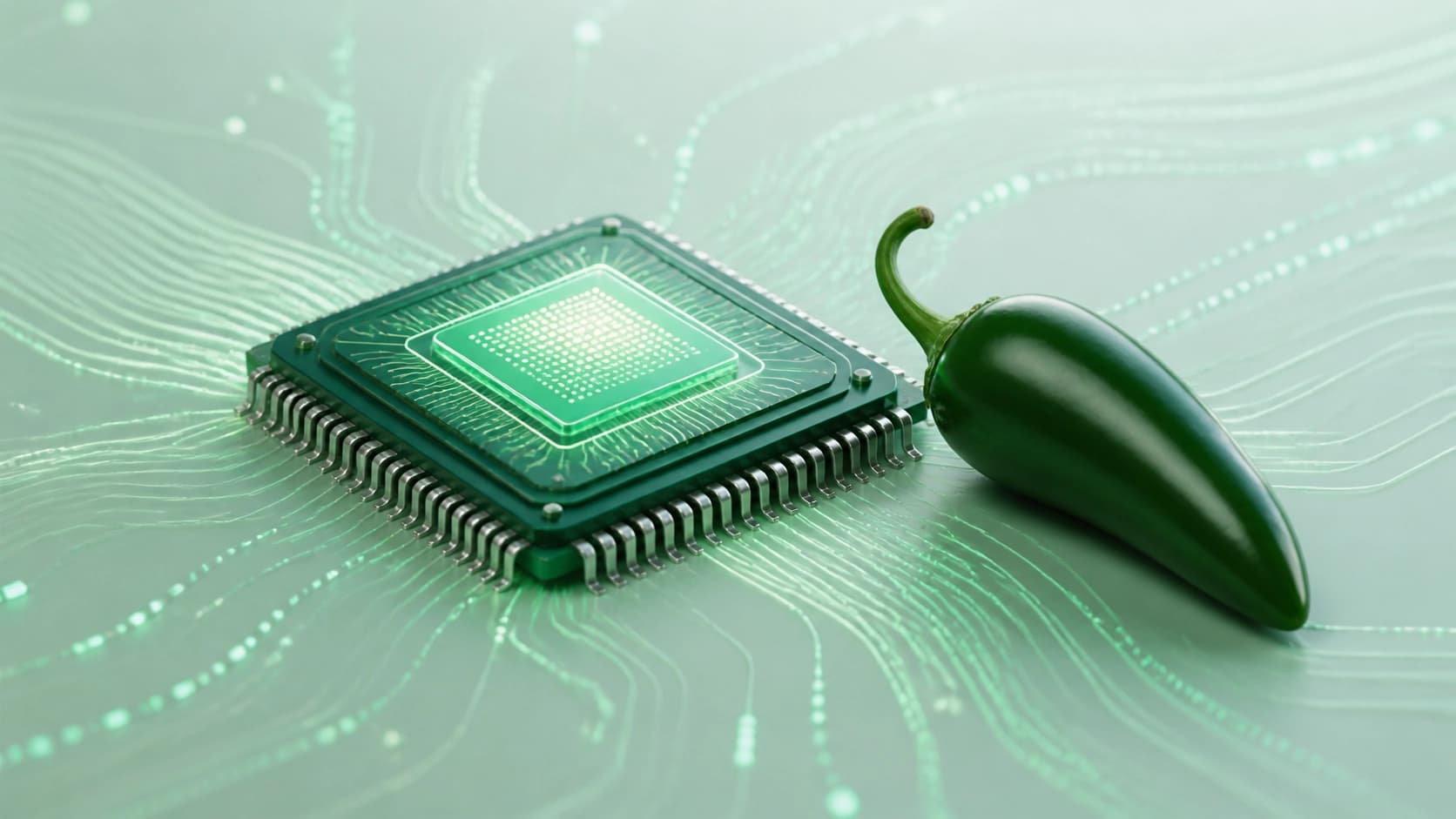
Company employees like to give projects informal codenames. "Jalapeño" — a hot pepper — hints at the chip's ability to heat up the market. The device, of course, has nothing to do with food or Mexican cuisine.
First tests: speed and power consumption
The most interesting data is so far only available secondhand. According to sources, on test workloads the prototype processes requests several times faster than top-tier server accelerators, but the main achievement is energy efficiency. OpenAI's own chip demonstrates a much higher performance-per-watt ratio.
This was achieved through several technical solutions.
- Low-precision computing. Model weights can be stored and processed in an 8-bit format without a visible drop in quality. The chip was designed for such calculations from the start.
- Streamlined pipeline. All instructions are subordinated to a single task, so cores do not waste clock cycles on unnecessary branching and context switching.
- Fast memory. Model weights reside directly on the die, close to the compute blocks, and high-speed connectivity to external memory is provided for larger models.
Power consumption under full load, according to unofficial data, turned out to be significantly lower than that of general-purpose solutions. This means servers will be able to handle more requests without expanding power capacity or cooling systems.
What will change in the AI market?
The success of "jalapeño" could lead to tectonic shifts. The cost of generating text and processing images will drop, making API access cheaper and more accessible for small businesses. New products that are currently economically unviable will emerge: real-time personalized assistants, mass audio and video analysis, and even autonomous agents capable of executing long chains of tasks.

Furthermore, owning a chip strengthens OpenAI's negotiating position with cloud providers. The company will be able to shift part of its workload onto its own platform. For users, this will mean fewer outages and more predictable pricing.
We should not forget about the environment either: lower power consumption means a smaller ecological footprint. Especially since data centers already account for a significant share of global carbon emissions.
Open questions
As often happens with big news, "jalapeño" also invites skepticism. Early silicon samples may not be representative: in mass production, clock speeds often drop due to thermal constraints and manufacturing variations. The production cost and target price for customers are unknown — if the price turns out to be high, savings on electricity will not save the day.

The chip's compatibility with popular frameworks is also in question. Most companies use graphics accelerators through high-level libraries like CUDA and PyTorch, and porting code to a new platform takes time. OpenAI will most likely use "jalapeño" in conjunction with its own software stack, but whether to make the chip open to third-party developers is a big question.
Summary
The first bell has rung: the "jalapeño" chip will most likely become a real product, not just an experimental prototype. For now, this is only an engineering story without official specifications or release dates. But if the test results are confirmed, the AI hardware market will face a new strong player capable of rewriting the usual rules of the game. We await official announcements and the first samples.
Frequently asked questions
Related materials
All materials
AURA-Eval: How to Check Whether an LLM Agent Recognized a Risk and Changed Its Next Step
The framework evaluates LLM agents’ behavior not by their final verdict, but by how they respond to risk at key decision points: tool-call trajectories are interrupted, after which the model must continue reasoning and acting, while a panel of LLM judges assesses risk detection, the nature of the step, and its safety. Across 1,249 tasks drawn from 157 R-Judge trajectories, unsafe actions become more frequent among 20 models when no safe path is available, and removing oversight before execution turns 52.3% of initially safe cases into unsafe ones.
10 November 2026
Chern–Simons Reservoir Memory: Autonomous Connectivity Dynamics and Density Transport
The article explores how a reservoir preserves the history of input signals both in its density distribution and in its geometric degrees of freedom. A comparison of four mechanisms shows that current creates a separate connected component that alters the subsequent density response, while accounting for all measured features yields a small improvement in decoding pulse order.
10 November 2026
STAR: Adaptive Normalization of Temporal Context and Service Graphs for End-to-End Incident Management
The STAR framework trains representations from metrics, logs, and traces, using learnable normalization that accounts for multiscale temporal dynamics and dependency structures between services. On two real-world datasets, this pipeline delivers consistent improvements in anomaly detection, failure ranking, and root cause analysis over state-of-the-art baselines.
10 November 2026