
What to use instead of Midjourney: an overview of free image generators
We review five free services that can serve as alternatives to Midjourney: from the Discord bot Blue Willow to open-source Stable Diffusion. We explain how they differ and which tasks they are best suited for.
Midjourney has firmly carved out a niche in high-quality generative graphics, but its main drawbacks are the paid subscription and the lack of free access. For those who want similar results without spending money, there are several worthy alternatives. Below is a selection of services that cover the main use cases, from photorealism to stylization.
Why you should take a closer look at free generators
The paid Midjourney subscription isn't for everyone: beginners who are just trying out neural networks don't want to pay for experiments. Free alternatives often deliver comparable quality, but with limitations on the number of generations or available features. However, they let you figure out which prompts work and develop your own style without financial risk. Below, we'll break down four services that can genuinely be used for free.
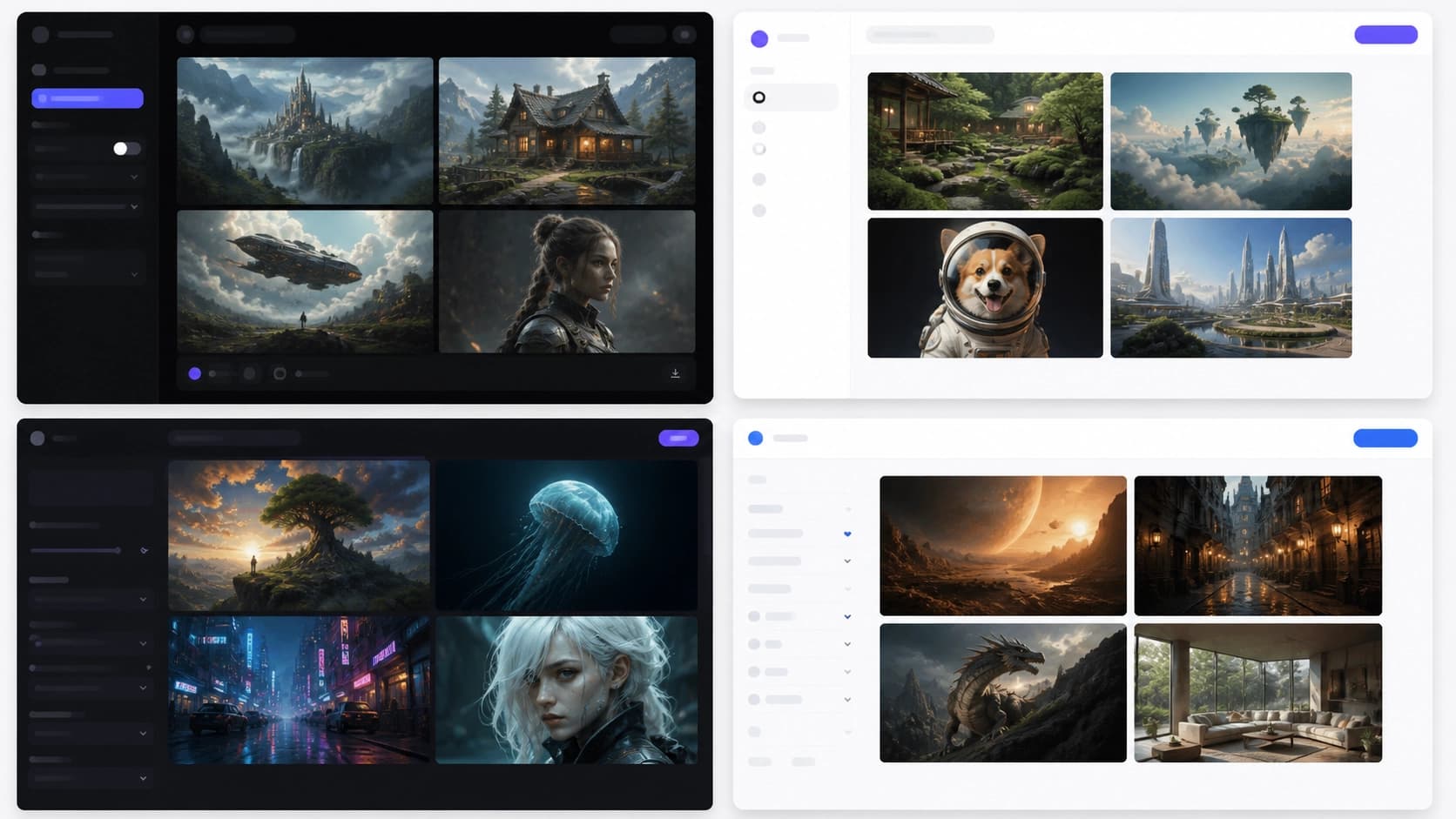
Blue Willow and Stable Diffusion — two sides of the same approach
Blue Willow is a Discord bot that, in spirit and output style, is the closest to Midjourney. Generation happens right in the chat, and the images come out atmospheric and "alive." The downside is that the neural network doesn't always follow the prompt precisely, so detailed requests can be executed with distortions. For quick sketches and concepts, it works great.
Stable Diffusion is the most popular open-source solution. Its main advantage is the open code, which lets enthusiasts constantly improve the model and create new versions. You can run generation locally on your own computer or use cloud builds. Configuration flexibility here is maximal: from choosing a model to fine-tuning steps and samplers. That said, the entry barrier for beginners is higher than with a Discord bot.
Both tools cover the basic needs of free generation, but in different ways: Blue Willow offers simplicity and closeness to Midjourney, while Stable Diffusion offers control and room for experimentation.
Leonardo AI — the most feature-rich free alternative
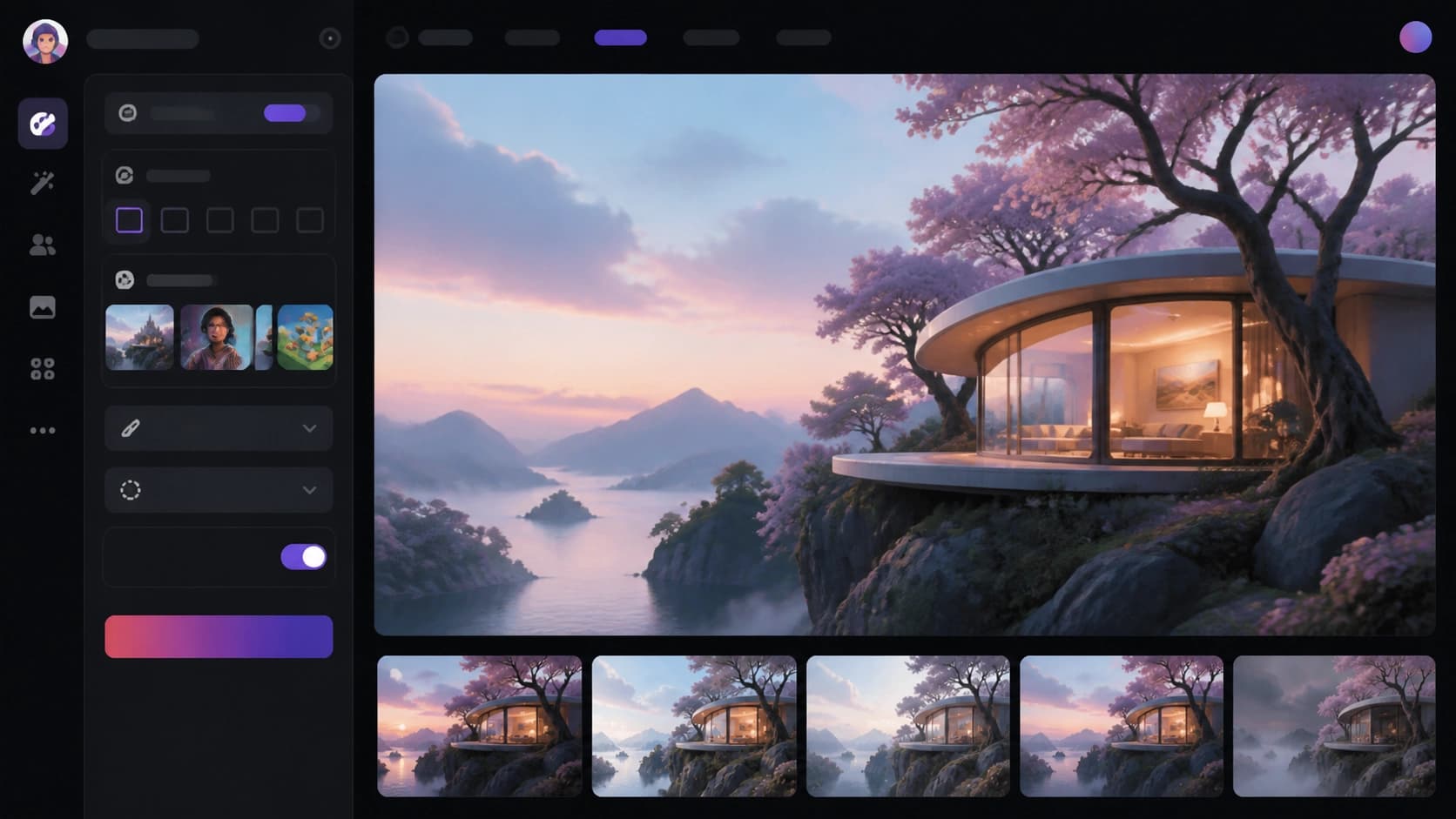
Leonardo AI is often called the best replacement for Midjourney. The service is in open beta, so you can get in, but you'll have to go through a bit of bureaucracy: an access request and a waiting period. Inside, there's a wide range of tools: multiple models, image editing, canvas work, and various styles. It's not just a generator — it's a full-fledged creative platform. Free tokens are allocated daily, and for most tasks, they're enough.
Niche solutions: Dreamlike and Imgcreator
If the services listed above are already familiar and you want something more specific, check out the lesser-known platforms.
Dreamlike is a mix of various models, from Kandinsky 2.1 to rare niche builds. The key feature is the ability to switch between models within a single interface and compare their results. But the free account gives you very few tokens, so active work will require topping up your balance.
Imgcreator is tailored for generating images in anime style. If your tasks involve manga, art in Japanese aesthetics, or characters in that style, the service provides the right settings and presets. Universal generators can also create anime images, but here the result will be more consistent and closer to expectations.
The short version
The choice of a free alternative depends on the task. Blue Willow is for quick, beautiful images without dealing with complex systems. Stable Diffusion is for those willing to dig in and control every step. Leonardo AI offers the optimal balance of functionality and accessibility. Dreamlike and Imgcreator are worth keeping in reserve for niche scenarios. The best way to find your generator is to try all the options and compare the results on your own prompts.
Frequently asked questions
Related materials
All materials
CARAT: Testing Whether Materials Science LLMs Generate Structure or Paraphrase the Prompt
This work proposes a protocol that fixes the question and gold-standard answer across eight ways of presenting structure, while separately marking links in GraphSpace. Experiments with pairwise fine-tuning, target-field masking, and evidence augmentation show that the model can learn both how to apply a relation and how to follow a link, although removing the link reduces accuracy below that of heuristic traversal methods.
27 October 2026
Muse’s launch outperformed ChatGPT’s debut in mobile app stores
According to Apptopia estimates, during its first 12 days on iOS in the US and Canada, Muse received 1.8 million downloads, compared with 1.3 million for ChatGPT; Muse also had more daily users in the US. The comparison is based on third-party estimates and covers different launch conditions: ChatGPT launched internationally from the outset, while Muse was available only in the US and Canada.
15 October 2026
SPARSEUP by Linkup: a sparse encoder with 149 million parameters
The article examines SPARSEUP’s architecture and results: 56.4 nDCG@10 on BEIR-13, as well as over 97% recall when paired with the Seismic index, at approximately 380 microseconds per query. The analysis covers techniques for preserving vector sparsity, comparisons with other models, and the terms of distribution under Apache 2.0.
12 October 2026