
JUMP: single-pass privacy audit in fine-tuned diffusion language models
The new JUMP method determines whether specific records were used during fine-tuning of a diffusion language model: it masks positions with low confidence in the base model and compares the reconstruction with the target model in a single pass. On the MIMIR benchmark, AUROC accuracy increased to 0.902 on LLaDA-8B-Base and to 0.942 on Dream-v0-Base-7B — with three model runs instead of 32 for SAMA.

Privacy Audit of Open Models
Public weights are convenient, but they also create a hidden risk. A company can take an open-weight model and fine-tune it on an internal database: correspondence, medical data, or corporate documents. The user usually does not know which specific records made it into the training set, and for regulators and clients this is a fundamental question. Membership inference — checking whether a sample belongs to the training set — is exactly what answers this: can we tell from the model's behavior whether a specific text was used during adaptation?
The task is complicated by the fact that we usually only have a checkpoint after fine-tuning and the open version of the model before it. By comparing the responses of two checkpoints to the same fragment, one can try to separate the effect of fine-tuning from the model's general behavior.
Features of Diffusion Language Models
Classic LLMs generate text token by token, from left to right. Discrete diffusion language models (dLLMs) work differently: they can restore several masked positions simultaneously. Instead of sequential predictions, the model takes text with an arbitrary set of masks as input and outputs probabilities for all "holes" in a single forward pass.
This capability makes dLLMs particularly interesting for privacy auditing. If you need to check whether the model remembers a specific passage, you can hide some tokens and observe the response. However, the question is which positions to mask and how to interpret the answer.
Why Simple Mask Averaging Does Not Work
The first intuition is to try many different random masks and average the reconstruction error. This is exactly how the old SAMA approach works: the model is run on dozens of random variants, and then the signal is averaged.
This solution has two drawbacks. First, random masks often capture "boring" positions that the model predicts identically even without fine-tuning — the useful signal drowns in noise. Second, each run costs resources: for a single sample, dozens of passes through the model are needed, which becomes an expensive operation at the scale of a large dataset. We need a way to select masks meaningfully, not at random.
Confidence Suggests Where to Mask
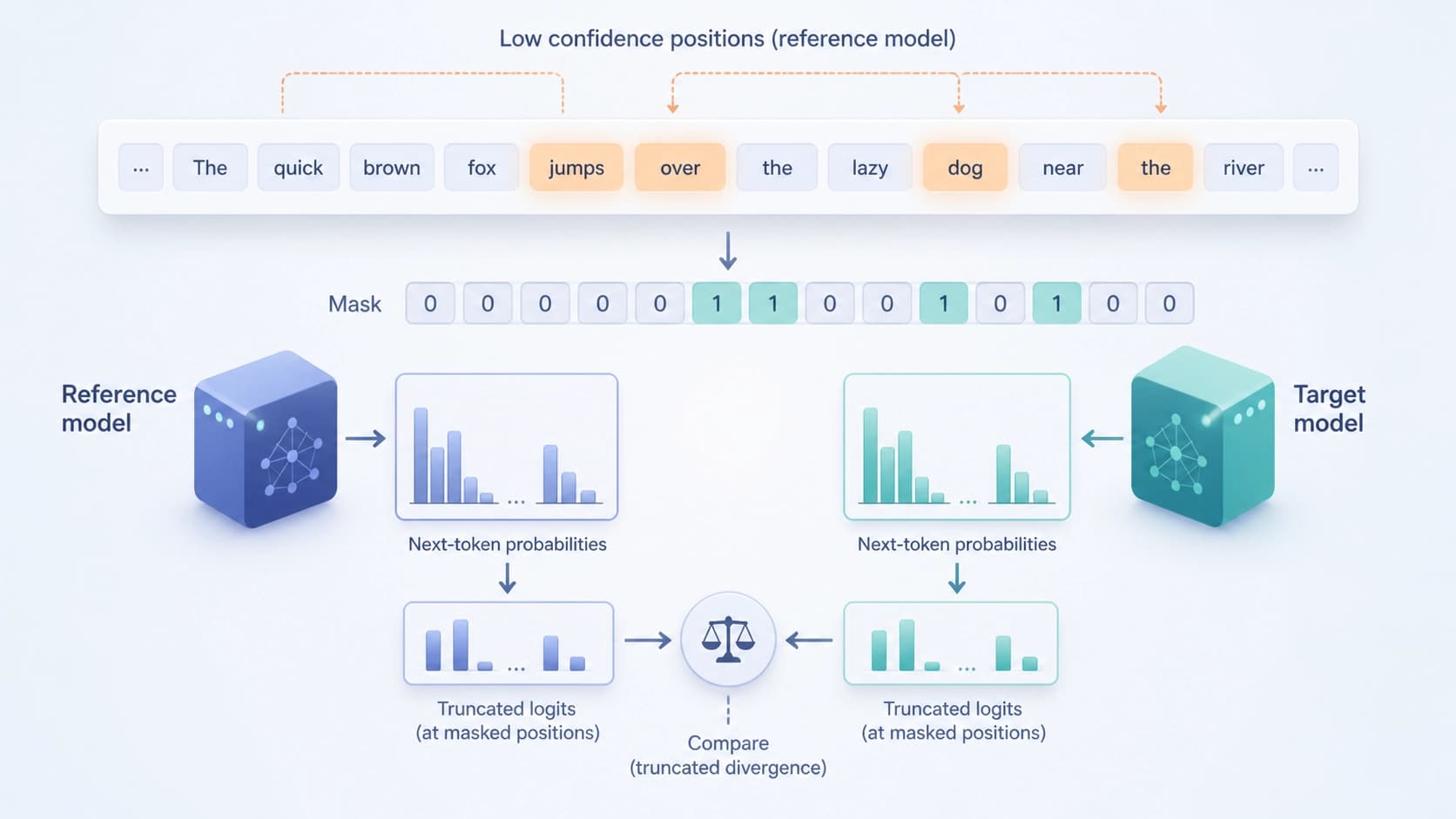
The authors of a new preprint proposed the JUMP (Joint Uncertainty-Guided Mask Probing) method. The idea is to use a reference model — the checkpoint before fine-tuning — as a "lie detector."
First, the reference model is run on the original text to find positions where it is least confident. The assumption is that these are exactly the places that change most during fine-tuning: if specific information flows through these points, the model was forced to learn it. Then these low-confidence positions are masked all together, and the target model reconstructs them in a single request.
Next, the gap between the reconstructions of the target and reference models is compared. To avoid accounting for random deviations, clipping is applied: only differences exceeding a certain threshold are included in the aggregation. This "clipped" gap better separates the true signal from noise, and joint masking of informative positions saves computation.
Results: Fewer Passes — Higher Accuracy
The authors ran their validation on the MIMIR benchmark, which covers six text domains. Two open-weight diffusion models served as test subjects: LLaDA-8B-Base and Dream-v0-Base-7B.
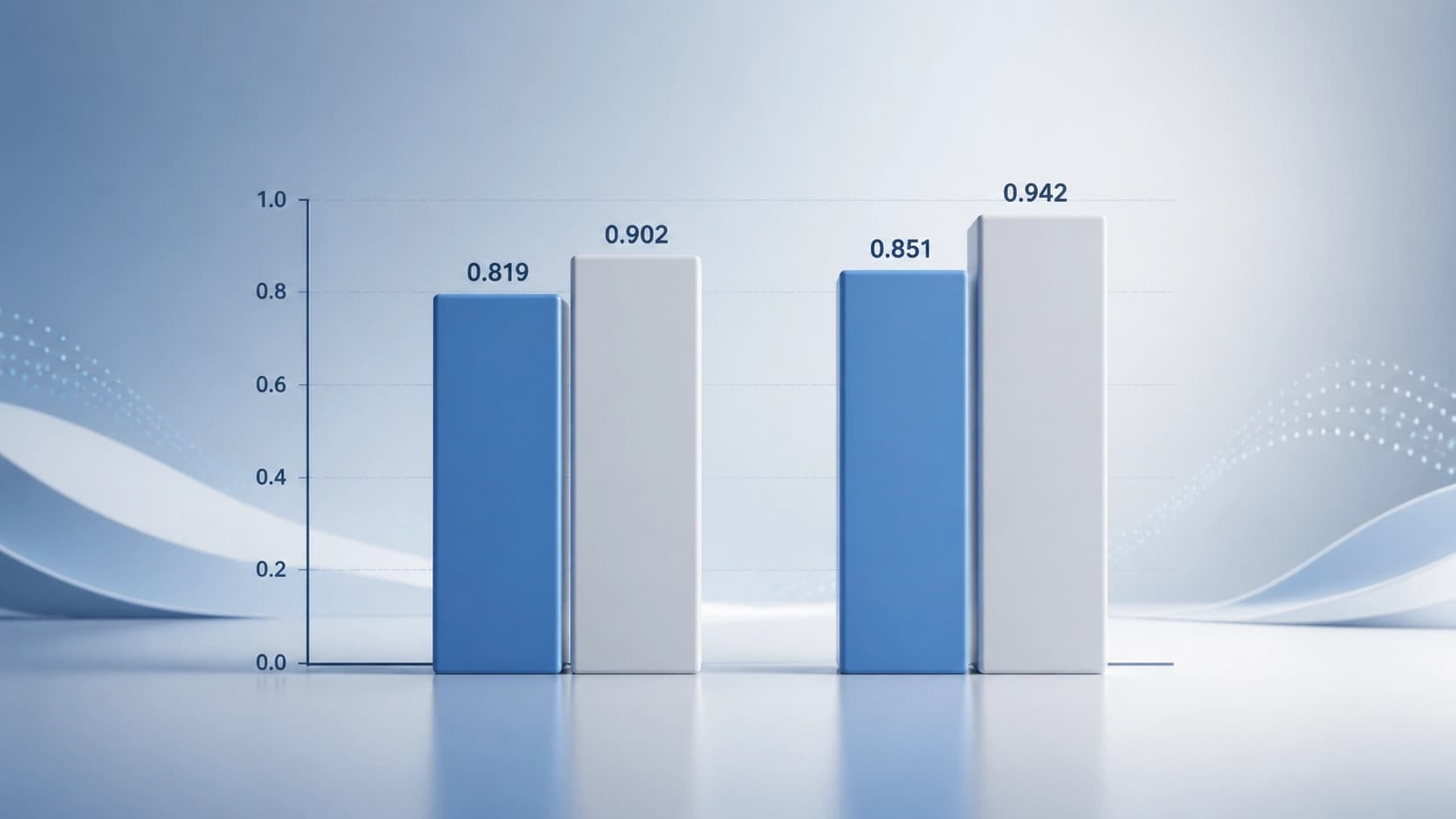
On average across domains, the ROC-AUC metric for LLaDA increased from 0.819 to 0.902, and for Dream — from 0.851 to 0.942. This is a noticeable gain in attribution accuracy. At the same time, JUMP spends only three model passes per sample, whereas SAMA requires 32. In other words, the method is not only more accurate but also roughly an order of magnitude cheaper in terms of the number of inferences.
Practical Significance
The proposed approach shows that auditing fine-tuned diffusion models does not require brute-forcing blind masks. It is enough to ask the reference model where it lacks confidence and direct the check precisely to those areas. This provides a tool that can be used when releasing updates to open-weight models and for verifying compliance with personal data requirements.
The work is still a preprint — 22 pages, current version v2 dated August 18, 2026. That said, the problem statement itself and the strong results suggest the method will see further development: adaptation to other types of diffusion architectures or robustness to more aggressive fine-tuning scenarios.
Frequently asked questions
Related materials
All materials
AURA-Eval: How to Check Whether an LLM Agent Recognized a Risk and Changed Its Next Step
The framework evaluates LLM agents’ behavior not by their final verdict, but by how they respond to risk at key decision points: tool-call trajectories are interrupted, after which the model must continue reasoning and acting, while a panel of LLM judges assesses risk detection, the nature of the step, and its safety. Across 1,249 tasks drawn from 157 R-Judge trajectories, unsafe actions become more frequent among 20 models when no safe path is available, and removing oversight before execution turns 52.3% of initially safe cases into unsafe ones.
10 November 2026
Chern–Simons Reservoir Memory: Autonomous Connectivity Dynamics and Density Transport
The article explores how a reservoir preserves the history of input signals both in its density distribution and in its geometric degrees of freedom. A comparison of four mechanisms shows that current creates a separate connected component that alters the subsequent density response, while accounting for all measured features yields a small improvement in decoding pulse order.
10 November 2026
STAR: Adaptive Normalization of Temporal Context and Service Graphs for End-to-End Incident Management
The STAR framework trains representations from metrics, logs, and traces, using learnable normalization that accounts for multiscale temporal dynamics and dependency structures between services. On two real-world datasets, this pipeline delivers consistent improvements in anomaly detection, failure ranking, and root cause analysis over state-of-the-art baselines.
10 November 2026