
Banana instead of a brush: how Generalist AI robots master tasks from video and adapt on the fly
In the Generalist AI office, robotic arms handled new actions after a short example video: when the brush was removed, the manipulator picked up a banana and swept objects aside. According to the authors, the approach resembles children's learning through intuitive understanding of physics, without thousands of repetitions.
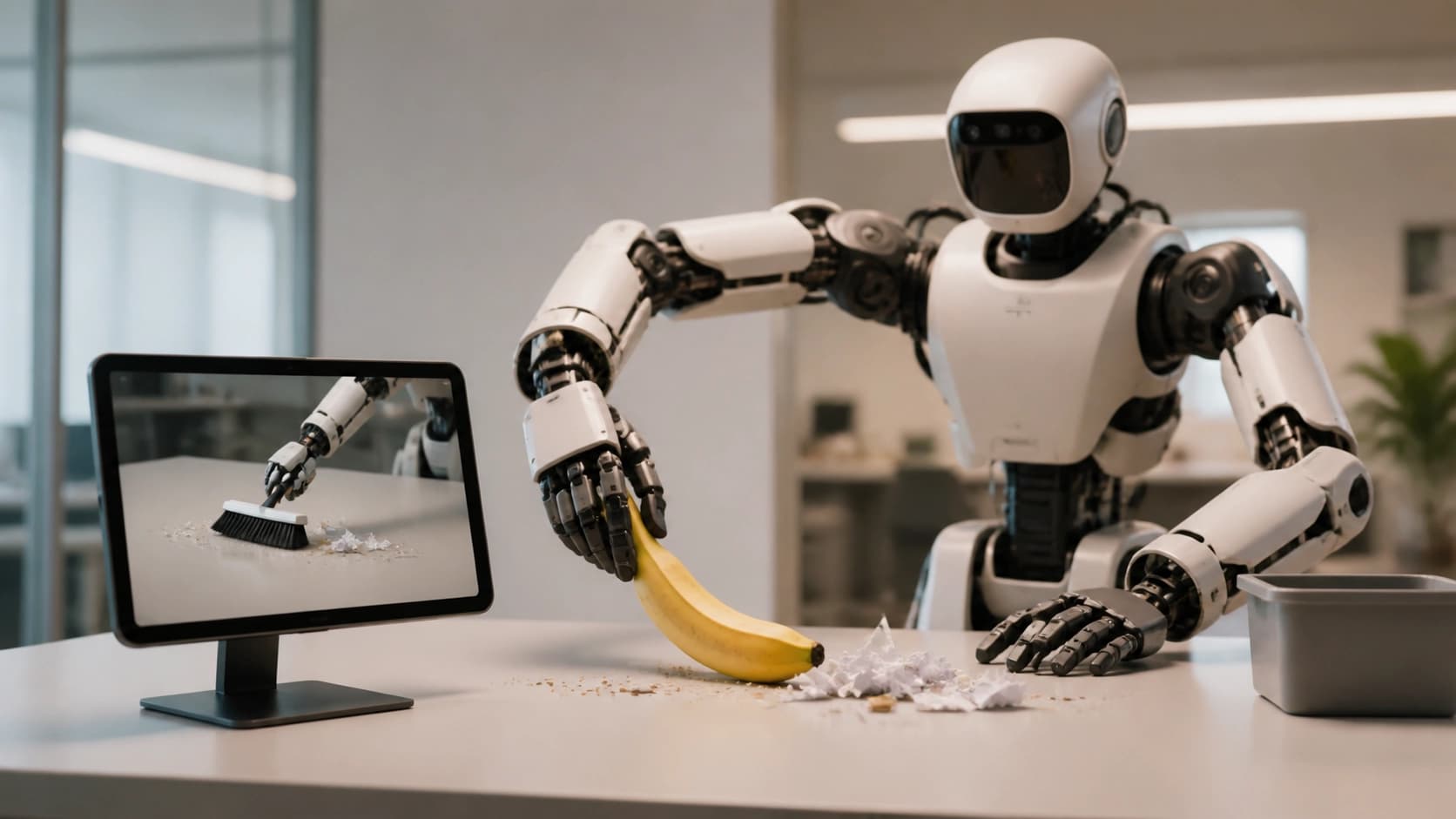
Robots usually aren't flexible: thousands of repetitions for a single motion, and any change in lighting or object shape can break a skill. The startup Generalist AI from Cambridge, Massachusetts, is trying to flip that logic. Instead of lengthy training on examples, the machine only needs to see a short video once — and it's ready to act in similar, but not identical, conditions. It's somewhat reminiscent of how a child copies adult behavior without even realizing it's learning.
Video as instruction: what robots learn "in one take"
The author, who visited the company's lab, witnessed an unusual sight. Manipulators were set up for a specific operation without any prior preparation: they handled cups, stacked them, moved blocks from one bowl to another. All that was needed was a short video demonstrating the action, after which the robot began working with objects new to it.
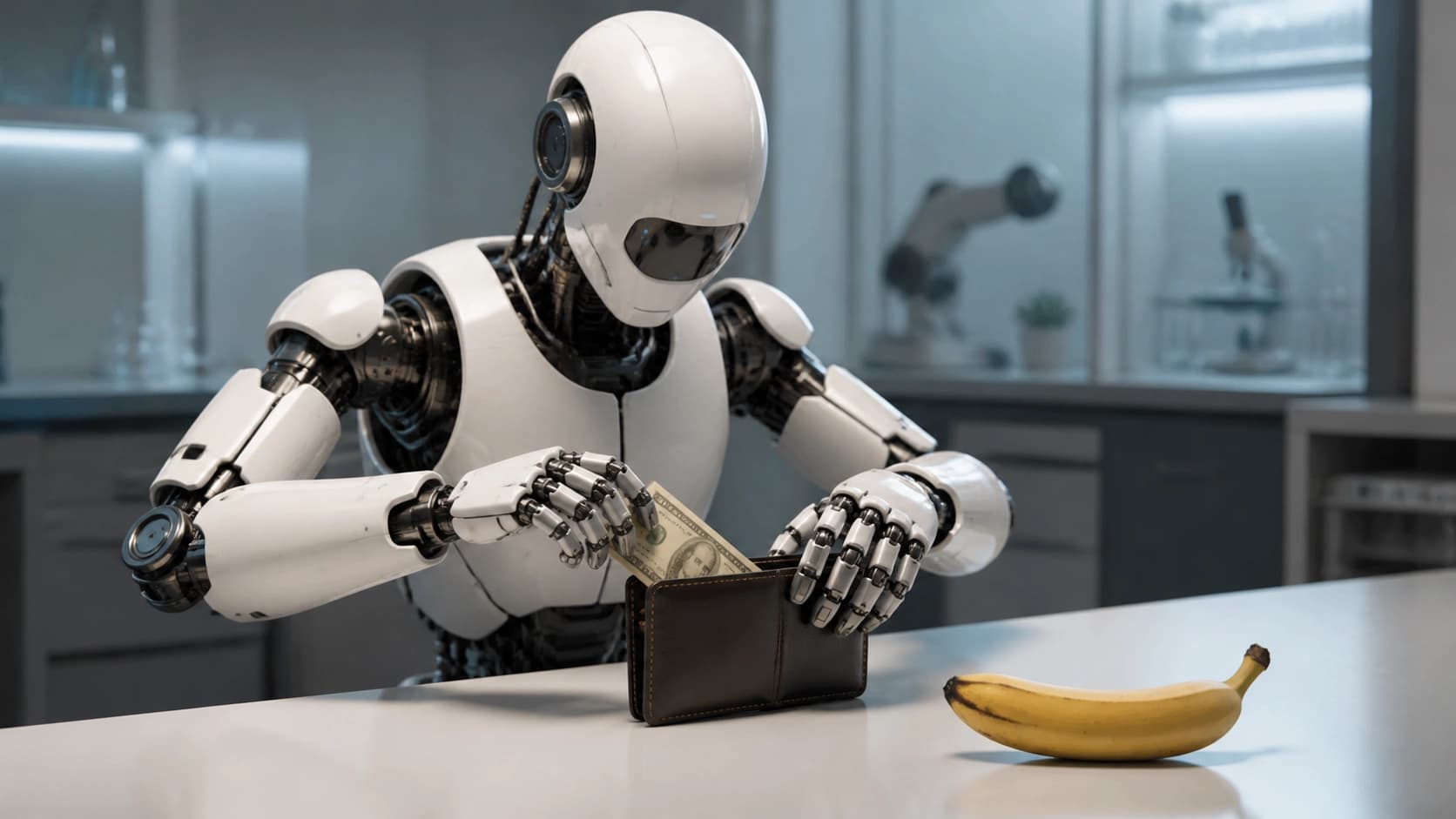
Some episodes look almost like little miracles of engineering. For example, a robot was tasked with pushing a block into a bowl, given a brush and a dustpan to help. When the brush was removed, the machine didn't stop — it adapted the dustpan for the purpose, grabbed it, and used it like a brush, successfully completing the task. Another case involved a dual-arm manipulator. It watched a video of a person unzipping a wallet and pulling out paper bills. The robot handled a different wallet perfectly, and when its right arm couldn't grip the banknote, it switched to the left, adjusted the angle, and finally retrieved the money.
Why it works: betting on "physical imagination"
Generalist AI CEO and co-founder Pete Florence compares his robots' behavior to GPT-3. A language model only needs a new task to be posed to find a solution without special training. Roughly the same happens with robots, but adjusted for the physical world: they don't just need to generate words, but to coordinate movements accounting for object physics. A dustpan can replace a brush, a wallet can open differently, and a banana can become a sweeping tool.
The last case actually happened: a banana was placed in front of the robot, and without missing a beat, it started sweeping parts off the table with it. It looked funny, but behind it lies an important idea — the system learns not a specific motion, but an intuitive sense of physics that humans have from birth. That's what the founding team is betting on: Pete Florence, Andrew Barry, and Andy Zeng previously worked at Google DeepMind and Boston Dynamics, and now they're building models capable of understanding the "behavior" of things in space.
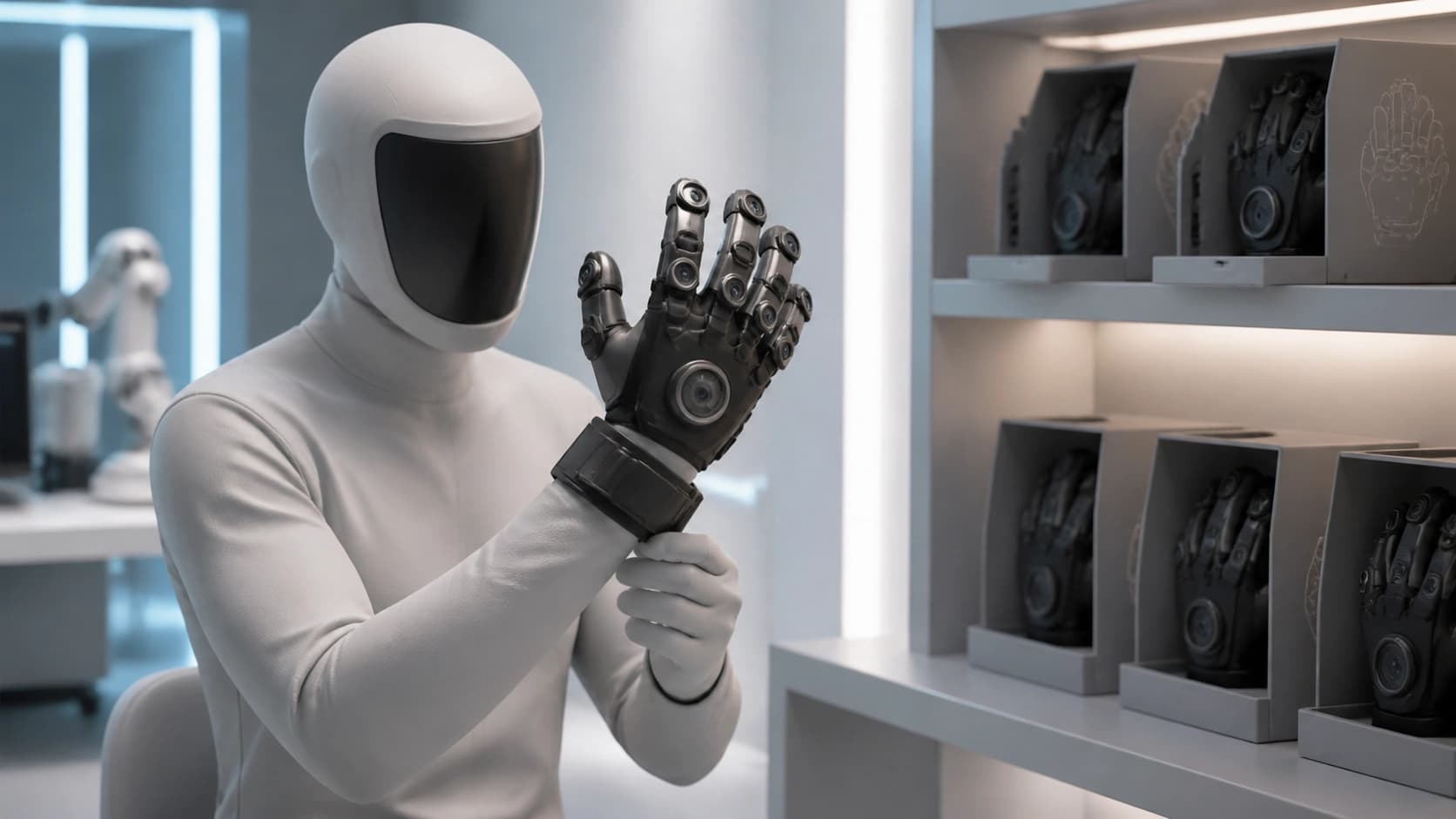
The secret to such understanding is a huge amount of quality data on physical interactions. To collect it as efficiently as possible, Generalist AI created special gloves resembling robot claws. They have cameras built in, and the gloves are designed for humans: operators around the world, including in Mexico, perform everyday household or industrial operations, and the system turns those recordings into training material. The author was even shown a box containing hundreds of such gloves, ready to be shipped to data collectors. At the same time, the company builds its neural networks from scratch, deliberately forgoing ready-made open language models.
Reliability, skepticism, and prospects for industry
The creators don't hide the weak points. Right now, the robot successfully completes a demonstrated task in about 59% of cases on average. That's far from industrial standards, which require reliability above 99%. It's unclear how well skills will transfer to completely unfamiliar scenarios, or how the model will behave under sudden changes in conditions. But the work done already impresses outside experts.
Danfei Xu, a roboticist at Georgia Tech, says Generalist AI is the closest of all companies developing general-purpose robotic models to real commercial application. In his words, the team pushed their idea to the extreme and executed it well, gathering a colossal volume of good data. Karen Liu from Stanford adds that the company's approach is interesting because data is collected at massive scale and isn't tied to any single robot design. That makes training resemble an open platform rather than a one-off trick.
The potential benefit for manufacturing is enormous. Imagine a conveyor line that can be instantly switched from packing bottles to assembling parts — you'd just show the robot a short video. No lengthy retooling, no programming of manipulations.
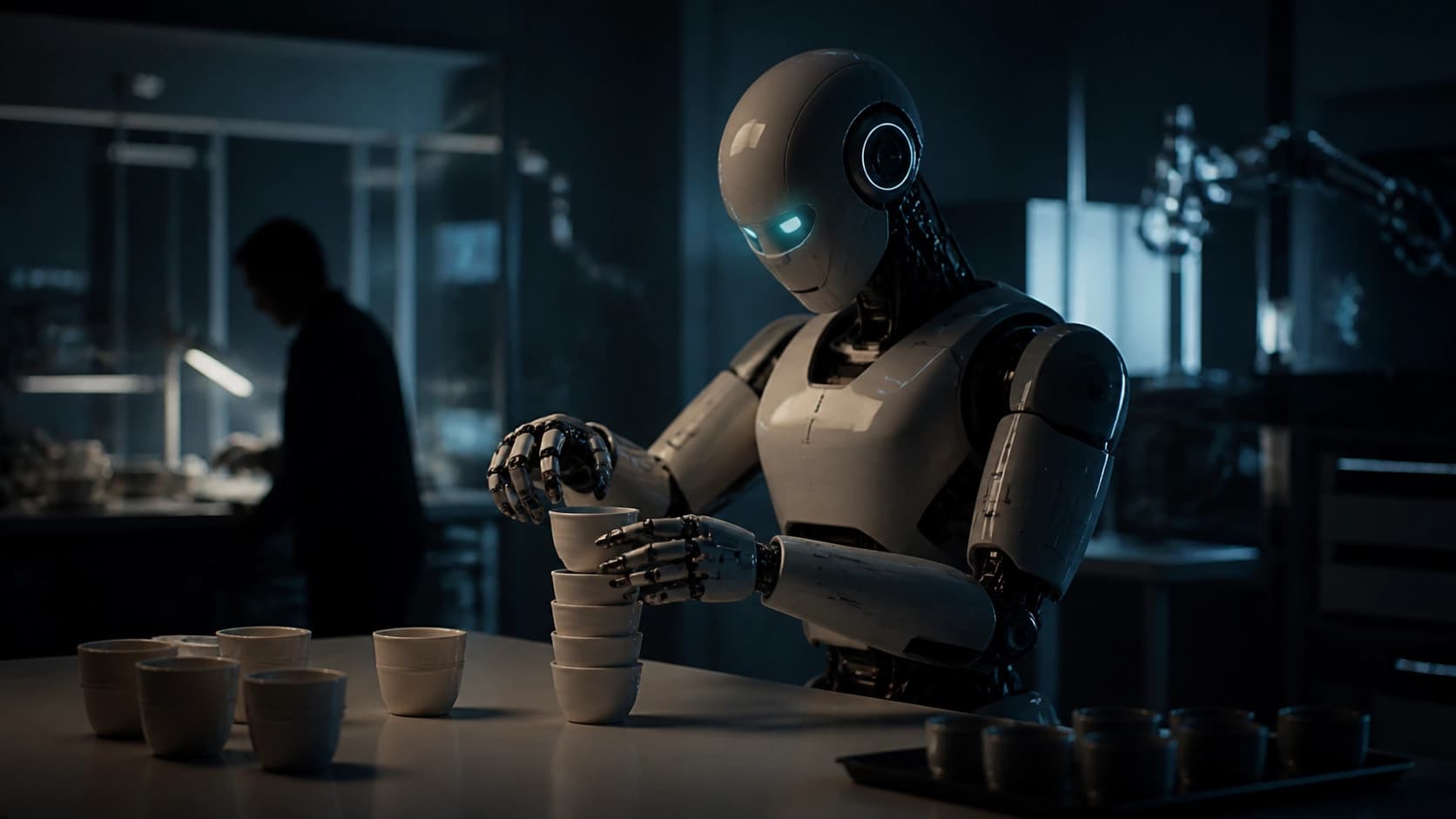
Perhaps the most telling episode was filmed late in the evening at the startup's office. An engineer was manually placing small cups in front of a dual-arm robot. Suddenly, the manipulator, without waiting for a command, began grabbing cups and stacking them neatly after the human. That spontaneous action — simple and fleeting as it was — suggests the machine is moving beyond being a soulless executor of instructions. And perhaps it's exactly that kind of "initiative" that will become the breakthrough bringing robots out of factory cages into the real world.
Frequently asked questions
Related materials
All materials
Step-by-Step Evaluation of GUI Agents for Dashboard Analysis: The DashAct Benchmark
Introducing DashAct, a benchmark of 348 human-verified trajectories that breaks down GUI agents’ work with interactive dashboards into three stages and four visual conditions. The results reveal persistent issues with action prediction and visual target grounding, as well as agents’ reliance on contextual and spatial support.
11 November 2026
WILSON: combining magnifications and patient slides for pathomorphological analysis and report generation
The preprint introduces WILSON, a vision-language model that encodes images of whole slides and series of slides from a single patient at different magnifications, rather than just a single “best” slide. Without task-specific fine-tuning, it outperforms specialized and larger slide models on a range of metrics while requiring substantially less compute, and its diagnostic descriptions received higher ratings from pathologists.
11 November 2026
Canonical Polynomial Invariants for Diagnosing RL Simulator Failures: Where Are They Actually Useful?
The study examines whether incorporating physical laws into learnable dynamics models is justified: invariants extracted from trajectories and reduced to canonical form using Gröbner bases yield modest forecasting gains, but prove powerful for diagnostics, enabling the localization of violated constraints and identification of specific erroneous parameters.
10 November 2026