In early 2025, Black Forest Labs introduced a new image generation model, FLUX.1 Kontext. It quickly spread across social media and reviews: bloggers are showing how the model handles composition, style, and speed. The hype around it is comparable to the releases of the most anticipated neural networks, so we decided to check how justified this buzz is. To understand whether it has a real advantage, we ran identical scenarios through four key models: Midjourney V7, GPT-4o Image, Ideogram 3.0, and FLUX.1 Kontext itself.
How we tested
We formulated the same prompt for each model and evaluated the result against four criteria. This is not a lab study, but a practical comparison that replicates typical tasks for a designer or content creator.
Here is the list of checks:
- maintaining the same character across different scenes;
- making targeted changes to individual details without affecting the rest of the image;
- transferring the style of a famous artist;
- generation speed.
Character consistency
When you create a series of illustrations or a storyboard, the hero should not "change face" from frame to frame. If the character falls apart between scenes, the narrative is lost, and the viewer cannot connect the images into a single story. Therefore, character stability is critical not only for art, but also for advertising campaigns, comics, and animatics.
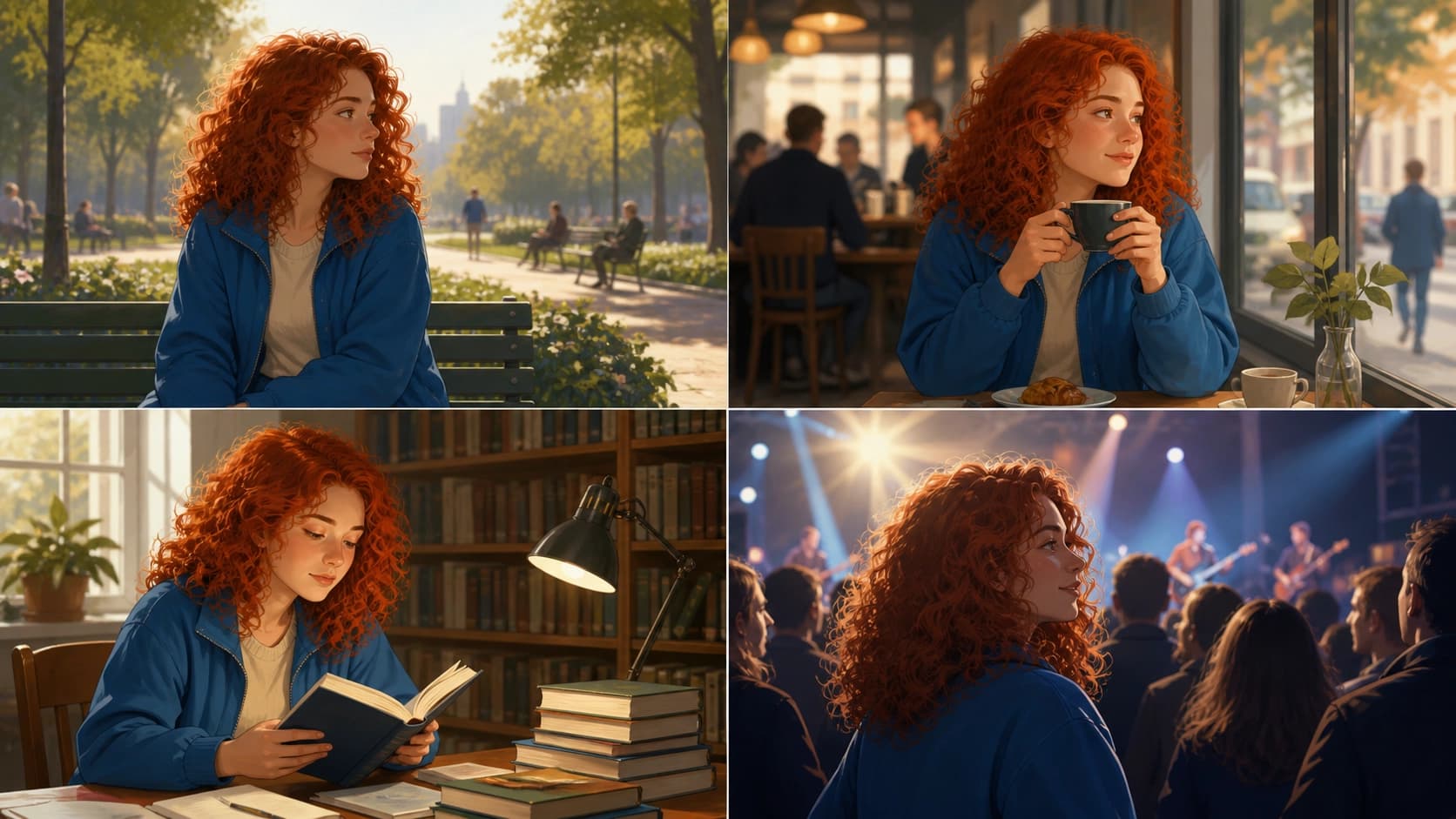
We asked the models to depict a young woman with red wavy hair in a blue jacket. She was supposed to appear in a city park, then in a café, in a library, and at a concert — in the same outfit.
FLUX.1 Kontext passed the test better than the others: facial features, hairstyle, and jacket remain recognizable across all scenes. Midjourney V7 was close to this, but by the last scene it lost character consistency. GPT-4o Image preserves the look quite well, but there are slight discrepancies in facial details. Ideogram 3.0 performed the weakest: the heroine literally jumps between styles — sometimes looking like a cartoon character, sometimes almost photorealistic.
Local editing
The second important task is to make targeted corrections to an image without redrawing it entirely. Such editing saves time and resources, especially when you need to quickly make changes to an already finished visual. But if the model also changes other elements, the point of such a feature is lost.
First, we generated a photo of a cat on a windowsill, then asked to change the collar color to red, add a gold bell, and place a vase with sunflowers next to it.
FLUX.1 Kontext performed the edits correctly: the collar, bell, and vase appeared where they should. However, the image changed more than we would have liked — the cat turned its head slightly compared to the original. GPT-4o Image also handled it, but introduced extra color changes, making the image look different. As for Midjourney V7 and Ideogram 3.0, at the time of testing they did not offer local editing capabilities, so we could not fully compare them here.

Style transfer
Artistic style helps create images tailored to a specific brand, mood, or era. Good style transfer is not simple color grading, but a true "redressing" of the scene in a new manner. This technique is often needed in branding, fashion shoots, and social media design.
We asked the models to show a dog running across a field in the style of Van Gogh's "Starry Night." Midjourney V7 delivered the best result — the style is conveyed expressively and very close to the original. FLUX.1 Kontext comes in just slightly behind, reproducing Van Gogh's characteristic brushstrokes and palette excellently. GPT-4o Image gives a good but less vivid stylization, while Ideogram 3.0 clearly loses in this test.
Speed
Generation time is critical when working with large volumes of content. If you need to run dozens of variants for A/B tests or quickly put together a series of posts, every second counts. Here the leader is obvious:
- FLUX.1 Kontext — 3–5 seconds;
- Ideogram 3.0 — 10–15 seconds;
- Midjourney V7 — 15–20 seconds;
- GPT-4o Image — 20–25 seconds.
So, the fastest participant can deliver results four to five times faster than the slowest one. This is especially noticeable when you need to generate not just one image, but a whole batch.

What to choose?
There is no clear winner for every case, but the overall direction is clear. Let's summarize the results in a table:
| Model | Character | Local edits | Style | Speed |
|---|---|---|---|---|
| FLUX.1 Kontext | Excellent | Good | Good | Excellent |
| Midjourney V7 | Good | Unavailable | Excellent | Good |
| GPT-4o Image | Good | Good | Good | Average |
| Ideogram 3.0 | Weak | Unavailable | Average | Average |
FLUX.1 Kontext looks like the most balanced solution. It is fast, holds the character well, and confidently handles local edits and stylization. This set makes it a convenient all-rounder for content creators, designers, and marketers who need fast and accurate generation.
At the same time, for specific tasks, the leaders may differ. If expressive artistic style is the priority, Midjourney V7 is worth a look. If precision with details and text matters, GPT-4o Image will be useful. And Ideogram 3.0 still lags on key parameters, although it does have its own features that were not included in this comparison.