
FILT3R fine-tunes latent memory updates for long-term 3D reconstruction
The authors introduce a filter that requires no additional training: it estimates the uncertainty of latent tokens and adjusts how much new frames are taken into account. This approach helps preserve accumulated information and respond more quickly to changes in the scene, improving the stability of depth, pose, and 3D structure estimates.
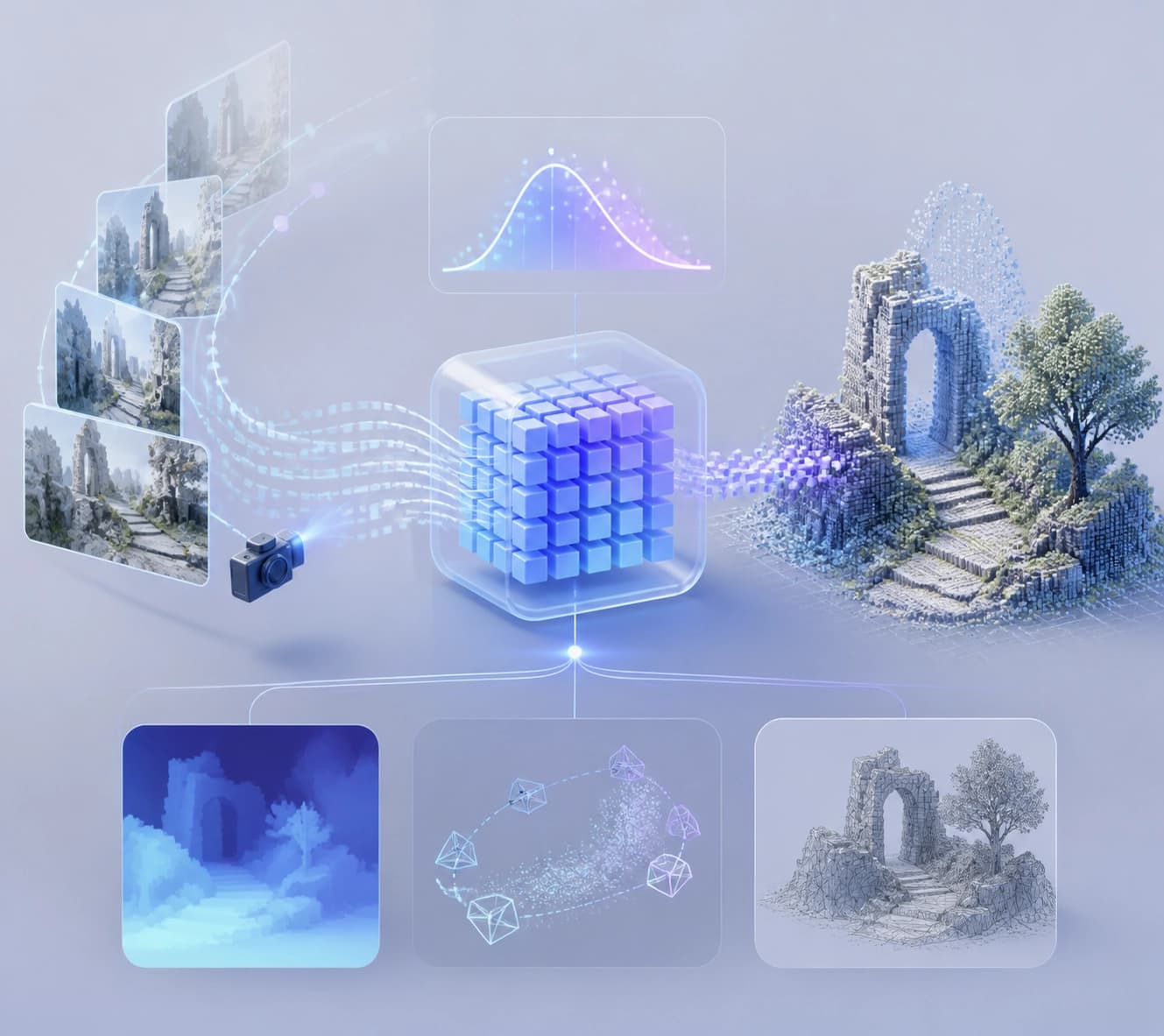
Why Memory Updates Become a Problem
In streaming 3D reconstruction, the system maintains a latent state and updates it as frames arrive. This approach supports inference with a constant memory footprint.
The challenge is to retain useful history while also incorporating new observations. Extreme update strategies create different problems:
- Aggressive overwriting leads to the loss of useful history.
- Conservative updating makes it difficult to incorporate new data.
- Beyond the training horizon, both modes become unstable.
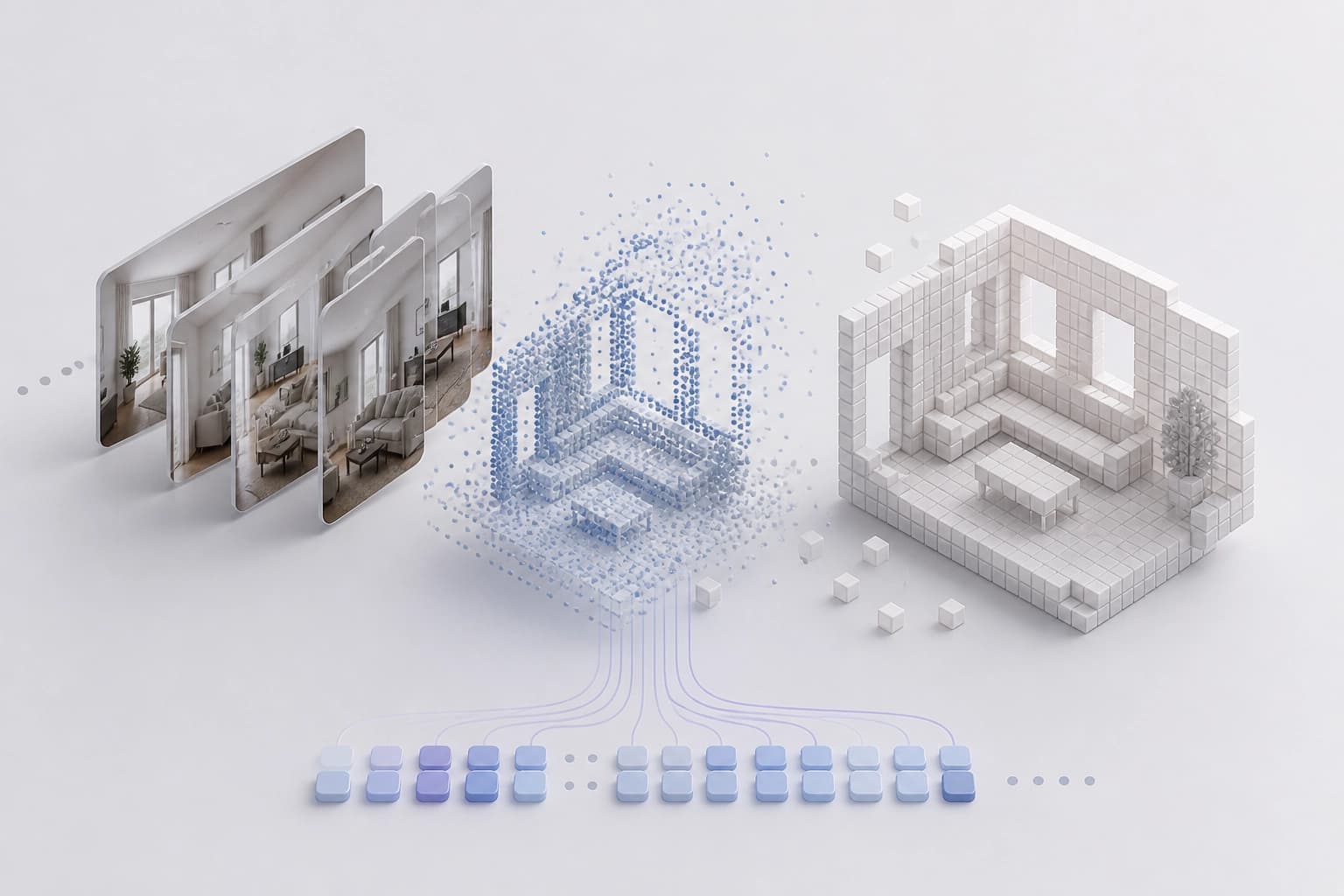
How Latent Filtering Works
FILT3R is a latent filtering layer that requires no training. It treats recurrent updates as stochastic state estimation in token space.
The update mechanism has three components:
- The system maintains a variance for each token.
- A Kalman filter-style gain balances memory retention and the incorporation of observations.
- Process noise is estimated online from the EMA-normalized temporal drift of candidate tokens.
Process noise reflects the expected change in the latent state between frames. Estimating drift helps adapt the update to incoming data.
How Updates Change Under Different Conditions
FILT3R adjusts the gain based on uncertainty. In a stable setting, uncertainty decreases as evidence accumulates.
| Condition | Change in uncertainty | Change in gain |
|---|---|---|
| Stable scene | Decreases | Decreases |
| Genuine scene change | Process uncertainty increases | Increases |
This behavior makes it possible to distinguish the accumulation of evidence from a scene change. The gain connects the uncertainty estimate to the balance between memory and new observations.
What the Experiments Show
The experiments present FILT3R as an interpretable, plug-in update rule. It generalizes common overwriting and gating policies as special cases.
The authors report improved long-term stability of depth, pose, and 3D reconstruction compared with existing methods. The work by Seonghyun Jin and Jong Chul Ye was accepted to ECCV 2026.
Source: arXiv:2603.18493. Version v2 revised on September 5, 2026.
Frequently asked questions
Related materials
All materials
Canonical Polynomial Invariants for Diagnosing RL Simulator Failures: Where Are They Actually Useful?
The study examines whether incorporating physical laws into learnable dynamics models is justified: invariants extracted from trajectories and reduced to canonical form using Gröbner bases yield modest forecasting gains, but prove powerful for diagnostics, enabling the localization of violated constraints and identification of specific erroneous parameters.
10 November 2026
AURA-Eval: How to Check Whether an LLM Agent Recognized a Risk and Changed Its Next Step
The framework evaluates LLM agents’ behavior not by their final verdict, but by how they respond to risk at key decision points: tool-call trajectories are interrupted, after which the model must continue reasoning and acting, while a panel of LLM judges assesses risk detection, the nature of the step, and its safety. Across 1,249 tasks drawn from 157 R-Judge trajectories, unsafe actions become more frequent among 20 models when no safe path is available, and removing oversight before execution turns 52.3% of initially safe cases into unsafe ones.
10 November 2026
Chern–Simons Reservoir Memory: Autonomous Connectivity Dynamics and Density Transport
The article explores how a reservoir preserves the history of input signals both in its density distribution and in its geometric degrees of freedom. A comparison of four mechanisms shows that current creates a separate connected component that alters the subsequent density response, while accounting for all measured features yields a small improvement in decoding pulse order.
10 November 2026