
The problem of over-provisioning
Modern LLM agents are increasingly taking over the management of critical infrastructure—from cooling systems to power grids. But for an agent to work, it needs an environment that defines the available data, tools, and permissible actions. In most systems, this environment is the same for all tasks: the full set of permissions, all available information, every possible function.
This approach may seem universal, but it has significant drawbacks. First, there are extra costs: each request to the full set of tools processes a large volume of data, consuming tokens and time. Second, an excess of capabilities can get in the way: the agent may get lost in irrelevant information or pick the wrong tool. Third, permission management and security also suffer when the agent has access to everything at once.
The approach: matching task resources to capabilities
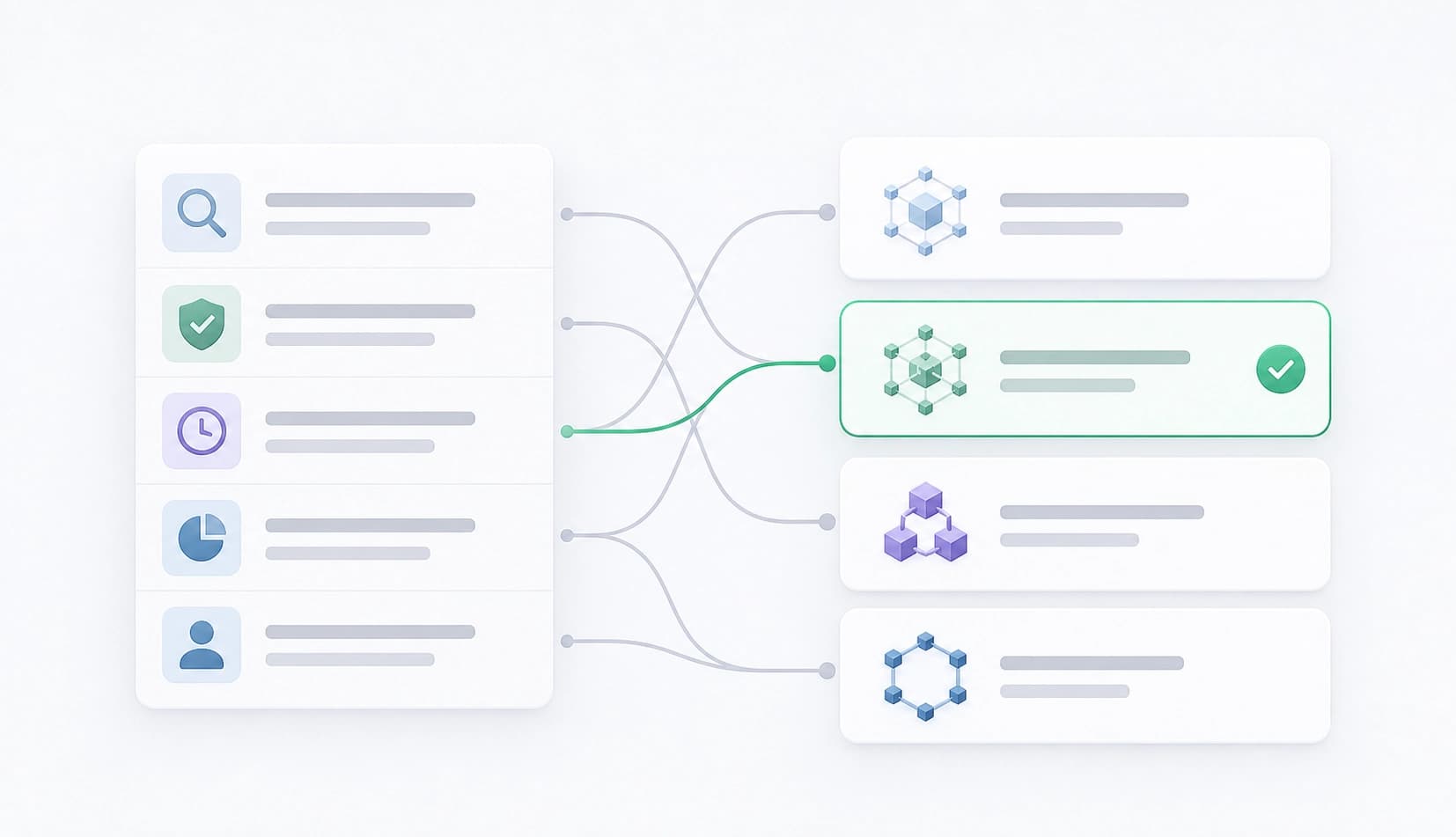
The researchers' key idea is to treat harness configuration as a resource-matching problem. Each task has requirements for data, tools, and actions, while the environment provides capabilities. The goal is to find the optimal match, not to hand out the maximum set "for all occasions."
To do this, tasks arising in critical infrastructure management are classified based on a mathematical description of the controlled system. For example, the task of temperature control in liquid cooling differs from the task of load balancing in a power grid: they have different parameters, time scales, and risks.
Harness configurations, in turn, are ranked by the amount and type of information they provide to the agent. This builds a map of possible "degrees of freedom" for each task category.
Where the correspondence maps come from
Task–harness maps are built in two ways. The first is an analysis of domain literature: what do agents typically use when solving specific tasks? The second is measuring real agent behavior in controlled experiments: what is actually needed, and what has no effect on the outcome. This provides a more reliable foundation than purely theoretical assumptions.
The guided escalation algorithm
Based on these maps, the authors propose a map-guided escalation algorithm. The agent first receives the minimal set of permissions that matches its task according to the map. After completing the work, the agent performs a self-check: were the resources sufficient, was the task solved correctly? If the self-check indicates failure, the harness is expanded—possibly to the next level or all the way to the full set. This cycle repeats until the task is solved successfully or the maximum is reached.
The beauty of this approach is that it does not require choosing settings for each task in advance—escalation happens automatically and only when necessary. Simple tasks are almost always solved with the minimal set, while complex ones receive additional resources as needed.
Experiments: what the tests showed
The researchers tested the approach on two scenarios. In liquid cooling, agent accuracy with the new method reached 0.715, higher than the 0.652 achieved with full provisioning. At the same time, token consumption was nearly halved—a 48% saving. Moreover, accuracy was comparable to the well-known Reflexion self-correction method, but without its cost.
In power grids, the results were different. The full set of tools still delivers maximum accuracy, so giving it up is not advisable when quality is critical. However, map-based provisioning offers cheaper alternatives—for tasks where a slight drop in quality is acceptable in exchange for resource savings.

Conclusions and practical recommendations
The main takeaway: there is no single correct configuration for everything. Each domain has its own Pareto frontier—the optimal balance between accuracy and cost. For some domains, economical configurations win; for others, the full set remains necessary.
Practitioners should:
- build and maintain maps of task–harness correspondences;
- start with the minimally sufficient set, expanding it only after a failed self-check;
- make optimization decisions not "on average," but for the specific domain.
This approach helps save resources without losing quality where over-provisioning is unjustified, while keeping the full set in cases where it is truly needed.