
New DeepMind AI benchmark — EVE Online: a test of strength in a world without restarts
DeepMind and Fenris Creations are preparing a standalone autonomous version of EVE Online, where neural networks will have to operate within a constantly changing in-game economy. The experiment will test whether models can retain knowledge, use long-term memory, and build multi-week plans without the ability to restart the match.
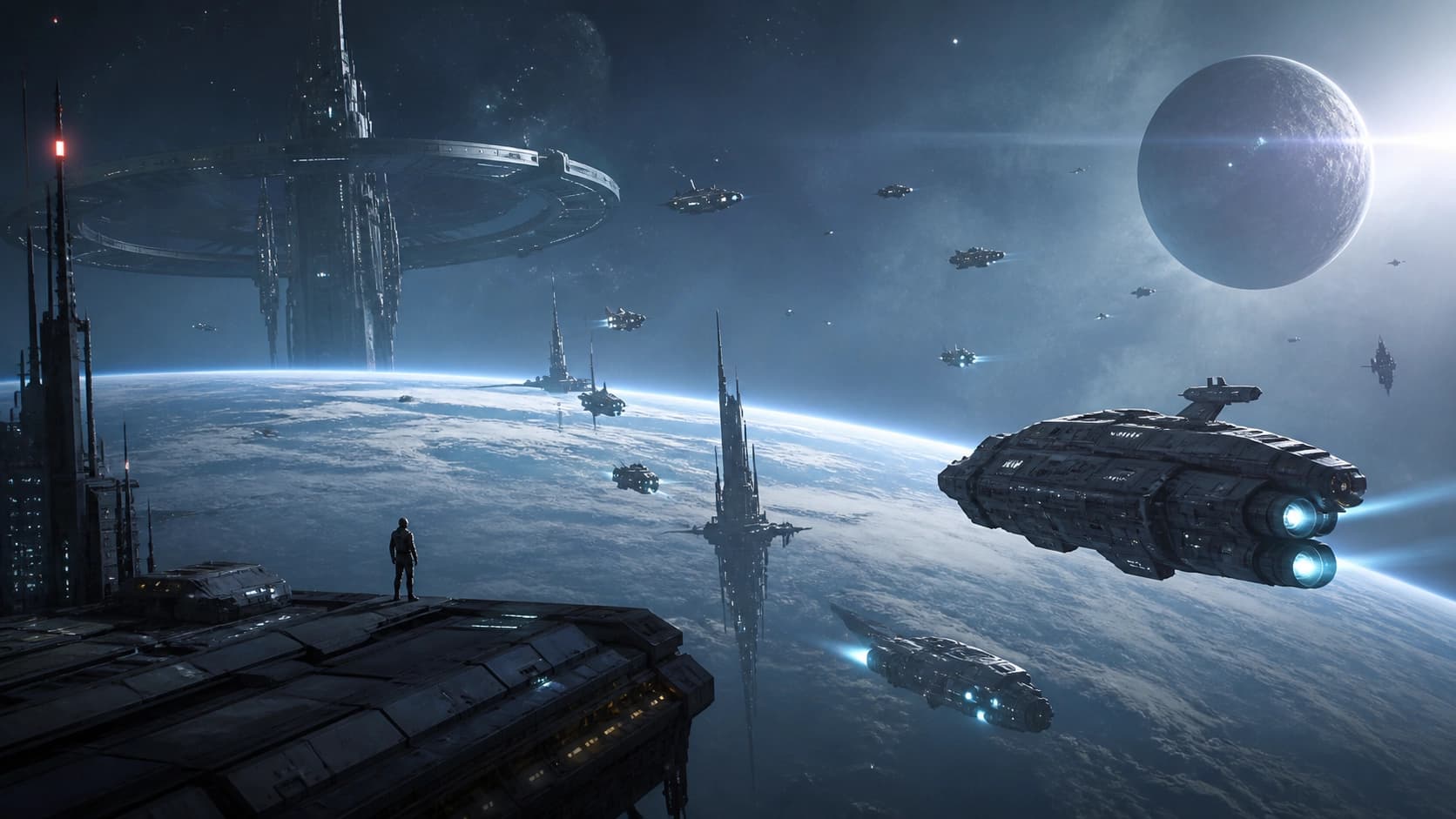
The Google DeepMind and Fenris Creations teams have joined forces around an unusual experiment — their agents will live in an autonomous copy of EVE Online, isolated from real players. While standard game tests usually answer the question "can AI win," here the task is far more complex: can artificial intelligence learn, remember, and plan in a world that doesn't restart after a mistake?
Why EVE Online Is Not Atari or StarCraft
In the past, DeepMind has already conquered Go, Atari, and StarCraft II. But all these disciplines share a common feature: the goal is fairly clear, and the match is finite. Once a game ends, you can restart and forget past actions. In EVE Online, there's no such luxury.
The multiplayer space game launched back in 2003 and has since built its own living economy run by the players themselves. Trade routes shift with demand, prices never stand still, and resources are limited. Players here don't just fight — they form alliances, compete, and sometimes deceive one another. Every decision affects the environment, and it can't be undone: the world has no "reset button." That's precisely what makes EVE Online a unique challenge for AI.
For researchers, such a proving ground means moving from finding the best move in a specific match to continuous existence within a complex system. It's not enough to find a successful strategy once — you need to keep acting appropriately as the world changes around you, even under the influence of your own decisions.
What Skills AI Agents Will Need
DeepMind highlights four key challenges that must be solved for agents to truly live in EVE Online.
Continuous Learning
Conventional models often suffer from "catastrophic forgetting": after learning something new, they lose part of their old skills. In a world without restarts, this becomes critical. If an agent that has mastered trading forgets how to pilot a ship, there's no going back — it must retain all acquired abilities simultaneously.
Long-Term Memory
Modern context windows are limited, but success in EVE requires remembering events from weeks and months ago. Price changes, old conflicts, promises from allies — all this information influences current behavior and must not slip from the agent's attention.
Planning Over Weeks and Months
In EVE, a profitable strategy is almost never a quick one. Buying resources today to sell them a month from now; taking a position that will only benefit an alliance several weeks later — the system rewards long-term schemes. AI will have to calculate the consequences of its actions over a long horizon.
Agent Interaction
Multiple AIs will operate in the simulation at once. They will need to cooperate, compete, and likely mislead one another — just as human players do. None of them will have the full picture of what's happening, and the results of many decisions will only emerge over time.
A Safe Experiment: Sandbox First, Open World Later
For now, the project is purely research-oriented. DeepMind publishes neither final metrics nor examples of completed missions — the experiment is in its early stages. In the first phase, agents work in an isolated environment on a local server, using simulation and historical data. This approach makes it possible to test hypotheses without risking the economy of the living world.
The next proving ground is slated to be EVE Frontier — a part of the universe with more open rules, where players can influence the very mechanics of the world. In the long term, the company does not rule out "grown-up" agents appearing alongside humans in EVE Online and EVE Vanguard. Fenris Creations believes such systems could test changes before they reach production, model the impact of innovations on the virtual economy, and help newcomers find their footing.
That said, the community is cautious about promises that agents won't be used to play on behalf of a human or circumvent the rules: for now, this is merely a statement from the developers, not a confirmed technical guarantee.
What Players Think and Why This Matters Beyond EVE
The community's reaction has been mixed. Some call EVE Online an ideal environment for this kind of testing and are glad the experiments have been moved off the live server: this way, the economy won't suffer from immature models. Others believe the studio should first address the game's long-standing technical and economic issues before bringing in neural networks. Concerns have also been raised about the automation of key activities, which could destroy an already fragile balance.
Nevertheless, the experiment holds value far beyond the game. If AI can demonstrate long-term memory, the ability to plan months ahead, and the capacity to adapt to an environment that changes without restarts, these developments could be applied to economic modeling, resource management, and other systems where the consequences of decisions cannot simply be rolled back. EVE Online is arguably a better fit for such trials than almost any other platform: there's no short round, but there are all the conditions for stress-testing AI.
Frequently asked questions
Related materials
All materials
Canonical Polynomial Invariants for Diagnosing RL Simulator Failures: Where Are They Actually Useful?
The study examines whether incorporating physical laws into learnable dynamics models is justified: invariants extracted from trajectories and reduced to canonical form using Gröbner bases yield modest forecasting gains, but prove powerful for diagnostics, enabling the localization of violated constraints and identification of specific erroneous parameters.
10 November 2026
AURA-Eval: How to Check Whether an LLM Agent Recognized a Risk and Changed Its Next Step
The framework evaluates LLM agents’ behavior not by their final verdict, but by how they respond to risk at key decision points: tool-call trajectories are interrupted, after which the model must continue reasoning and acting, while a panel of LLM judges assesses risk detection, the nature of the step, and its safety. Across 1,249 tasks drawn from 157 R-Judge trajectories, unsafe actions become more frequent among 20 models when no safe path is available, and removing oversight before execution turns 52.3% of initially safe cases into unsafe ones.
10 November 2026
Chern–Simons Reservoir Memory: Autonomous Connectivity Dynamics and Density Transport
The article explores how a reservoir preserves the history of input signals both in its density distribution and in its geometric degrees of freedom. A comparison of four mechanisms shows that current creates a separate connected component that alters the subsequent density response, while accounting for all measured features yields a small improvement in decoding pulse order.
10 November 2026