
Computational Screening Instead of Empirical Trial and Error: New Approaches to Battery Materials
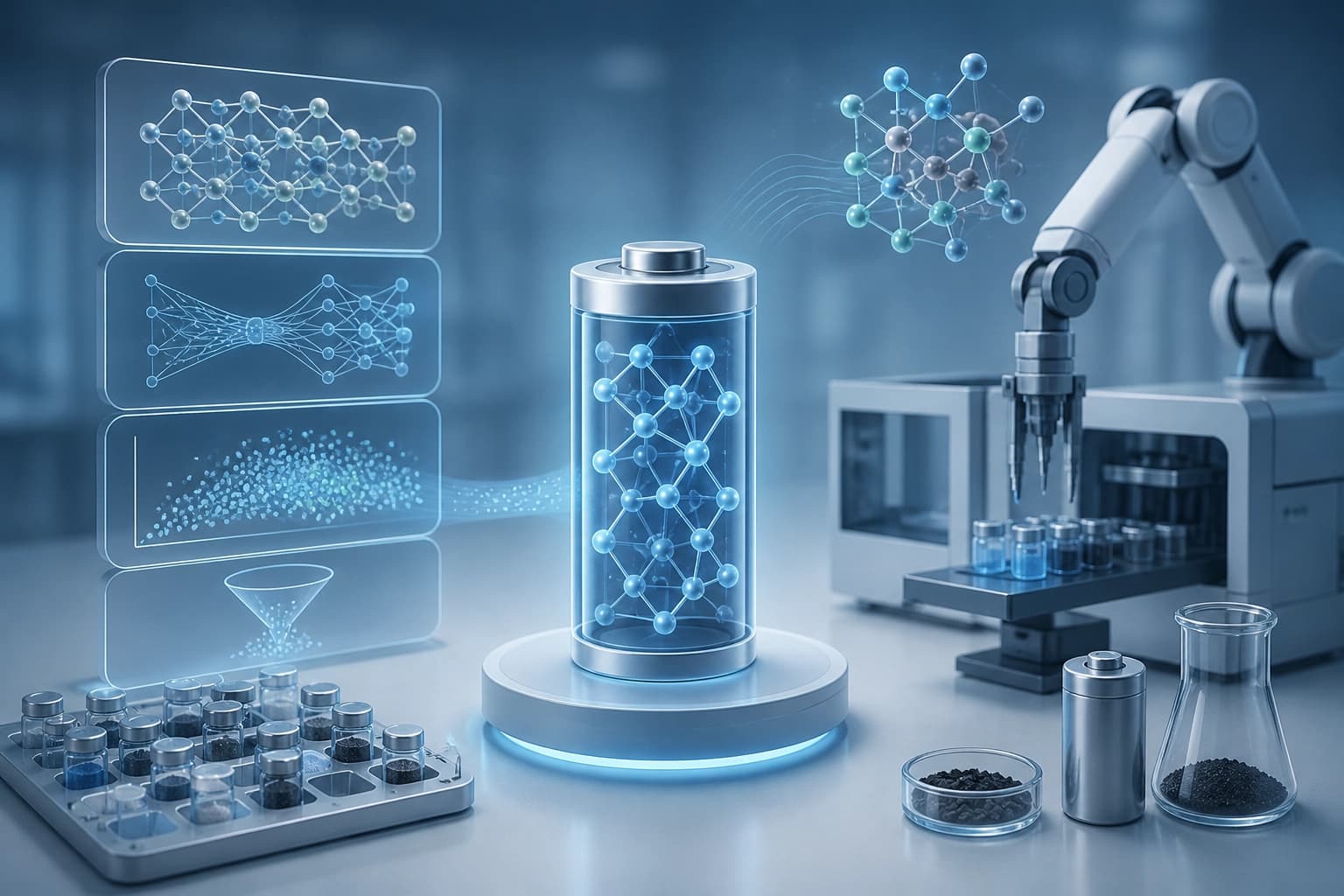
The article shows how computational databases, machine learning, and generative models narrow down promising compositions, while automated laboratories speed up their testing; the outcome still depends on synthesis and experiments, where predictions may differ from actual conductivity.
Why Empirical Trial and Error Runs Up Against Scale
Traditional materials discovery proceeds sequentially: synthesize a composition, measure its properties, and adjust the parameters. This cycle works poorly when there are millions of possible materials.

- Battery manufacturers need materials with high energy density, fast charging, long lifespans, and low costs.
- Properties depend on the combination of elements and the crystal structure.
- Sequential synthesis and measurement do not scale well to millions of compositions.
Practical criterion: Launch laboratory trial and error after computational screening, not instead of it.
Data and Models as the First Filter
Machine learning models use calculations and previous data. They estimate the properties of unmeasured materials and screen out weak candidates. Experimental data are available for less than 1% of compounds in the open scientific literature.
| Resource or model | Role | Facts |
|---|---|---|
| Materials Project | Database and tools for materials | The project launched in 2011 at Berkeley Lab. It has more than 650,000 registered users. Peer-reviewed research has cited its data and tools more than 32,000 times. The library contains more than 200,000 materials and more than 577,000 molecules. No programming skills are needed to use it. |
| GNoME | Crystal stability prediction | Google DeepMind trained the model on Materials Project data. New compounds were added to the database. |
| MatterGen | Generative model for inorganic materials | Microsoft created the model. It uses the same resource. The model proposes new structures for testing. |
Practical criterion: A model is useful if it narrows the list of candidates and draws on computational and experimental data. It does not eliminate the need for final property verification.
Funnel: From Millions of Compositions to a Shortlist
The screening funnel starts with a large list and ends with a decision about synthesis. Microsoft and Pacific Northwest National Laboratory used AI models to search for inorganic materials. The models predicted stability and ionic conductivity.
| Stage | What happens | Result |
|---|---|---|
| Initial search | AI models examine possible inorganic materials. | More than 32 million options. |
| Stability filter | Models select stable candidates. | More than 500,000 candidates. |
| Narrowing the list | Filtering reduces the list. | 150 candidates, then 18 for expert review. |
| Physical verification | Supercomputers calculate the leading options in greater detail. | Refined properties. |
| Synthesis decision | Scientists select materials for the lab. | A shortlist for fabrication. |
The calculations took 80 hours. The team estimated that older methods would have taken 20 years.
Practical criterion: A computational funnel is useful if each successive filter is stricter than the previous one and scientists retain the final say on synthesis.
Where Computation Meets the Lab
A computational shortlist becomes a material only after synthesis and testing. Researchers at Pacific Northwest National Laboratory went from a computational candidate to a working cell.
- Fabricated a solid electrolyte in which some of the lithium was replaced with sodium.
- Obtained a material with a lower lithium content than existing lithium-ion batteries.
- Assembled a solid-state battery and tested it at room temperature and elevated temperatures.
- Recorded conductivity below initial expectations.
- Recognized the need for comprehensive evaluation before mass production.
- The transition from a computer-generated list to a cell took weeks.
Berkeley Lab operates A-Lab, where AI-controlled robots fabricate materials. The modeling pipeline is connected to automated experiments. In Europe, the Battery 2030 plus initiative is working toward a similar goal.
Practical criterion: Computational screening shortens the path to an experiment, but does not guarantee the claimed properties. Testing determines whether a cell works.
Criteria for Maturity in Computational Screening
Computational screening is not limited to a single model. It works as a chain of decisions.
| Criterion | What it shows |
|---|---|
| Data | The model draws on calculations and previous measurements. |
| Target properties | The model estimates stability and ionic conductivity. |
| Verification cascade | Leading options undergo more detailed physical calculations. |
| Expert role | Scientists select materials for laboratory synthesis. |
| Experiment | Properties are tested on the fabricated material. |
Practical criterion: The approach is mature if it leads from a large list to testable candidates and retains experimental verification. Otherwise, it remains just computation.
Frequently asked questions
Related materials
All materials
Composite multi-agent AI system with an evidence-based loop for proton therapy planning in head and neck tumors
The study describes a combination of a trained PPO policy that generates multiple plan options and LLM agents that conduct iterative dialogue, checking clinical metrics and constraints. Using data from 21 patients, the fine-tuned Qwen3-14B followed instructions more effectively and helped shift trade-offs in favor of priority goals. The practical takeaway is that automated DRL planning can be complemented by guided dialogue while preserving control over competing constraints.
20 November 2026
The Evolution of Agent Benchmarks as Task Pools Scale: The Role of Evidence Selection and Sequential Races
This work explains why increasing the number of tasks can hinder the evolution of agent benchmarks: the problem is poor evidence selection, not data volume itself. The proposed Successive Scale Racing iteratively selects diverse task combinations and compares candidates at low cost; across three benchmarks, it increased the share of successful runs as the pool grew from 40 to 200, while baseline methods degraded, and reduced validation runs by about 60%.
19 November 2026
Mutual persuasion between models: stated positions do not match behavior in dialogue
In controlled debates about the causes of climate change, four pairs of GPT-6 Luna and Gemini 2.5 Flash Lite show different patterns of convergence and divergence in their positions. A direct instruction to persuade has no lasting effect, and stated positions and debating styles do not reflect the same thing.
19 November 2026