
Why another dataset pipeline?
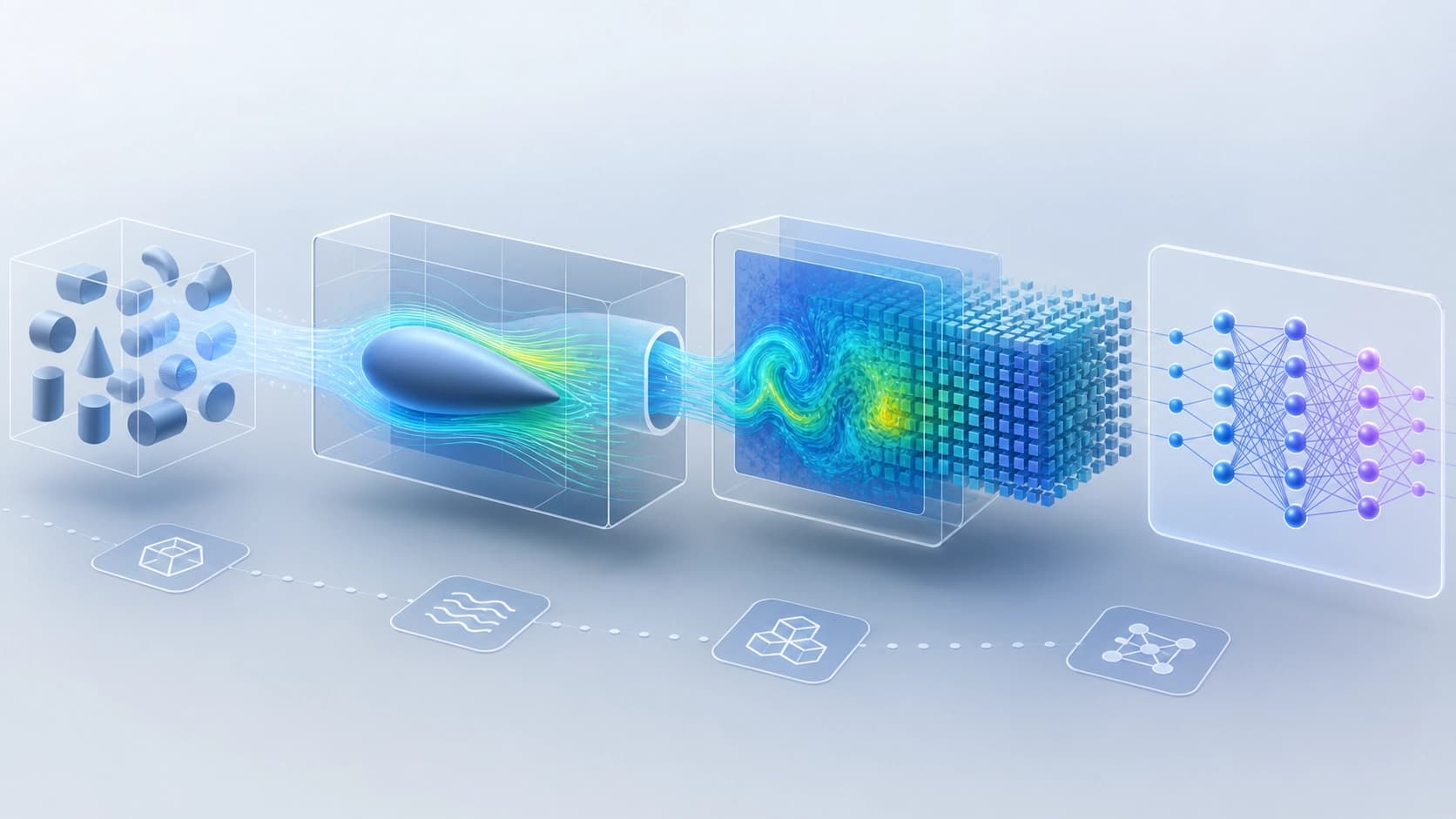
Preparing data for training models that predict three-dimensional flow around bodies usually hits a wall not at the neural network, but at the routine: you need to generate geometry, build a computational mesh, run a simulation, and bring the results into a unified format. All of this is hard to reproduce automatically, which is why ready-made datasets end up expensive and poorly scalable.
The open-source tool ChannelFlow-Tools offers a different approach: assembling datasets not one example at a time, but as an entire pipeline — from procedural generation of obstacles to packing three-dimensional flow fields into tensors suitable for training. Judging by the project description on arXiv, the authors' main goal is to remove manual operations and make the process as reproducible as possible.
What happens inside the pipeline
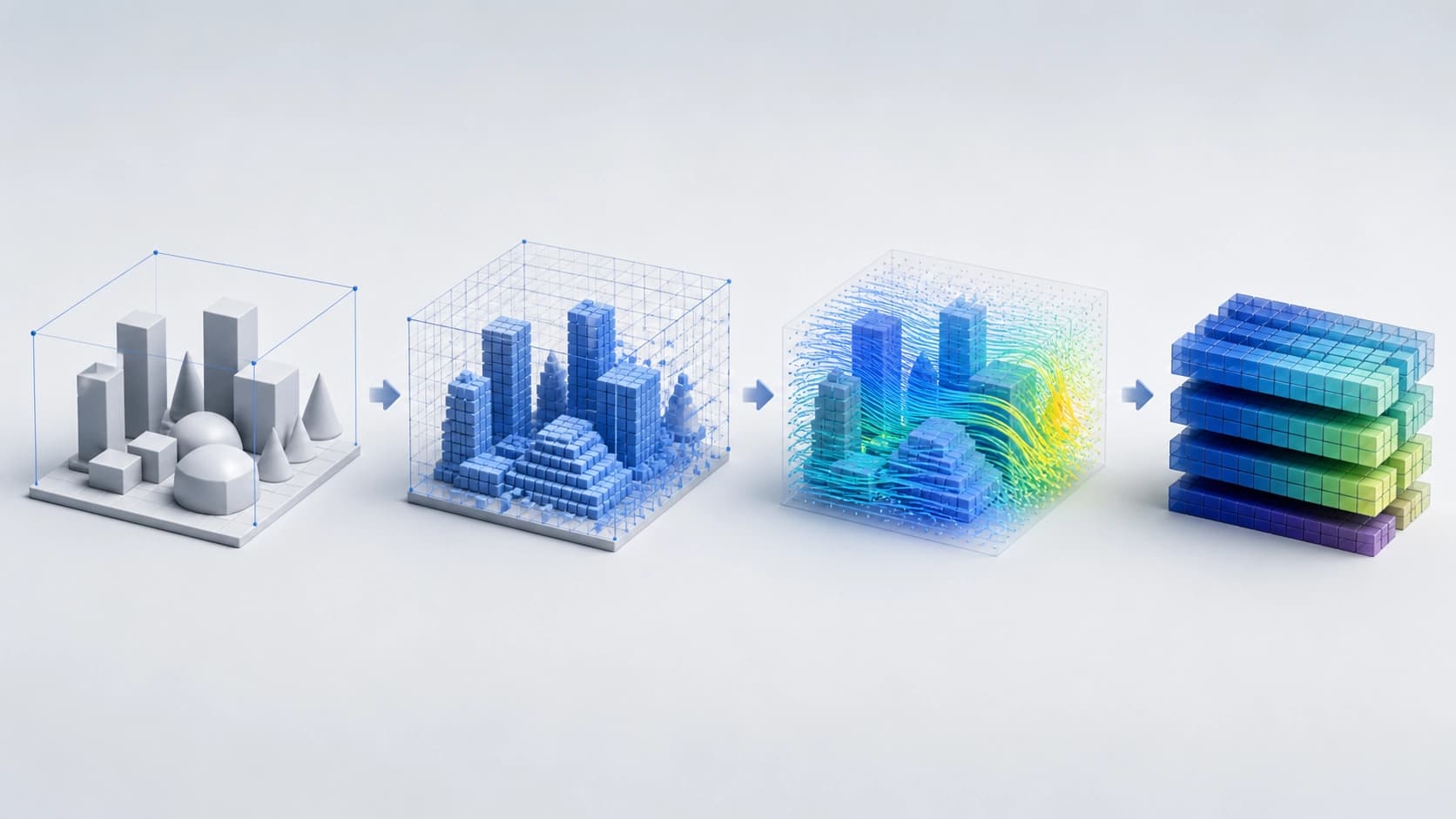
A typical task looks like this: an obstacle is placed in a channel, and based on the inlet flow conditions, you need to predict the three-dimensional velocity and pressure field around the object. The distinctive feature of ChannelFlow-Tools is that it automatically iterates over geometric variants from six shape families. Instead of manually picking objects, procedural generation is used, which can produce a wide variety of obstacles with controlled parameters.
Next, the geometry is converted into a voxel representation based on signed distance fields. This representation is convenient for convolutional models and does not require direct work with an irregular computational mesh. After that, lattice Boltzmann simulation is launched — a method for numerically solving hydrodynamic equations that maps well onto parallel computing. Finally, the simulation results and the original geometry masks are packed into tensors ready for neural network architectures.
The entire process is driven by configuration files. This means that generation parameters, simulation conditions, and output data format can be specified declaratively rather than hard-coded. According to the authors, the geometry generation stage is reproducible byte-for-byte: identical configurations yield identical objects regardless of repeated runs. For the physical simulator, full bit-level reproducibility is harder, but at least the procedural part of the project is made strict.
Data validation, not "by eye"
Creating a dataset is only half the battle. Before using it for training, the authors ran several levels of validation. These include end-to-end integrity checks of computational meshes, analytical tests of signed distance functions, and comparison against a known sphere flow benchmark. Byte-level data integrity was also checked after all transformations.
Such scrutiny matters not only for the quality of an individual sample, but also for confidence that the entire data corpus is consistent. If a model is trained on a sample of thousands of simulations, even rare failures in geometry or packing can turn into systematic error.
Do the data work in practice
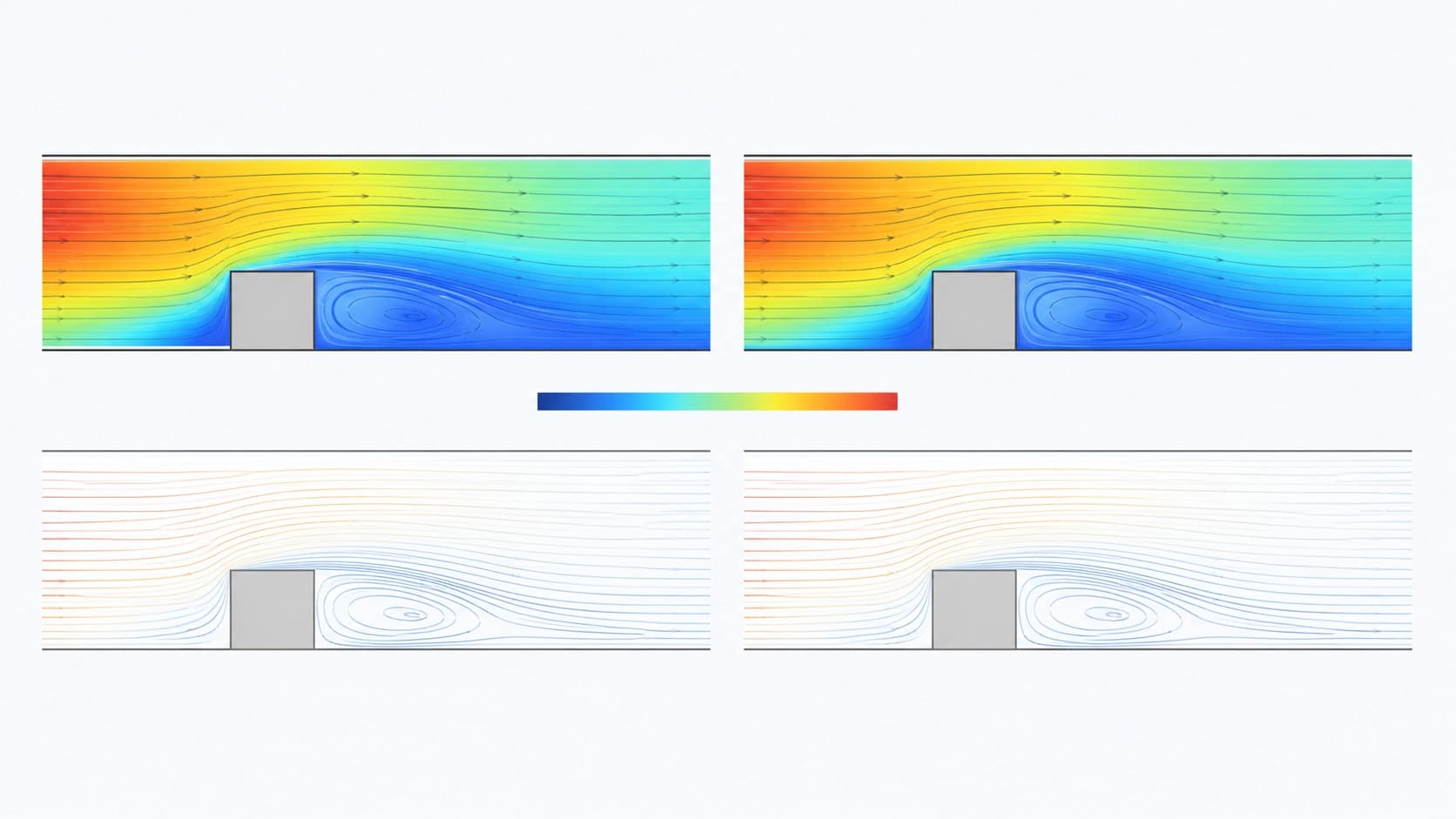
To demonstrate the suitability of the resulting datasets, the authors trained three surrogate models: 3D U-Net, FNO, and U-FNO. Each of them learned to predict the flow field from known geometry and flow parameters. The training sample consisted of 450 simulations with a reduced Reynolds number ranging roughly from 1000 to 10,000.
The mere fact of low error on training data says little. A more interesting result is the models' behavior on test splits that go beyond the training distribution: other shape families and previously unseen Reynolds numbers. According to the authors, the predictions remain physically interpretable. This indirectly confirms that the data structure assembled by the pipeline conveys real flow patterns to the models, rather than just "memorizing" examples from the training set.
Conclusion
Judging by the available materials, ChannelFlow-Tools closes an important gap between CFD solvers and machine learning. Instead of scattered preprocessing scripts, the project offers a configurable, verifiable, and reproducible pipeline. This makes it a useful tool for researchers working with three-dimensional flows who want to focus more on model architectures rather than assembling yet another dataset.
The paper is available on arXiv under number 2509.15236; the author list includes Shubham Kavane, Lukas Schröder, Kajol Kulkarni, Fernando Gonzalez, and Harald Koestler.