
AirPods with built-in cameras revealed in macOS leak: why Apple needs them
In a test build of macOS, a demo video was found showing headphones with cameras helping Siri recognize a book through Visual Intelligence. These AirPods aren't designed for filming — they're meant to serve as "eyes" for AI features and compete for consumer attention with Meta's glasses.

What the leak revealed
In the latest test build of macOS Tahoe 26.7 Release Candidate, a short internal demo was found that Apple clearly didn't prepare for the public. The video was discovered by MacRumors. In it, a person stands with a book in their hands and holds its cover right up against the body of the brand-new AirPods. In response, Siri's voice explains that thanks to Visual Intelligence, everything you see can be "saved for later" — you just need to ask the assistant. It sounds like the idea of visual bookmarks: you don't photograph an object, but tell the system "remember this," and it pulls the relevant information from the camera.
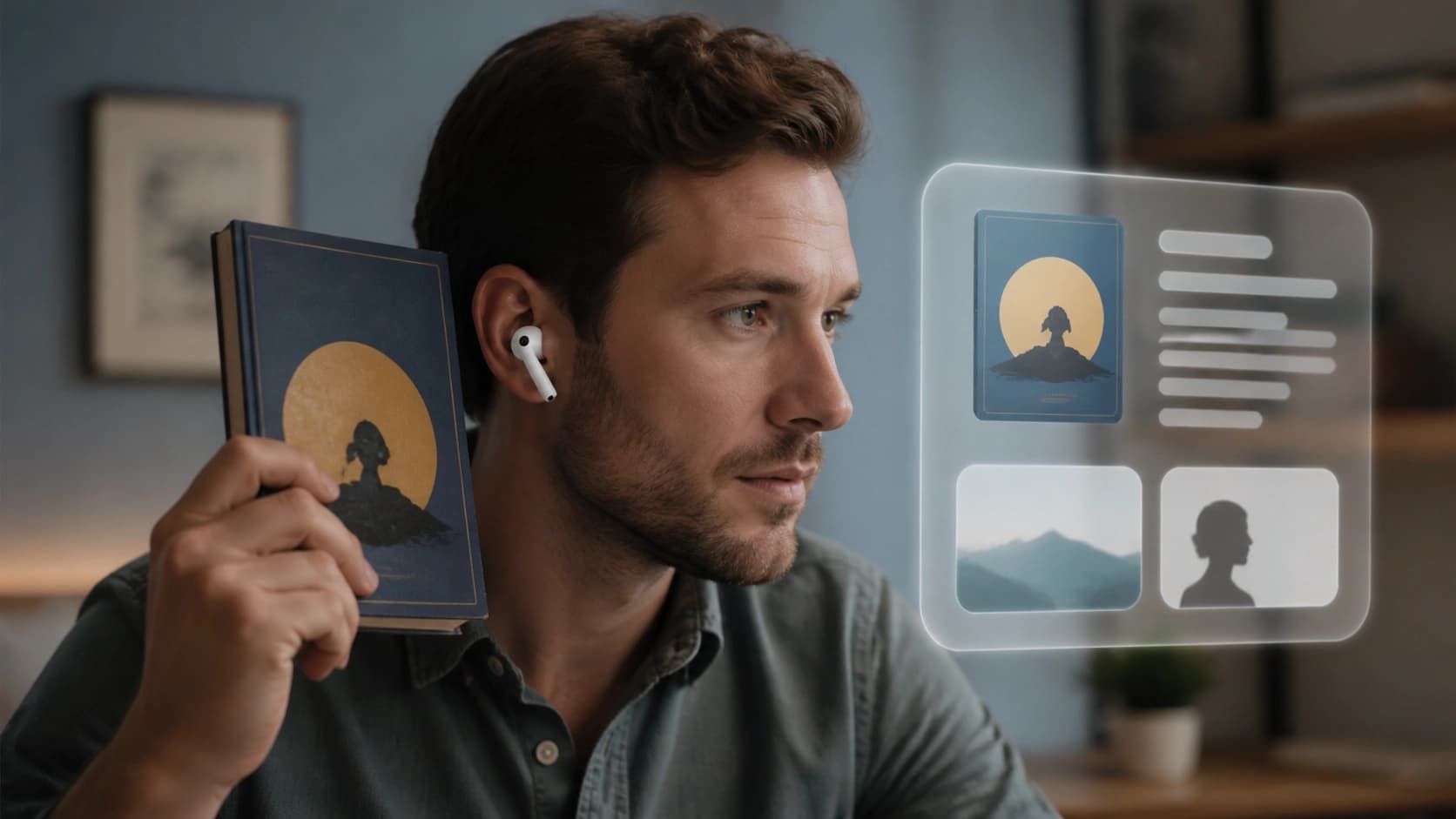
Judging by the available frames, the cameras don't drastically change the look of the earbuds. The new model looks like a slightly bulkier version of the AirPods Pro 3, and the earbuds themselves are only shown from the back in the video. From the front, where the lens would typically sit, nothing is visible. Apple may have deliberately hidden the cameras to preserve the familiar minimalist design, or simply hasn't settled on their placement yet. In the demo, the focus is on functionality, not external details.
Why Apple wants cameras in earbuds
The cameras in AirPods aren't meant for taking beautiful photos or videos. According to Bloomberg, Mark Gurman describes them as "eyes" for Apple's AI features. The system will receive "low-resolution visual information" from the cameras — enough to understand what's in front of the user, but not needed for full-fledged shooting. This data stream will let Siri and Visual Intelligence answer questions about the surroundings, suggest step-by-step directions, or recognize objects, books, storefronts, and simply interesting things around you.
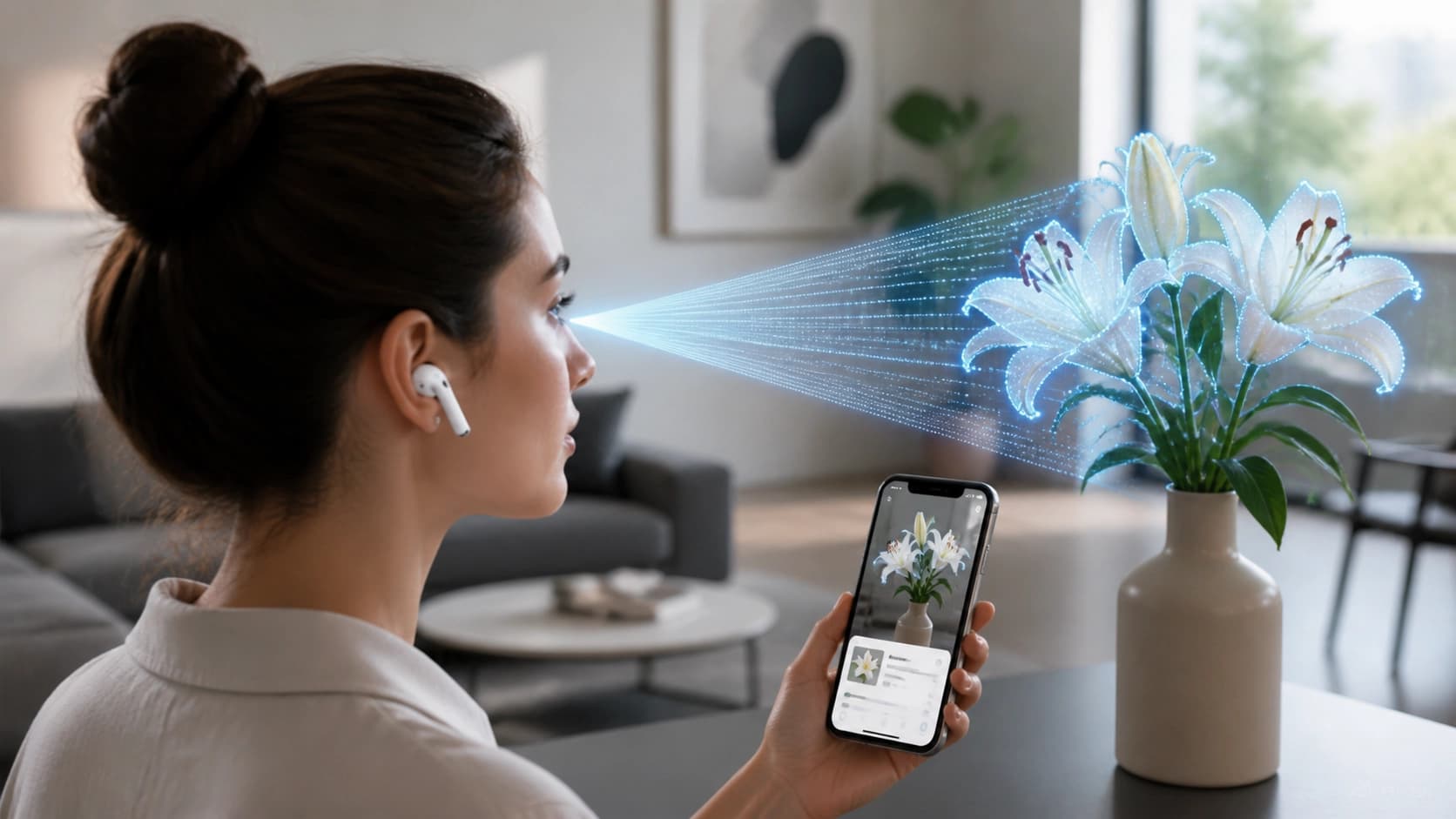
Here it's important to understand Apple's logic. Earbuds are almost always in your ears — they're a natural "sensor" for an AI assistant. Unlike a phone, which you still have to pull out of your pocket, or glasses, which you can take off, AirPods are always with you and can see roughly what you see. That's why they're positioned as a more discreet alternative to camera-equipped smart glasses like the Meta Ray-Ban. Apple, by the way, is also working on its own smart glasses in parallel, but earbuds are a less radical step toward "wearable AI." The company may be testing several form factors at once and picking the one that proves most convenient in everyday life.
That said, it's precisely the hidden form factor that raises privacy concerns. When a camera is built into earbuds, people around you may not know whether recording is taking place. This issue already surfaced after criticism of the Meta Ray-Ban: bystanders don't always realize they're being filmed. Apple, judging by Gurman's predictions, will try to make the process more transparent — he expects the new AirPods to have longer stems and LED indicators signaling data transmission to the cloud. These indicators aren't visible in the leaked demo because the earbuds are only shown from the back, but their presence seems entirely logical: without an external signal, user trust is out of the question.
When to expect the new AirPods
The appearance of a demo video inside a beta version of macOS is a strong hint that the announcement is just around the corner. Internal materials usually either don't make it into public builds or are carefully hidden, so such a leak is hardly accidental. Most likely, Apple is preparing to release the new AirPods this fall — alongside the updated Siri, which is promised to be unveiled in September along with the new iPhones. By that point, the company will surely have refined not only the earbuds themselves but also the software that's supposed to turn camera imagery into clear answers and actions.
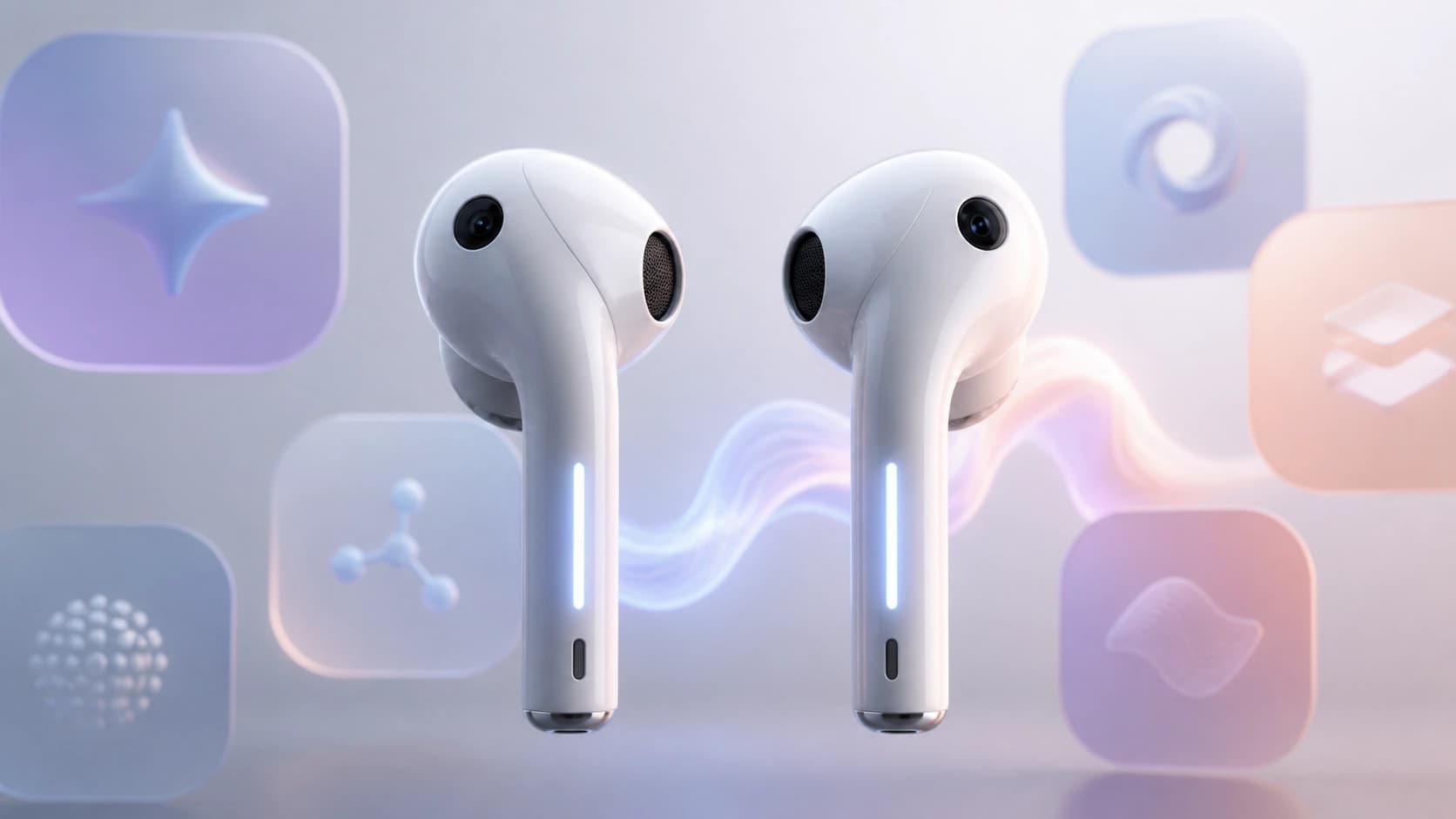
If Gurman's calculations are right, AirPods will stop being just a music accessory and become part of the Apple Intelligence ecosystem. Cameras in earbuds aren't a way to shoot a vlog, but a way to gather context: what you see, where you're going, which objects caught your interest. The system will be able to use this for navigation, information lookup, quick reminders, and other scenarios where the voice assistant was previously "blind." The low image resolution, meanwhile, plays into privacy's favor: full-fledged photos aren't needed for analysis — rough data is enough.
The main question remains open — whether Apple can turn this technology into a product people trust. The company traditionally bets on security and privacy, and this could become its advantage over competitors. But to do that, it will have to explain in detail to users when the camera is active, where images go, and who gets access to them. If the answers are convincing, camera-equipped AirPods could become one of the biggest launches of the year. If not, scandals around covert recording will outweigh any technical merits.
Now all that's left is to wait for September. If the leak wasn't a fake, we'll see AirPods for the first time in a long while that can not only hear, but also see.
Frequently asked questions
Related materials
All materials
Chern–Simons Reservoir Memory: Autonomous Connectivity Dynamics and Density Transport
The article explores how a reservoir preserves the history of input signals both in its density distribution and in its geometric degrees of freedom. A comparison of four mechanisms shows that current creates a separate connected component that alters the subsequent density response, while accounting for all measured features yields a small improvement in decoding pulse order.
10 November 2026
Validating Candidates Costs More Than Generating Them: Honeypots Against LLM Vulnerability Hunting
The study examines the cost asymmetry in agentic vulnerability discovery: generating candidate versions is cheap, while confirming them through reachability analysis, execution, and PoC development consumes most of the budget, making verification a potential standalone target for defense. The proposed RedHerring—repository-adapted decoys with a hidden certificate—reduced the number of real vulnerabilities found by 38.7–60.4% at equal cost across 33 OSS-Fuzz projects; even after the agent was warned, the reduction remained at 37.2%.
9 November 2026
Checking LLM Hallucinations via SQL-Based Source Representation Without Fine-Tuning
The study examines whether an LLM can apply a basic symbolic skill—building a SQL database from source documents—to ground its outputs in sources without supervision when detecting hallucinations. On RAGTruth and DiaHalu, this neuro-symbolic pipeline proves more accurate than direct prediction and comparable to state-of-the-art methods, without requiring domain-specific fine-tuning.
9 November 2026