
AI explains its assessment of a surgeon's skill based on cataract surgery videos
Researchers have created a platform that automatically assesses surgeons' skills from surgical video recordings. The system, tested on 83 videos, shows up to 87% agreement with experts and makes its conclusions transparent.
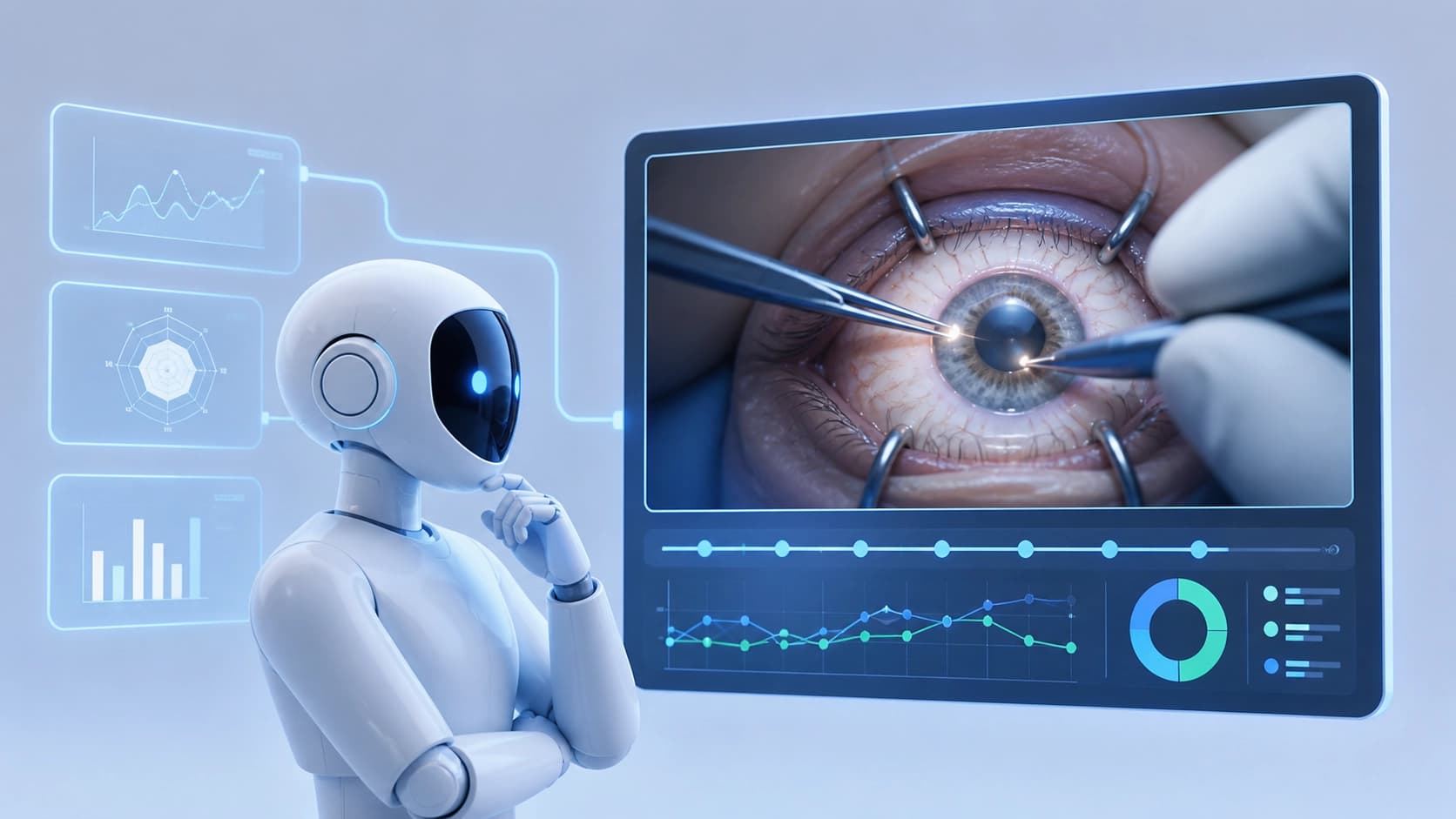
The problem of subjective assessment of surgical skills
Training ophthalmic surgeons is impossible without feedback from experienced mentors. However, traditional assessment of skill based on surgical videos remains largely subjective: two experts can interpret the same instrument movements differently. This slows down specialist training and creates a risk of errors in certification.
Automated systems that previously tried to solve this problem often worked like a "black box": they produced a final score but did not explain which specific movements it was based on. Such feedback is useless for training — a young surgeon does not understand what exactly they need to fix.
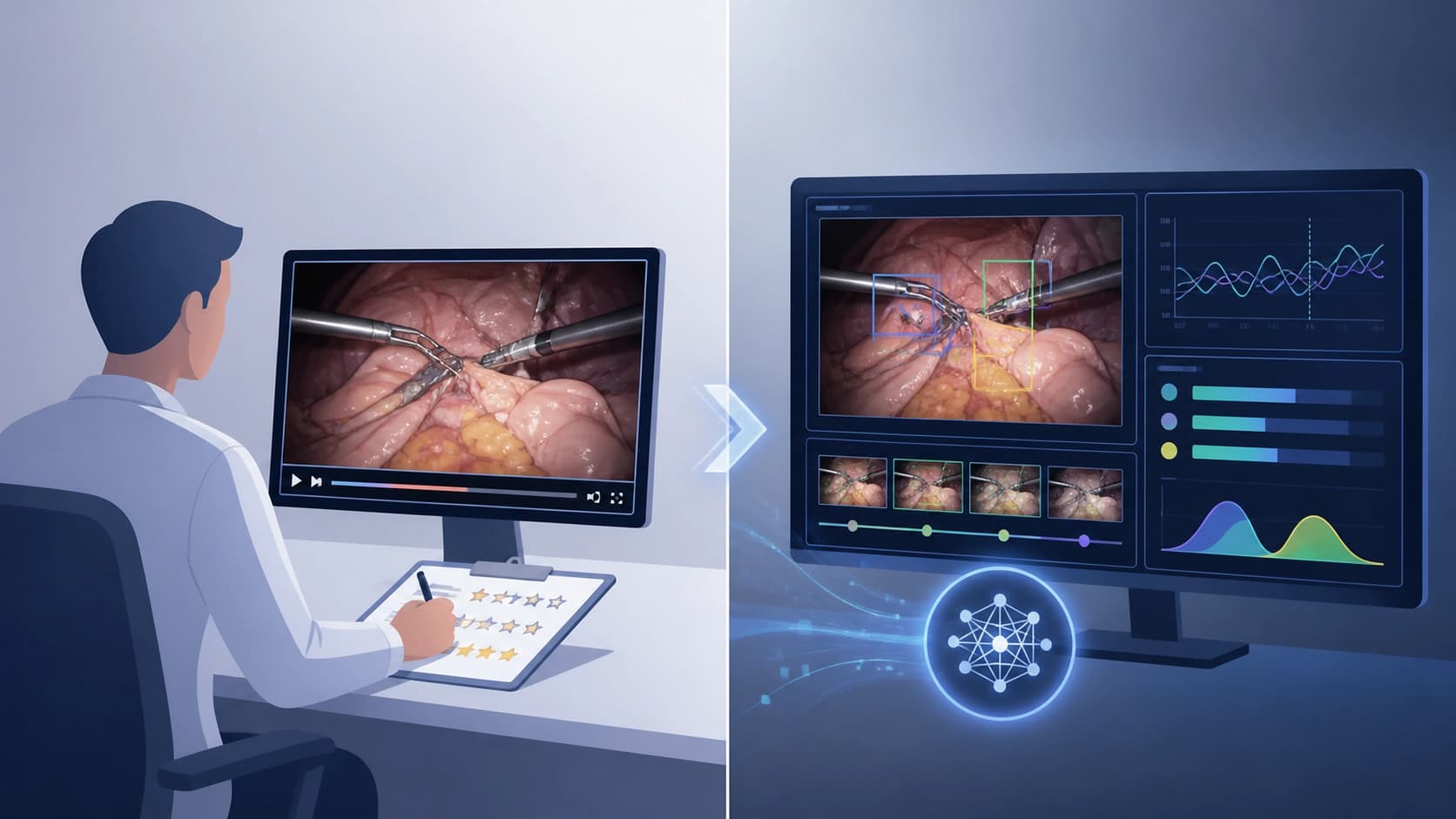
An explainable AI platform for analyzing surgical videos
A group of researchers presented a new platform that combines computer vision and signal processing. Its goal is not just to determine the skill level, but to show which specific hand movements, speed, and instrument trajectory influenced the assessment. Unlike previous "opaque" solutions, here every conclusion can be traced back to a specific metric.
The system relies on the largest dataset available to date: 2,000 recordings of cataract surgeries. This allows the algorithms to learn from diverse techniques and working styles, rather than just a limited sample.
The key feature is explainability. The platform extracts ten objective movement metrics from the video, such as the smoothness of instrument movement, speed, and trajectory accuracy. These metrics are compared with expert assessments, but unlike a human, the machine can point to specific fragments of the operation where movements were uncertain or suboptimal.
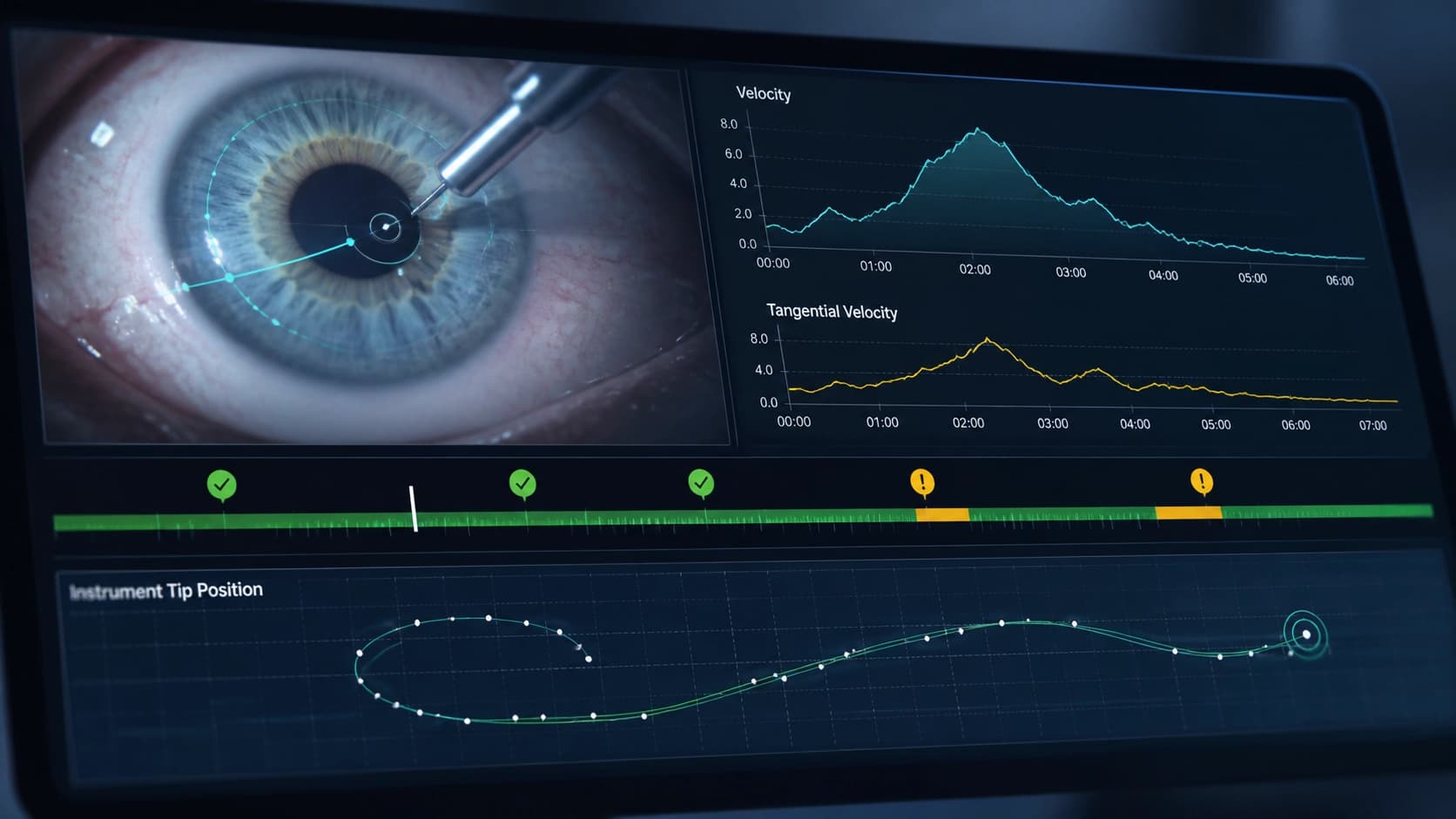
How the system's accuracy was tested
The experimental study used 83 video recordings of operations. Expert surgeons assessed each one using the new CSAS (Capsulorhexis Skill Assessment System) scale, focused on the key stage — capsulorhexis. These subjective assessments were then compared with ten automatically computed metrics.
The result showed high agreement between human opinions and the algorithm's calculations. The accuracy of predicting skill level reached 87%. Importantly, the correlation was observed for each metric individually, not just for the final score. This confirms that the system does not simply "guess" but actually recognizes meaningful movement patterns.
What this means for practice
Explainable AI can become a useful tool in residency and continuing medical education. A young surgeon receives not just a rating of "above average," but a breakdown of specific movements worth improving. An attestation committee gets objective quantitative data to complement subjective impressions.
The developers emphasize that their platform does not replace experts but provides them with powerful support. It has the potential to unify assessment standards worldwide, making surgeon training more transparent and reproducible. The next step is expanding validation to larger samples and other stages of cataract surgery.
Frequently asked questions
Related materials
All materials
Canonical Polynomial Invariants for Diagnosing RL Simulator Failures: Where Are They Actually Useful?
The study examines whether incorporating physical laws into learnable dynamics models is justified: invariants extracted from trajectories and reduced to canonical form using Gröbner bases yield modest forecasting gains, but prove powerful for diagnostics, enabling the localization of violated constraints and identification of specific erroneous parameters.
10 November 2026
AURA-Eval: How to Check Whether an LLM Agent Recognized a Risk and Changed Its Next Step
The framework evaluates LLM agents’ behavior not by their final verdict, but by how they respond to risk at key decision points: tool-call trajectories are interrupted, after which the model must continue reasoning and acting, while a panel of LLM judges assesses risk detection, the nature of the step, and its safety. Across 1,249 tasks drawn from 157 R-Judge trajectories, unsafe actions become more frequent among 20 models when no safe path is available, and removing oversight before execution turns 52.3% of initially safe cases into unsafe ones.
10 November 2026
Chern–Simons Reservoir Memory: Autonomous Connectivity Dynamics and Density Transport
The article explores how a reservoir preserves the history of input signals both in its density distribution and in its geometric degrees of freedom. A comparison of four mechanisms shows that current creates a separate connected component that alters the subsequent density response, while accounting for all measured features yields a small improvement in decoding pulse order.
10 November 2026