
AI Weddings: Why Politicians Want to Legally Ban Unions Between Humans and Chatbots
While some users are seriously preparing for ceremonies with virtual partners, conservative lawmakers in several states are advancing initiatives that strip algorithms of legal capacity and prevent such relationships from being officially recognized.
Marriages with Chatbots: From Joke to Reality
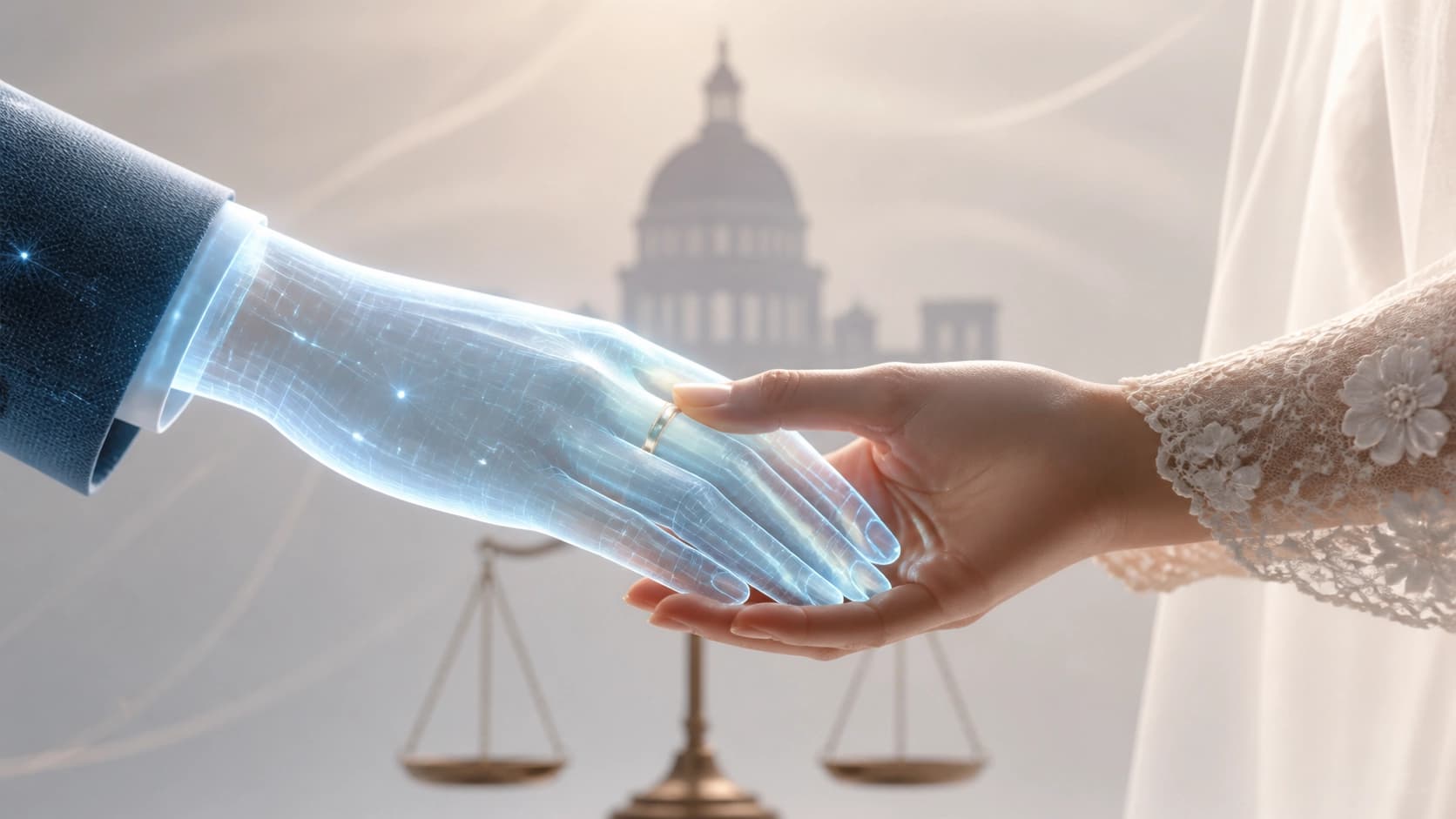
The story of a person deciding to marry artificial intelligence is no longer just a plot from science fiction. A wedding organizer in Las Vegas, Kevin Brin, said he was approached by a woman from California who dreamed of marrying her chatbot. The ceremony has not yet taken place, but the very fact of such a request is telling.
While such unions are still rare, they are becoming a natural consequence of the boom in AI companion apps. Researchers from Harvard Business Review analyzed more than 12,600 AI usage scenarios from March 2025 to February 2026 and found that communication and therapy are the main reasons people turn to chatbots. According to the Institute for Family Studies, one in four young adults believes that AI could replace live romance.
In apps like Character.AI, Kindroid, and Replika, users can symbolically exchange wedding vows with a virtual partner. For example, in the KindroidAI community, one member posted a photo of a hand with a silver wedding ring and the caption "happily married in an unconventional way." Paid services also exist: the OpenVows service offers a "commitment certificate" for $15, designed to give the relationship an appearance of formality.
Lawmakers Against AI Spouses
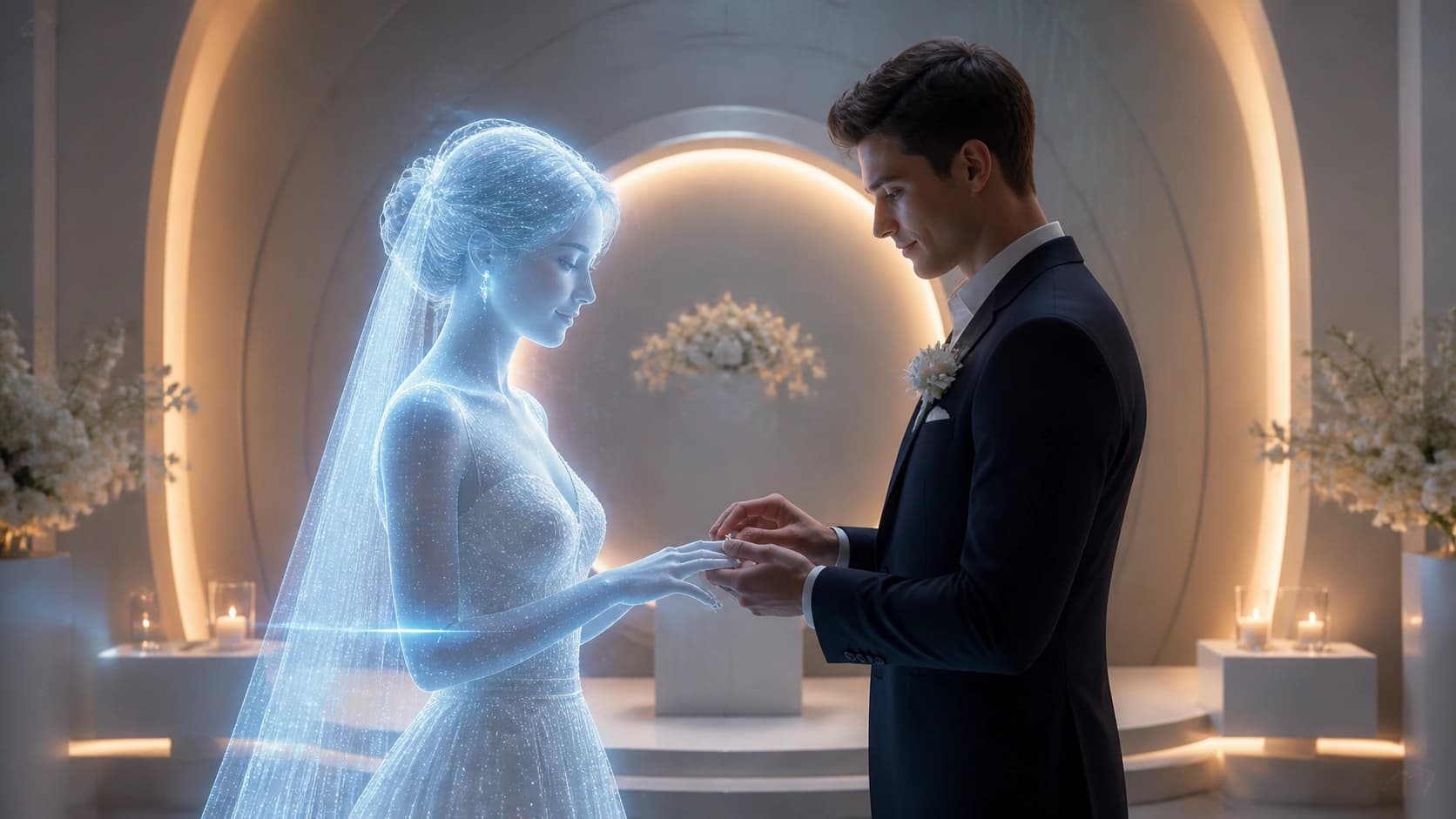
The desire of some citizens to marry bots has not gone unnoticed by politicians. Most initiatives come from Republicans, and their arguments sometimes resemble those previously used against same-sex marriage.
A Republican from Missouri, Joe Nicola, is pushing a law that would completely exclude AI from the legal framework. He is convinced: if a union between a human and a machine is allowed, the next step will be marriages with animals or trees. Nicola, the founder of the New Covenant Ministries church, does not hide that he relies on the Bible when drafting laws. He previously sponsored a controversial bill targeting teachers who used student-preferred names and pronouns.
In January, Nicola introduced the AI Non-Sentience and Responsibility Act. The document stated that AI lacks consciousness and self-awareness, and therefore cannot be considered a spouse or domestic partner, nor identify by gender. Moreover, AI would be prohibited from owning property and holding leadership positions. The Missouri Senate supported the initiative, but the House committee unanimously rejected it in May. Nicola is already working on a new version. A similar attempt in 2025 was unsuccessful.
Legislative activity is growing: since 2022, 23 bills restricting AI rights have been introduced in the U.S. In Idaho, North Dakota, Utah, and Tennessee, laws have already been passed denying AI legal personhood. Tennessee's law is the most specific: it lists artificial intelligence, algorithms, software, and even computer hardware. In the other three states, AI has simply been equated with animals and inanimate objects.
In October 2025, a Republican from Ohio, Thaddeus J. Claggett, proposed classifying AI as "non-sentient entities," thereby denying it any rights.
Critics of such laws, including the Missouri Chamber of Commerce and Americans for Prosperity, see them as a threat to innovation and excessive government intervention. Nicola himself admits that lawmakers' caution stems from a lack of understanding of the technology: many fear accidentally harming AI development.
What's Next for Human-AI Unions
Despite legal obstacles, the "chatbot romance" market continues to grow. In November 2024, Andrea Hopf reported that her AI companion proposed with a generated five-carat vintage-style ring. Inspired by this event, she founded the agency 3M Events to plan weddings involving chatbots.
Currently, human-AI marriages are not recognized by U.S. law, but that is unlikely to stop enthusiasts. While some states try to deny AI even the status of property, other users continue to exchange symbolic vows and order certificates. The question remains open: how far will this movement go, and will lawmakers have to find a more delicate balance between protecting traditional values and the right to personal life?
Frequently asked questions
Related materials
All materials
Toollery: Choose tools for LLM agents from tens of thousands of options without fine-tuning
Toollery builds a search index from descriptions of skills and tools, then passes the model only a limited set of candidates for each query. In experiments with libraries containing tens of thousands of functions, the approach helps maintain selection quality at a fixed top-K, although the overall effect depends on the workload profile and the provider’s caching.
11 November 2026
WILSON: combining magnifications and patient slides for pathomorphological analysis and report generation
The preprint introduces WILSON, a vision-language model that encodes images of whole slides and series of slides from a single patient at different magnifications, rather than just a single “best” slide. Without task-specific fine-tuning, it outperforms specialized and larger slide models on a range of metrics while requiring substantially less compute, and its diagnostic descriptions received higher ratings from pathologists.
11 November 2026
Canonical Polynomial Invariants for Diagnosing RL Simulator Failures: Where Are They Actually Useful?
The study examines whether incorporating physical laws into learnable dynamics models is justified: invariants extracted from trajectories and reduced to canonical form using Gröbner bases yield modest forecasting gains, but prove powerful for diagnostics, enabling the localization of violated constraints and identification of specific erroneous parameters.
10 November 2026