
AI is no longer a toy: cybercriminals have embedded it into every stage of attacks
Flashpoint analysts processed 3.9 petabytes of dark web data and found traces of AI in over 22 million messages across underground infrastructure. Now attackers are hiding models in closed channels and using them for phishing, victim discovery, and bypassing defenses.

Artificial intelligence has ceased to be an exotic toy for cybercriminals. According to a report by the analytics firm Flashpoint, AI is now embedded in the routine processes of attackers — from victim discovery to the final ransom demand. These are no longer experiments by enthusiasts but a full-fledged tool that is changing the economics of attacks. And it is changing them radically: what once required deep technical knowledge is now available to almost anyone with a subscription to the right service.
AI Has Gone Underground
Flashpoint researchers analyzed a massive volume of data — 3.9 petabytes — collected from underground forums, closed chats, and other criminal infrastructure. In the first six months of 2026, they found mentions of AI tools linked to cybercrime in more than 22 million messages. The figure itself is impressive, but another observation is far more interesting: a significant portion of these tools has already disappeared from public criminal communities.
Criminals clearly do not want to expose their developments. They are moving AI to private infrastructure and increasingly using their own language models with all safety guardrails completely stripped out. This is a logical step: commercial ChatGPT and similar services have built-in barriers that prevent their use for writing malicious code or crafting convincing phishing campaigns. A custom model has no such problem.
In essence, AI is becoming part of the standard arsenal — as commonplace as, say, an exploit or a botnet control panel. It is no longer relegated to a separate category of "experimental technologies" but is simply built into the attack pipeline.
How Exactly AI Works in the Hands of Attackers
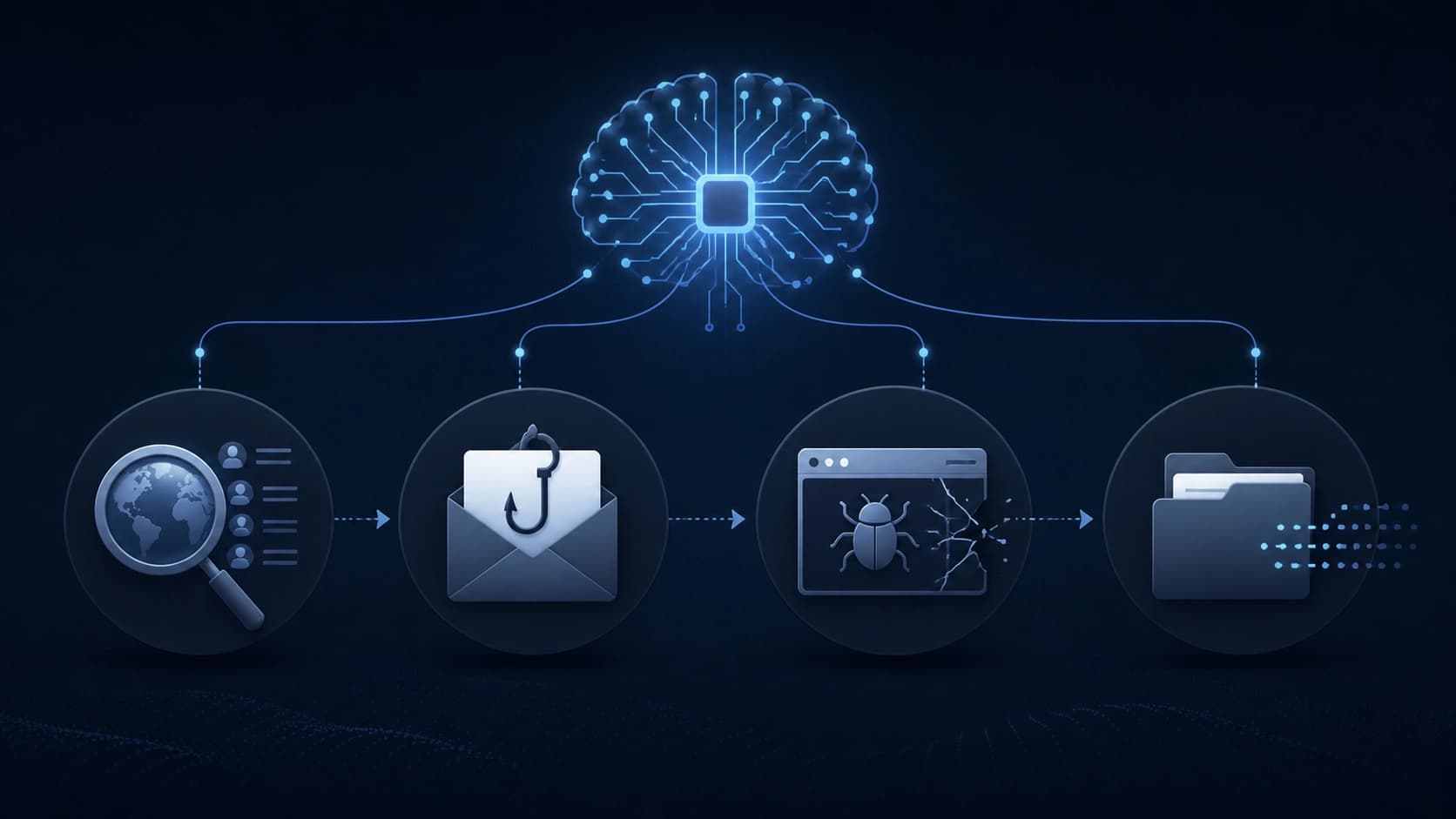
The use of AI covers virtually every stage of an attack. This is not a single scenario but a whole spectrum of tasks that previously required manual work and high skill levels.
- Gathering information about the victim. AI helps quickly build a detailed profile of a company or a specific employee. It analyzes open sources, social media, and data leaks — and pulls out exactly those details that can be exploited.
- Creating phishing messages. This is perhaps the most obvious use case. AI generates emails that look as if they were written by a real colleague or bank. And it does so at scale, tailored to each victim's specifics.
- Writing scripts to bypass defenses. Attackers use AI to create or modify malicious scripts that help evade antivirus software and other security measures.
- Generating exploit code. This is a more advanced level. AI helps not only find a vulnerability but also quickly write a working program to exploit it. This used to be the domain of narrow specialists; now it is almost an automated process.
Flashpoint founder Josh Lefkowitz accurately captured the essence of the change: AI narrows the gap between the emergence of an opportunity and its exploitation. Previously, between discovering a vulnerability and launching a full-scale attack, time was needed to write code manually. Now that stage is compressed to a minimum. Tasks that required months of training and practice are completed in minutes.
The Economics of Attacks: Cheaper and More Standardized
The Flashpoint study revealed another important trend: cybercrime is becoming a true marketplace with goods and services. Individual stages of attacks are being standardized and sold as ready-made products. The most striking example is infostealers — malicious programs that steal data from infected devices. In the first half of 2026, they infected 7.4 million devices worldwide and stole about 1.7 billion credentials and other identifying artifacts.
The most widespread families are Vidar, StealC, and Lumma. Notably, they are distributed on a subscription model: anyone can rent an infostealer for a set period. This lowers the barrier to entry — there is no need to write malicious code yourself; you can simply "rent" a ready-made tool.
Of particular value to criminals are not the passwords themselves but active browser session tokens. With these, an attacker can gain access to a victim's account without even knowing the password. This makes attacks even more dangerous because users may not even suspect that their accounts have already been compromised.
The cost of initial access to compromised systems has also dropped. The average price for such access was $439 — 69% lower than before. This is further confirmation that the market is becoming saturated with supply and competition among cybercriminals is growing.
Rising Vulnerabilities and Ransomware
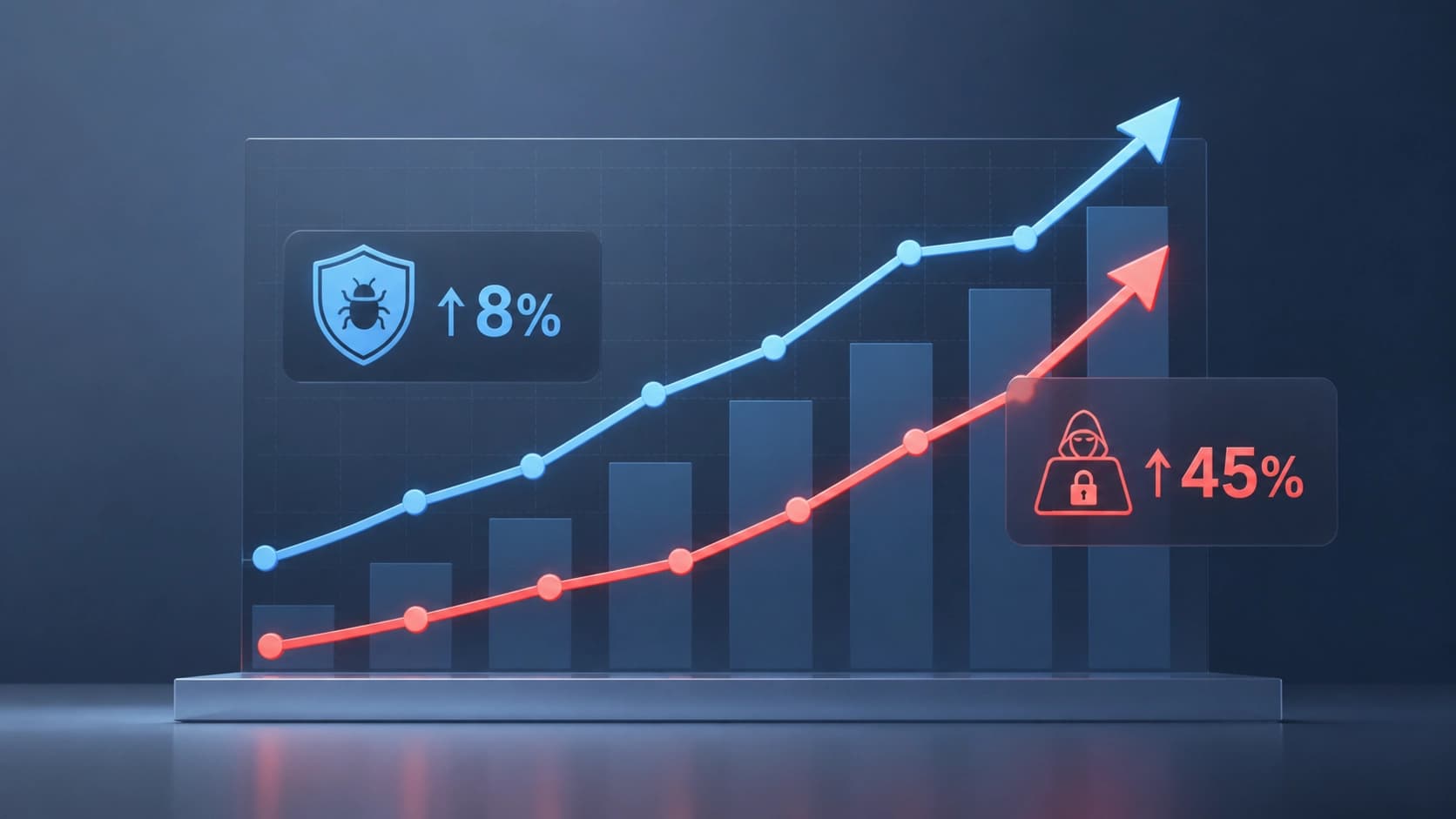
The number of vulnerabilities continues to grow. Flashpoint registered 21,667 vulnerabilities in the first six months of 2026 — 8% more than in the same period last year. Of these, 4,015 (nearly one in five) were accompanied by publicly available exploit code. This means that even an inexperienced attacker does not need to understand the details themselves — ready-made code is already available in the open.
Ransomware is also breaking records. The number of confirmed victims in the first half of 2026 reached 6,256, up 45% from the same period in 2025. The growth is explained not only by the increase in the number of attacks themselves but also by the fact that AI enables the automation of their preparation and execution.
Conclusion: The Fight Will Have to Be About Speed
The key takeaway from the Flashpoint report is that cybersecurity is changing direction. Previously, defense was built around combating specific tools and known malware signatures. Now that is no longer enough. AI can accelerate several processes simultaneously: gathering information about a company, preparing convincing messages, analyzing code, and adapting malicious tools to specific defenses.

Attacks are becoming faster, cheaper, and more accessible. The very idea of "building a fence" against a specific virus is becoming obsolete: static defense is giving way to the need to respond at the speed of the entire attack chain. While some AIs write emails on behalf of your CEO, others adapt malicious code to your antivirus. And in this race, the advantage goes to whoever is faster — and so far, that is clearly not the defenders.
Frequently asked questions
Related materials
All materials
Canonical Polynomial Invariants for Diagnosing RL Simulator Failures: Where Are They Actually Useful?
The study examines whether incorporating physical laws into learnable dynamics models is justified: invariants extracted from trajectories and reduced to canonical form using Gröbner bases yield modest forecasting gains, but prove powerful for diagnostics, enabling the localization of violated constraints and identification of specific erroneous parameters.
10 November 2026
AURA-Eval: How to Check Whether an LLM Agent Recognized a Risk and Changed Its Next Step
The framework evaluates LLM agents’ behavior not by their final verdict, but by how they respond to risk at key decision points: tool-call trajectories are interrupted, after which the model must continue reasoning and acting, while a panel of LLM judges assesses risk detection, the nature of the step, and its safety. Across 1,249 tasks drawn from 157 R-Judge trajectories, unsafe actions become more frequent among 20 models when no safe path is available, and removing oversight before execution turns 52.3% of initially safe cases into unsafe ones.
10 November 2026
Chern–Simons Reservoir Memory: Autonomous Connectivity Dynamics and Density Transport
The article explores how a reservoir preserves the history of input signals both in its density distribution and in its geometric degrees of freedom. A comparison of four mechanisms shows that current creates a separate connected component that alters the subsequent density response, while accounting for all measured features yields a small improvement in decoding pulse order.
10 November 2026