What the Research Is About
Can an AI agent independently devise a new method for solving a complex problem — or does it merely rearrange fragments of already known solutions? This question is the focus of the recent paper "When AI Designs AI: Innovation or Imitation?" (arXiv:2608.17471), authored by Yikang Yang, Zhengxin Yang, Luzhou Peng and colleagues. The research team submitted the paper on August 18, 2026; it spans two sections: cs.AI and cs.LG.
The authors start from a simple but important idea: it is not enough to show that an agent has solved a task. One also needs to understand how original its approach was. To that end, the paper formulates two questions:
- whether the methods proposed by agents actually perform no worse than human ones;
- whether these methods differ in their algorithmic structure from what humans typically produce.
How the Analysis Works
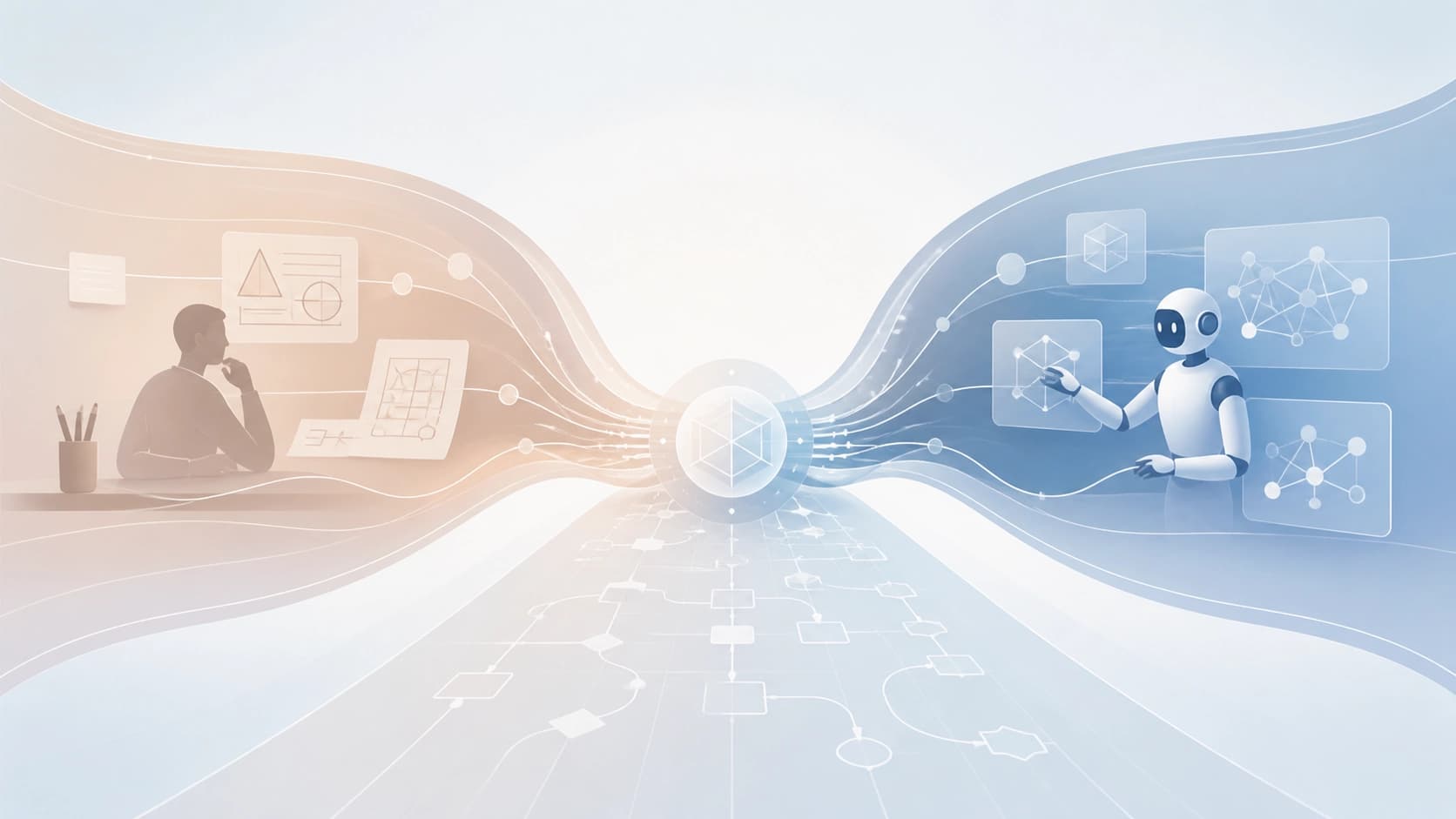
To answer these questions, the researchers built a dedicated framework. First, from a set of human methods for a given task, they derive so-called algorithmic design spaces — that is, the set of typical modules and the connections between them that characterize solutions devised by humans. Both human and agent methods are then mapped into these spaces. The difference between them is measured at the level of individual modules — this makes it possible to see which parts of a solution coincide and which arise anew.
The experiment was conducted on several widely used LLM agents and a selection of open AI tasks covering different modalities: text, images, and more. For each method generated by the agents, two parameters were evaluated: the quality of the solution to the task and the degree of algorithmic difference from human counterparts.
What This Gives in Practice
This approach makes it possible not just to say "the agent won" or "the agent lost," but to separate success from novelty. A system can deliver an excellent result while completely copying a known scheme. Conversely, it can propose an unusual design that performs worse. It is precisely this duality that the authors sought to capture.
What the Results Showed
The first part of the results sounds encouraging: in some cases, modern agents reach the level of human state-of-the-art and even surpass it. Ten such successful configurations were found out of 72. However, there is no stability: success does not reliably transfer either to other tasks or to other agents. In other words, an agent that brilliantly handled one task may completely fail a neighboring one — no pattern by which success could be predicted is visible yet.
Far more telling was the second part. Nearly all methods created by the agents — 96.8% — fall within those very algorithmic design spaces derived from human solutions. Agents do not go beyond what humans have already devised; they mostly combine and rearrange familiar algorithmic blocks. Moreover, roughly half of the generated methods exactly match existing human designs.

Conclusions
The authors of the study arrive at a dual conclusion. On the one hand, modern LLM agents are already capable of producing solutions comparable to the best human developments, and sometimes even surpassing them. On the other hand, it is too early to speak of their "genuine" novelty. Almost everything they do is careful reuse and recombination of already discovered algorithmic ideas. A true breakthrough beyond the human design space is a rare exception, not the rule.
This does not mean agents are useless: the ability to quickly find a working combination of known methods is valuable in itself. But if the goal is to obtain a fundamentally new algorithm, relying solely on the current generation of agents, judging by the results, is not advisable. Perhaps the next step will be not just a "smarter" agent, but one trained to deliberately go beyond known patterns.