

Facia
Platform for biometric identity verification with face recognition and anti-spoofing protection.
Overview
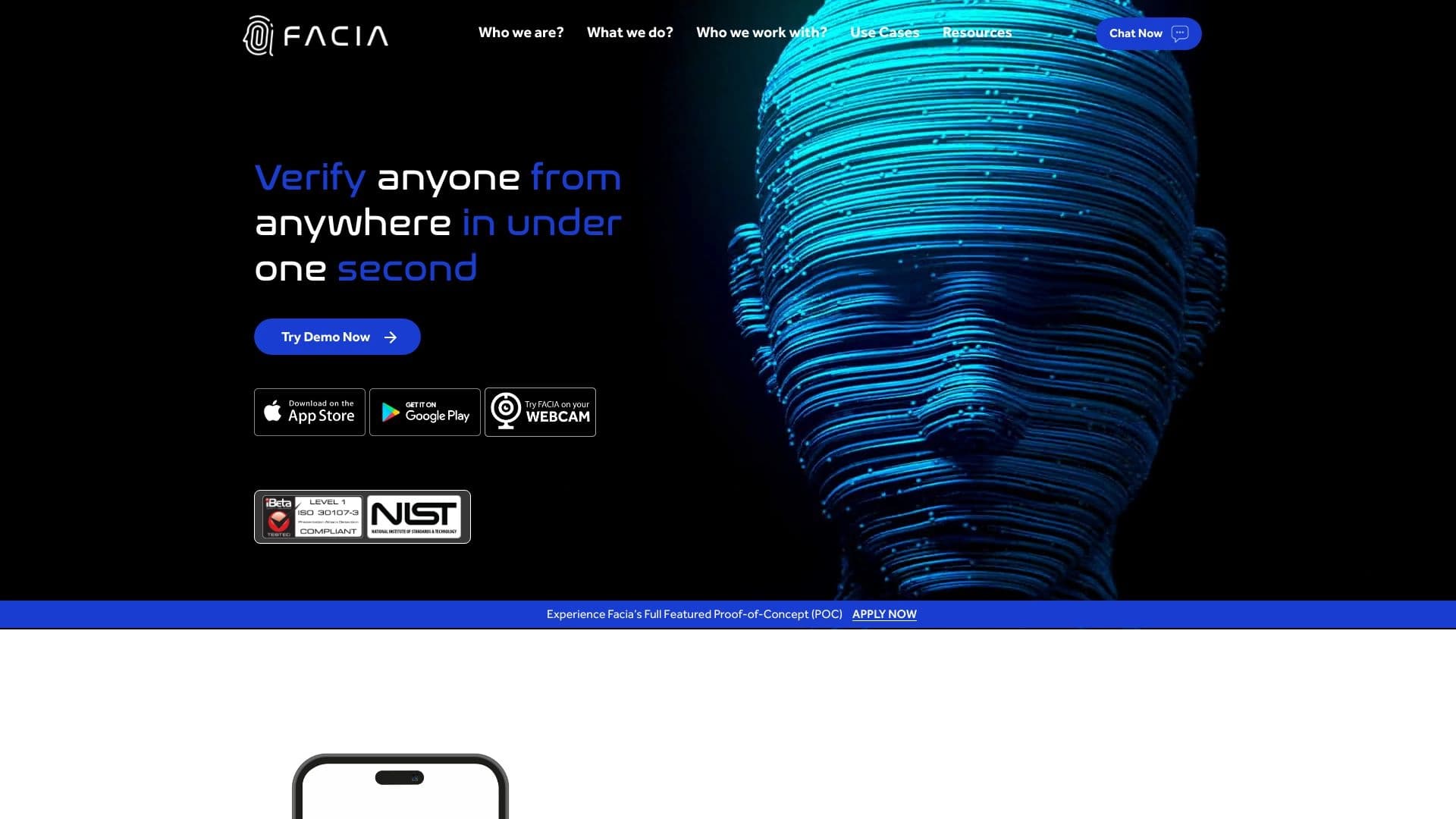
Facia is a biometric identity verification platform built on advanced three-dimensional facial recognition technology. Unlike classic 2D systems, Facia analyzes facial geometry in three dimensions, achieving high accuracy in user identification.
A key feature of the platform is its built-in liveness detection system. This technology distinguishes a real person from a photograph, video, or 3D mask, which is critical for protection against spoofing — attempts to deceive the system using fake biometric data.
The solution is positioned as a comprehensive tool for KYC (Know Your Customer) processes, information security, and fraud prevention. Facia is designed for integration into company business processes, as well as for developers building their own products with reliable user authentication requirements.
Facia Features
| Feature | Value |
|---|---|
| Recognition technology | 3D facial recognition |
| Liveness detection | Built-in liveness detection system |
| Primary purpose | Biometric identity verification |
| Spoofing protection | Yes |
| Target audience | Businesses, developers |
| Application areas | KYC processes, security, anti-fraud |
| Distribution model | Not specified |
Who is Facia suitable for?
Financial organizations and fintech companies
For banks, payment services, and insurance companies, Facia is suitable for remote customer identification when opening accounts, processing loans, or confirming transactions. The system helps meet regulatory KYC requirements while reducing the risk of fraud involving personal data.
Digital platforms and marketplaces
For services that require user identity verification — from property rental to cryptocurrency exchange — Facia helps build trust with the audience. Fast biometric checks simplify onboarding for new customers and prevent the creation of fake accounts.
Developers and system integrators
Teams building applications or services with identification features can embed Facia into their products. Through APIs, the solution adapts to specific user scenarios — from mobile apps to web services.
Enterprises with high security requirements
Companies handling confidential information or managing physical employee access can use Facia as an additional or primary authentication method. The technology is suitable for access control to premises, corporate systems, and data.
How to use Facia?
API integration
Facia provides options for connecting to a company's existing infrastructure through software interfaces. Developers can integrate the facial recognition module into their own application or web service, configuring verification parameters for specific tasks.
Configuring verification scenarios
After integration, the administrator configures usage scenarios: sets the required recognition accuracy, selects necessary checks (3D scanning only or additional liveness detection), and defines system behavior for suspicious attempts.
Conducting user verification
The end user goes through the procedure, typically using a smartphone or computer camera. The system captures the facial image, builds a 3D model, and performs a liveness check. The verification result is then passed to the integrated system.
Core Facia Features
3D facial recognition
Facia analyzes not a flat image but the volumetric structure of the face — depth, contours, and proportions. This ensures resilience to changes in lighting, angle, and facial expression, and makes it difficult to bypass the system using photographs and videos.
Liveness detection
Liveness detection technology verifies whether the object in front of the camera is a real person. The system tracks micro-movements, skin reflections, blinking, and other physiological signs that cannot be reproduced in a static image or a fake.
Anti-spoofing protection
The combination of 3D recognition and liveness checks creates a multi-layered barrier against fraudulent attempts. The system can detect highly realistic fakes, including silicone masks and projected images.
Identity verification module
The platform includes a complete identity verification workflow: from facial scanning to delivering the verification result. This process can be part of a broader KYC pipeline that combines document checks and biometric data.
Facia Advantages
Reliability and accuracy
The use of 3D technology delivers higher recognition accuracy compared to traditional 2D algorithms. The system is less sensitive to capture conditions and can correctly handle a wide range of appearance variations — from hairstyle changes to age-related differences.
Effective anti-fraud protection
The built-in liveness detection system makes the platform resilient to spoofing attempts. This is a key advantage for companies in the financial sector and any service where user authenticity is critical.
Versatility of application
Facia suits a wide range of tasks — from traditional banking KYC procedures to non-standard scenarios requiring confirmation of a real person's presence. The solution adapts to the needs of both large organizations and small development teams.
Facia Disadvantages
Information about the platform's limitations and weaknesses is not available in the provided source data. Without data on technical constraints (e.g., compatibility with specific camera models), deployment scale, and real-world system performance, it is impossible to objectively assess Facia's drawbacks. Potential users are advised to conduct their own testing under conditions as close to real operational scenarios as possible.
What problems does Facia solve?
Fraud prevention in remote operations
Facia makes it possible to quickly and reliably establish that a real person is behind the device, rather than an automated system or an attacker with fake data. This reduces risks in online lending, platform registration, and other remote operations.
Regulatory compliance
The solution helps companies meet legal requirements for customer identification. Automated biometric data verification accelerates KYC processes and reduces the impact of human error in manual document checks.
Security for digital services
The platform serves as an access control tool for protected resources. Biometric authentication via Facia can replace passwords and one-time codes, reducing the risk of account compromise.
Optimized user experience
Fast, seamless identity verification without the need to present physical documents shortens onboarding time. Users only need to complete a facial scan once to gain access to services.
Facia Pricing
The exact cost of using Facia is not disclosed in the source data. It is only known that the platform's distribution model is not defined in open sources. Typically, the cost of similar biometric services depends on several factors: the number of checks per month, integration volume, required support level, and individual agreement terms. For a current price quote, it is recommended to contact the provider directly or submit a request on the product's official website.
Facia Terms of Use
Detailed terms of use, including hardware and software requirements, data processing volumes, and legal aspects of biometric technology application, are not described in the source data. Before deploying the platform, users must review the license agreement and personal data processing policy, and ensure the solution complies with local regulations on biometrics and data protection.
Facia Availability
Information about Facia's availability is limited: the platform is marketed as a solution for businesses and developers, which implies the availability of an API and technical documentation. Detailed information about whether a cloud solution is available, whether an on-premises version is offered for deployment on a company's own infrastructure, and which platforms and operating systems are supported — is absent from open sources. For availability questions, contact the vendor.
How Facia differs from alternatives
Depth of analysis: from 2D to 3D
The main difference between Facia and most competing solutions is its reliance on 3D facial recognition. Many traditional systems work with 2D images, making them vulnerable to fakes and less accurate under changing lighting conditions. The 3D approach involves building a volumetric model of the face, fundamentally improving identification reliability.
Built-in liveness check as a single unit
In some solutions, liveness detection is implemented as a separate option that must be additionally activated or configured. In Facia, this function is an integrated part of the verification system, making spoofing protection a baseline rather than an additional security layer.
Focus on the user scenario
The product is designed with specific business processes in mind — KYC, access control, anti-fraud. Instead of a universal facial recognition tool that requires customization, Facia offers a ready-made component for embedding into the identity verification process, simplifying integration and reducing implementation time.
Conclusion
Facia is a technologically advanced biometric verification solution that stands out in the market through its use of 3D facial recognition combined with a liveness detection system. This approach provides a high level of fraud protection and makes the platform attractive to companies in the financial sector, digital platforms, and developers requiring reliable user identification. The lack of open information about pricing, licensing terms, and technical parameters limits a full comparison of Facia with competing products; however, the stated technological level indicates the platform's serious potential for KYC and information security tasks. As with any specialized tool, potential customers are advised to run a pilot test of Facia within their own business processes.
Frequently asked questions
See also


Service for tracking brand mentions in generative AI responses.
AI-powered online service that automatically converts bank statements from PDF into structured CSV files.

Service for creating personalized avatars and photo shoots using AI based on uploaded selfies.

A community for daily discovery and discussion of new technology products.


Free web tool from Google that uses machine learning to turn rough sketches into neat icons and illustrations.


AI-powered virtual clothing try-on service.


Generative platform for creating realistic images and short videos from text or images with control over style and camera movement.


Service for quickly generating e-books on a given topic.