

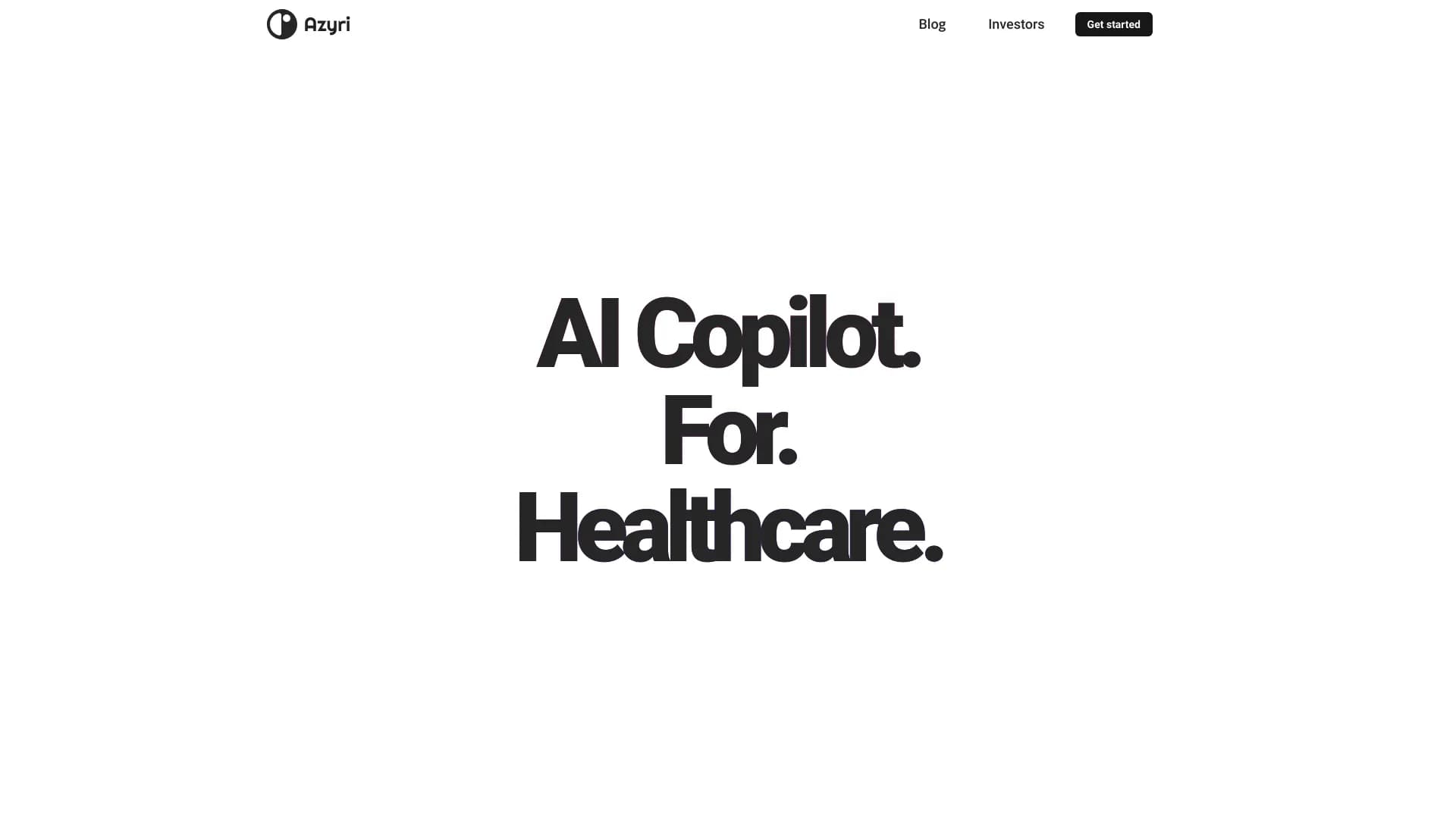
AI Co-pilot for Healthcare
AI tool for analyzing X-ray images and determining bone age.
Overview
AI Co-pilot for Healthcare is a specialized artificial intelligence platform designed to assist medical professionals in analyzing X-ray images. The tool's primary task is to automatically determine a patient's bone age from an image and generate a structured report with recommendations. The system acts as a virtual assistant: it handles the routine part of the work related to the initial review of images, allowing the physician to focus on complex clinical cases.
The service is developed by Azyri and is available through a web interface. To get started, simply upload an X-ray image to the website — within a few minutes, the system will produce a ready-made report. The developers emphasize that the tool does not replace a full medical consultation: all generated data is advisory in nature, and the final decision always rests with the specialist. The free tier allows users to explore the platform's capabilities without time restrictions.
AI Co-pilot for Healthcare Features
| Feature | Value |
|---|---|
| Type | AI-powered healthcare assistance platform |
| Categories | Healthcare tools, image and photo generators, image recognition tools, image segmentation tools |
| Developer | Azyri |
| Platforms | Website (web) |
| Free tier | Available |
| Monthly visits | 56.2K |
| Distribution model | Freemium |
Who is AI Co-pilot for Healthcare for?
Physicians and medical professionals
The platform is primarily aimed at practicing physicians who regularly work with X-ray images. The tool helps speed up the bone age determination process and reduces workload during high patient flow. The system generates detailed reports that can be used as supporting material when making a diagnosis.
Medical students and trainees
The service is also useful for medical university students and residents. They can practice on real clinical cases, compare their conclusions with AI-generated findings, and better understand what the diagnostic process looks like in practice. Free access for learning makes the platform a convenient educational tool.
Anyone interested in working with AI in medicine
Beyond the professional community, the service is open to a broad audience. Anyone can upload an image and see how artificial intelligence handles a medical task. This allows users to evaluate the potential of modern healthcare technologies without special training.
How to use AI Co-pilot for Healthcare
Uploading an image and getting results
The process of working with the service is extremely simple. Users need to go to the platform's website, upload an X-ray image in a suitable format, and wait for processing. Within a few minutes, the system will produce a ready-made report with recommendations. The entire process happens online and requires no additional software installation.
Access from any device
The service works through a browser, so it can be used not only from a computer but also from a phone or tablet. An internet connection is all that's needed to access all features — including image analysis and viewing request history. This is convenient for physicians who work across multiple departments or consult patients remotely.
Free access for medical professionals and students
For medical professionals and students, the platform works free of charge: users can upload images, test report generation, and use core features without a subscription and without time limits. This allows users to evaluate the tool's accuracy and convenience before moving to paid plans.
Core features of AI Co-pilot for Healthcare
Virtual assistant for physicians
The platform works as an intelligent assistant: it analyzes X-ray images, recognizes key structures, and generates a preliminary report. The neural network processes images without fatigue or emotion, which is especially important during high patient flow and at the end of the workday.
Automatic bone age determination
The service's key function is the automatic calculation of bone age from an X-ray image. The system compares the image against reference data and produces a result that the physician can use to assess the patient's development. This is one of the most in-demand tasks in pediatrics and orthopedics.
Automatic report generation
Based on the analysis, the platform creates a structured report describing identified features and recommendations. The document can be used as a foundation for the physician's further work. It's important to remember that the report is for reference purposes and is not an official diagnosis.
Advantages of AI Co-pilot for Healthcare
Lightning-fast image processing
The neural network delivers hints and preliminary results within seconds. This is especially valuable in settings where a physician must handle a large number of patients in a short time. The automated system's processing speed is significantly higher than manual analysis.
Improved diagnostic accuracy
AI processes images without emotional fluctuations or fatigue, reducing the risk of errors related to human factors. The platform can spot details that might be missed during prolonged work, helping the physician make more informed decisions.
Reduced routine workload
The service handles image sorting and initial analysis, generates detailed reports, and highlights complex cases. This frees up the physician's time for patient communication and solving non-trivial clinical tasks, rather than monotonous image work.
Limitations of AI Co-pilot for Healthcare
Does not replace a full medical consultation
It's important to understand that the service does not issue official diagnoses. All AI recommendations are merely hints that require confirmation from a physician. The final decision on each case always rests with the specialist, which limits the tool's use in situations requiring a complete clinical picture.
Potential for analysis errors
With poor image quality or rare pathological cases, the artificial intelligence may make mistakes. False alarms, missed problem areas, or inaccurate recommendations are possible. Therefore, automated analysis results should always be manually verified.
Data security concerns
Uploading medical images to a third-party service carries risks related to protecting patient personal data. Although the platform is expected to ensure confidentiality, a potential risk of information leakage exists. Medical institutions must consider this factor when choosing a tool.
What tasks does AI Co-pilot for Healthcare solve?
Fast bone age determination
The platform's primary task is the rapid calculation of a patient's bone age from an X-ray image. This is in demand in pediatrics for assessing the physical development of children and adolescents, as well as in sports medicine and orthopedics.
Online report generation
The service automatically creates structured reports from uploaded images. The physician receives a ready-made text with feature descriptions and conclusions that can be used in further work. This saves time on documentation.
Decision support for physicians
The platform serves as an additional source of information for decision-making. It provides data analysis and recommendations that help the physician look at a case from different angles and avoid missing important details.
AI Co-pilot for Healthcare Pricing
Free tier
The basic tier provides access to the platform's core features at no cost. It's suitable for exploring the service and basic use, including bone age determination and report generation.
Starter tier
The cost is 2,999 rubles per month. This tier includes expanded features designed for medical professionals. It's suitable for physicians who regularly use the platform in their daily work.
Professional tier
The maximum tier costs 5,999 rubles per month. It unlocks the platform's full functionality, including individual user support. Recommended for clinics and specialists with high workloads.
Terms of use for AI Co-pilot for Healthcare
The service operates under a freemium model: basic features are available for free, while expanded functionality requires a subscription. For medical professionals and students, the free version works without restrictions — users can upload images and test report generation without paying for a subscription. Paid tiers include expanded analysis features and priority request processing.
An important condition is that AI-generated results do not constitute an official medical opinion. The service only provides recommendations and analysis that are auxiliary in nature. The physician bears responsibility for making a diagnosis. The developers also emphasize that the final decision is always made by a specialist based on the complete clinical picture.
Availability of AI Co-pilot for Healthcare
The platform is available through the website azyri.com. An internet connection is required — the tool requires no local software installation. The service works on desktop computers and mobile devices alike through a browser.
Information about geographic restrictions, supported interface languages, and VPN requirements is not specified on the official page. Since the service is positioned as international, it is assumed to be available to users from different countries. However, the exact list of regions and languages should be verified on the platform's website.
How AI Co-pilot for Healthcare differs from alternatives
AI Co-pilot for Healthcare combines three aspects rarely found together in similar tools: specialization in medical diagnostics, a narrow focus on bone age determination, and an accessible pricing model. Classic image generators like Midjourney or Nano Banana handle visual content creation and are not designed for X-ray analysis.
General-purpose AI tools like Perplexity AI or GenAPI work with text and general data but lack the medical expertise needed for image recognition and structure segmentation on radiographs. Automation services are oriented toward office tasks and have no industry-specific focus.
The key difference of AI Co-pilot for Healthcare is its deep integration into the workflow of a radiologist or pediatrician, including automatic image segmentation and professional report preparation. At the same time, the availability of a free tier for evaluation makes it accessible to a broader audience than most specialized medical platforms.
Conclusion
AI Co-pilot for Healthcare is a highly specialized tool that helps medical professionals speed up X-ray analysis and automatically determine a patient's bone age. The platform handles the routine part of the work, generates structured reports, and serves as an additional source of information during diagnosis. At the same time, the service does not replace a full medical consultation, and its recommendations are auxiliary in nature. The availability of a free tier, the ability to work from mobile devices, and its focus on physicians and students make the platform a practical solution for those looking to integrate AI into medical practice. The development of such tools is a significant step toward reducing the burden on healthcare professionals; however, using such services requires careful attention to data security issues and always presupposes the physician's final decision.
Frequently asked questions
See also


AI assistant for doctors that automatically creates structured SOAP notes from appointment audio recordings.


An online service that recognizes text on manga and manhwa pages, translates it into different languages, and embeds it back into the image without damaging the original artwork.

Neural network for automating the analysis of lumbar spine MRI and report preparation.

A set of AI tools for image editing: background removal, object removal, quality enhancement, and variation generation.

AI-powered service that creates personalized hypnotic audio sessions.


AI platform for CRM automation, call analytics, and real-time sales training.


AI-powered service for digitizing paper calendars and handwritten notes through photos.


Service for automatically generating alt text for images, improving SEO and website accessibility.