
Agent Crop
AI platform for detecting plant diseases and identifying their species from photos.
Overview
Agent Crop Neural Network Description
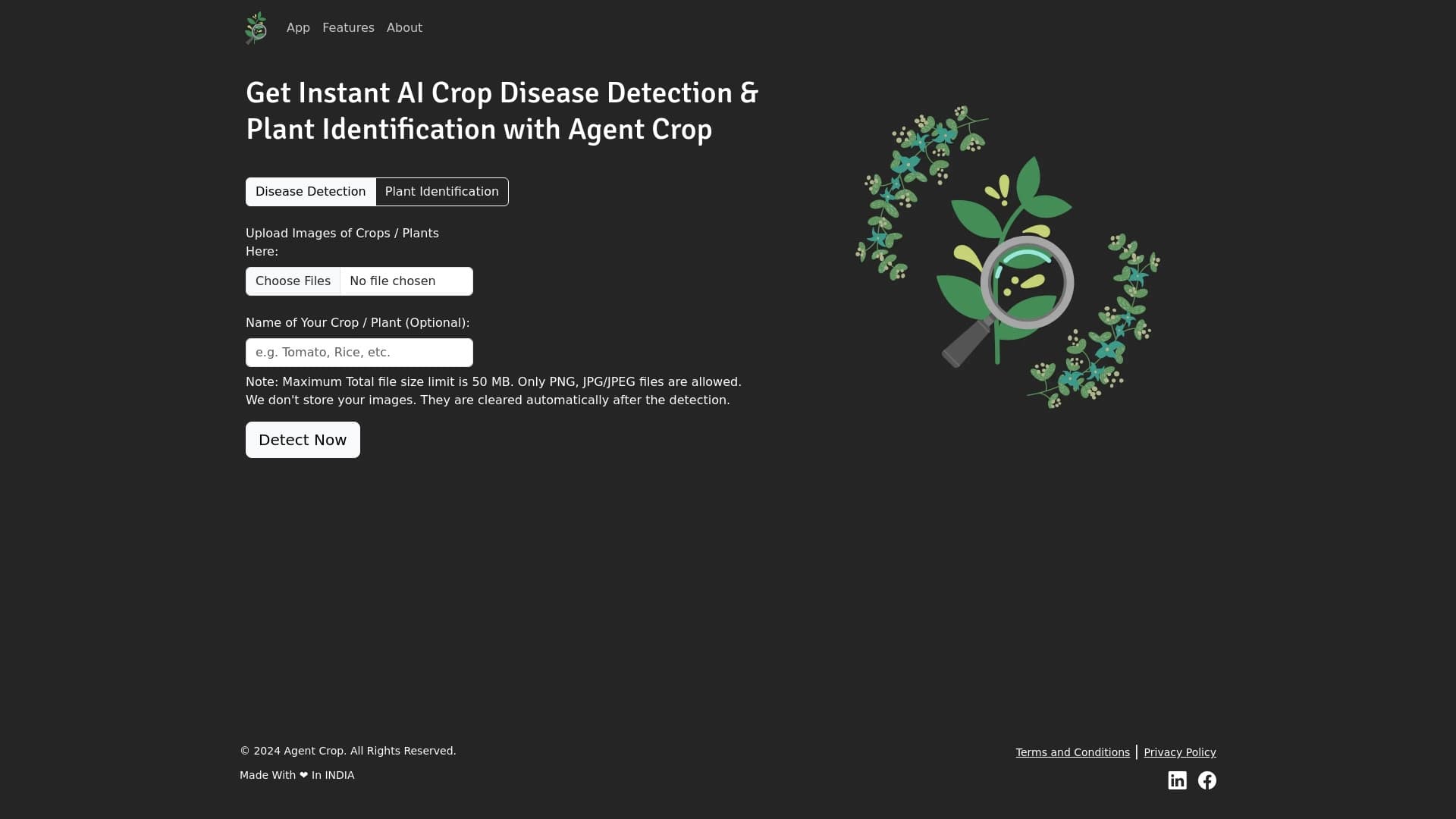
Agent Crop is a specialized AI platform designed for use in agriculture. Its primary purpose is to analyze plant photos using computer vision technology. The service allows users to determine, from a single image, which disease is affecting a crop and to accurately identify the plant species.
The main value of the tool is the speed of obtaining a diagnosis. Instead of waiting for an agronomist's consultation or laboratory analysis, users can instantly get information about the problem right in the field or greenhouse. This is especially important when dealing with rapidly spreading infections, where every day of delay can cost part of the harvest.
The accuracy of the algorithms is based on training neural networks on large datasets of plant images in various states — from healthy to those affected by different pathogens. The platform not only recognizes diseases but also performs the reverse task: identifying the plant species, which is useful when working with rare or lesser-known crops.
Agent Crop Features
| Feature | Value |
|---|---|
| Tool type | AI platform for crop production |
| Core technology | Computer vision |
| Key tasks | Plant disease detection, species identification |
| Input data | Plant photos |
| Target audience | Farmers, agronomists |
| Distribution model | Not specified |
| Key function | Image analysis for diagnosis |
| Description language | English |
| Application area | Agriculture |
Who Is Agent Crop Suitable For?
Farmers and Farm Owners
For those who work daily with large numbers of plantings, the platform becomes a kind of "second opinion." When harvests are measured in tons and each crop requires an individual approach, it's important to quickly notice the first signs of problems. Agent Crop helps identify deviations at early stages, when treatment can still be effective and not too costly. This reduces the risk of crop loss and cuts expenses on chemical treatments, which are applied only after accurate diagnosis.
Agronomists and Consultants
Specialists who serve several farms at once often physically cannot visit all fields in a short time. With this tool, agronomists can remotely receive preliminary analysis of plant conditions from photos sent by clients. This helps prioritize requests: visiting the most critical areas first, while resolving simple cases remotely or by phone.
Researchers and Breeders
For scientific staff, the ability to quickly identify species and diseases is useful in field research, herbarium collection, or monitoring experimental plots. Reducing time spent on routine recognition allows more attention to be given to data analysis and conducting experiments.
How to Use Agent Crop?
Main Workflow
Working with the platform is based on uploading photos. Users simply need to photograph a plant with a smartphone or professional camera and upload the image to the service. The artificial intelligence processes the image, analyzes visual signs, and provides a result: the suspected disease or plant species.
Practical Recommendations
To get quality results, several conditions should be met when taking photos. The image should be sharp, with sufficient lighting, and free of extraneous objects in the frame. It's better for the plant to occupy most of the frame. Depending on the type of disease, leaves, stems, or fruits should be visible in the photo, depending on where symptoms appear. After receiving the result, it's recommended to compare it with the actual condition of plants in the field to verify the accuracy of the assessment.
Integration into Workflow
The service's functionality allows building a simple action algorithm: when a suspicious plant is found, it is photographed and sent for analysis the same day, so protective measures can be taken quickly if needed — such as treatment or isolating the affected area.
Key Features of Agent Crop
- Disease diagnosis from photos — the platform analyzes visual symptoms and matches them against signs of known crop diseases. Users receive not only the disease name but also a basis for deciding on treatment.
- Plant species identification — the reverse function of diagnosis. When users encounter an unfamiliar crop or weed, the service helps accurately determine what is growing on the plot.
- Recognition from a single image — no need to upload a series of photos or videos; one quality shot is enough.
- Real-time analysis — image processing takes minimal time, which is critical in cases of mass crop damage.
- Decision support — the obtained information allows quickly choosing a plant protection strategy without waiting for external consultation.
Advantages of Agent Crop
Speed of diagnosis. The traditional path of disease identification — from detecting symptoms to laboratory confirmation — takes at least several days. With Agent Crop, this interval is reduced to a few minutes, and repeat analysis can be done if needed.
Accessibility anywhere. Only a smartphone or camera with internet access is required. This is especially convenient for farms far from major agronomic centers and laboratories.
Resource savings. Prompt problem detection at an early stage allows reducing the volume of treatments, and accurate species identification helps avoid using unsuitable products. As a result, costs decrease and the environmental impact is reduced.
Lower entry barrier for beginner farmers. Young agronomists without years of practical experience can rely on AI hints for initial plant condition assessment while gradually building their own skills.
Disadvantages of Agent Crop
The main limiting factor is dependence on the quality of the source image. With poor lighting, heavy blur, or an unclear shot, identification accuracy may decrease, and the result will be tentative in nature.
It's also important to understand that computer vision cannot fully replace visual inspection by a specialist. Some diseases have similar symptoms, and some pathogens manifest in complex ways. In such cases, the service can only act as an assistant, and the final decision should be made by an experienced agronomist.
Additionally, the limited information available about the platform's operating parameters makes it difficult to assess its suitability for specific user tasks before practical use.
What Problems Does Agent Crop Solve?
Plant health monitoring. Regular checks of fields and greenhouses with photo documentation of problem areas allow timely detection of the onset of epidemics or pest spread.
Accelerating field work. Agronomists don't need to carry every suspicious plant to the lab — some issues can be resolved on the spot using a smartphone.
Staff training. Young farm employees can use analysis results as educational material — comparing AI conclusions with actual disease manifestations and plant characteristics.
Mapping problem zones. By collecting disease statistics tied to specific areas, high-risk zones can be identified and preventive measures taken.
Working with rare crops. If a non-standard or newly introduced crop is grown on a plot, identifying its species and typical diseases can be difficult even for experienced specialists — this function is handled by AI.
Agent Crop Pricing
Up-to-date information on platform pricing was not officially published at the time of writing. The distribution model is not specified, so it cannot be confirmed whether the service is free, subscription-based, or offers one-time payment per analysis.
It is recommended to follow official project updates or contact the development team directly for commercial terms. Various pricing plans are likely to be available, designed for both individual users and large agricultural enterprises, though there is no confirmation of this in open sources.
Agent Crop Terms of Use
Since detailed legal descriptions of the service terms are absent from available materials, a standard set of requirements typical for such platforms can be assumed: the need to register an account, compliance with image upload rules, and responsibility for using the results.
Users should keep in mind that AI-based diagnosis is advisory in nature and cannot be the sole basis for using chemical plant protection products. Decisions on specific measures should be made considering local agronomic standards and regulations.
Likely, the terms of use will include a limitation of liability regarding diagnostic accuracy — computer vision does not exclude errors, especially in non-standard cases with rare diseases or unusual shooting conditions.
Agent Crop Availability
Currently, the platform is positioned for the international market, with information presented in English. Support for other languages is not officially confirmed, which may be a temporary obstacle for non-English-speaking users when studying documentation and the interface.
Based on the description, the service works via a web browser or mobile devices, but specific formats — mobile app, desktop version, or web client only — are not detailed in open sources. Device technical requirements are also not published. Internet access and the ability to take high-quality photos of plants will be needed for the recognition algorithms to function properly.
How Agent Crop Differs from Alternatives
The key difference lies in combining two functions in one tool — disease detection and plant species recognition. Many alternatives specialize only in diagnosing known crops, while Agent Crop is positioned as a universal solution for working with any plants.
Most market products have a narrow focus on major agricultural crops — wheat, corn, sunflower. The species identification capability significantly expands the platform's applicability beyond the standard crop set — from ornamental plants to medicinal herbs.
Another nuance is the emphasis on use in real production cycles. The service is designed not as a reference guide for curious gardeners, but as a working tool for rapid decision-making in agribusiness. This is reflected in its focus on analysis speed and the practical applicability of results for disease control.
Conclusion
Agent Crop represents a modern solution at the intersection of artificial intelligence and agronomy, focused on rapid diagnosis of crop diseases and plant species identification from photos. The use of computer vision allows farmers and agronomists to significantly reduce the time needed to identify problems, make informed plant protection decisions, and reduce crop losses. Complete data on pricing policy and access terms are not yet available, which does not prevent viewing the platform as a promising tool for improving crop production efficiency, provided it undergoes testing on real farms.
Frequently asked questions
See also

Free web tool from Google that uses machine learning to turn rough sketches into neat icons and illustrations.
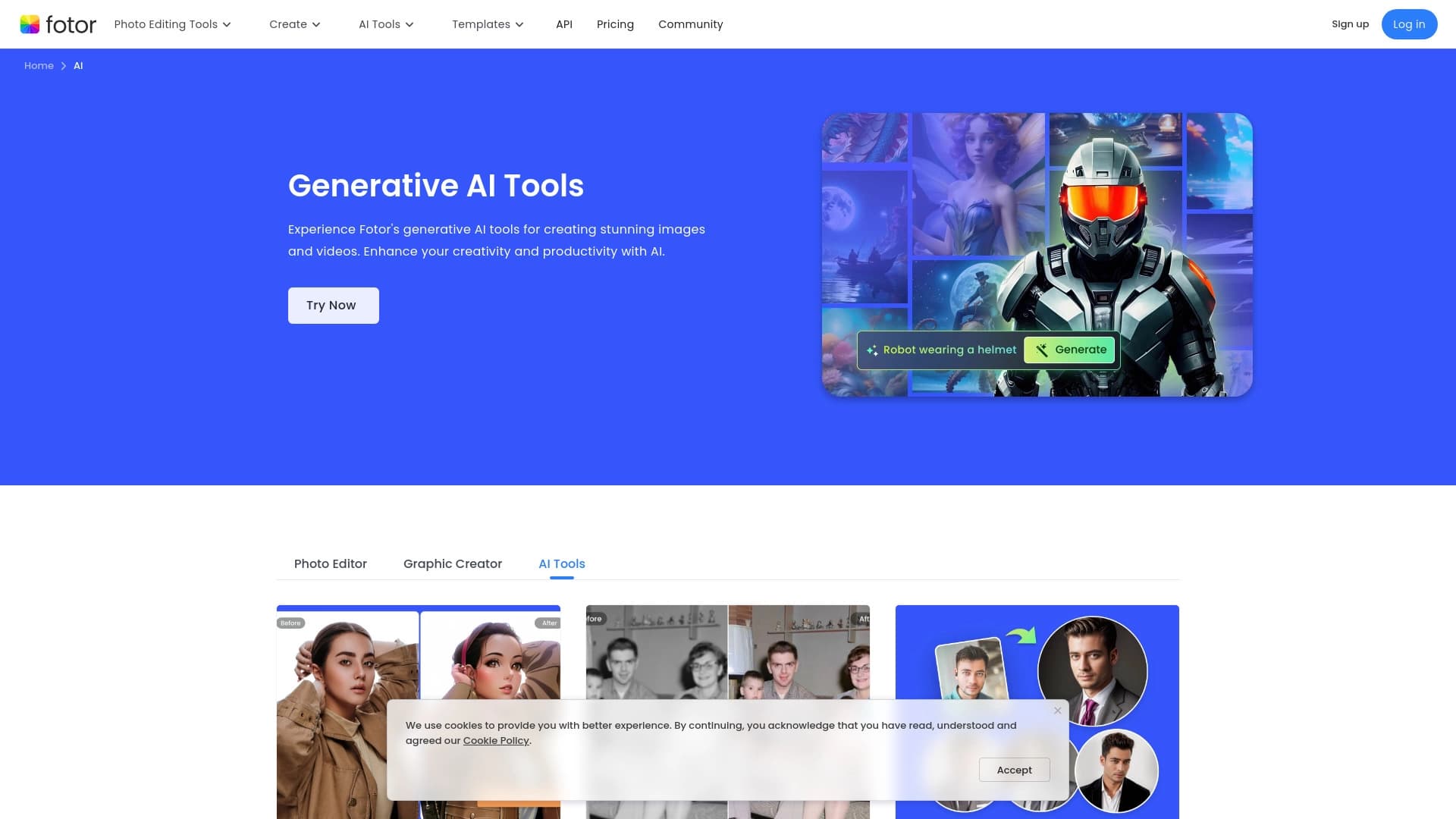

Online image editor with AI-powered features for photo processing, design, and content generation.


An online service that recognizes text on manga and manhwa pages, translates it into different languages, and embeds it back into the image without damaging the original artwork.

A multimedia AI toolkit for editing and enhancing photos, videos, and PDF documents.

A set of AI tools for image editing: background removal, object removal, quality enhancement, and variation generation.


AI platform for CRM automation, call analytics, and real-time sales training.


AI-powered service for digitizing paper calendars and handwritten notes through photos.
AI service for analyzing nutrition and creating personalized meal plans based on food photos.