

Unlearn.AI
Platform that creates digital twins of patients to optimize clinical trials.
Overview
Unlearn.AI
Description of Unlearn.AI neural network
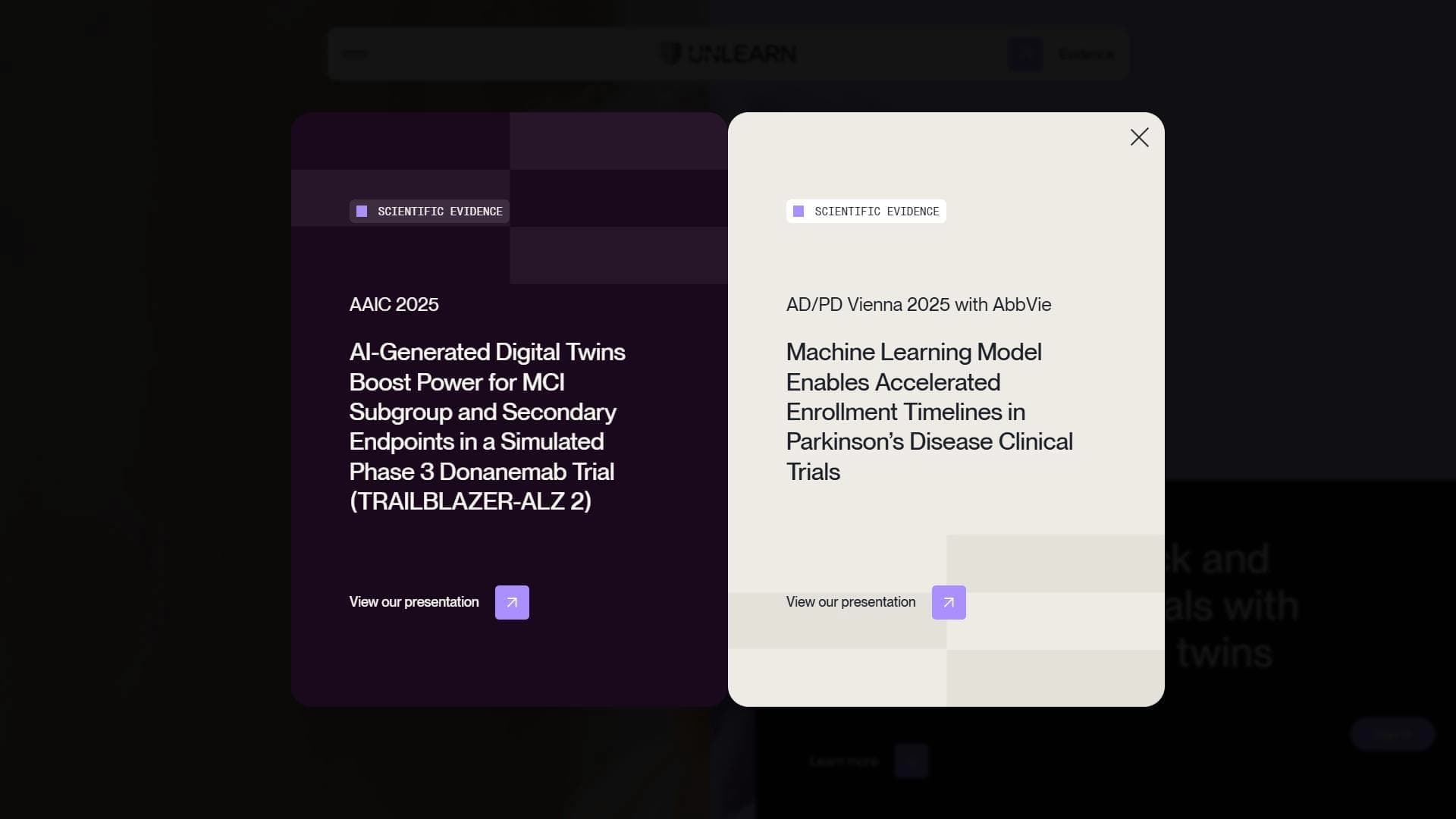
Unlearn.AI is a platform that uses artificial intelligence to create digital twins of patients. The system uses historical medical data to build virtual models that can predict how a particular patient will respond to a particular treatment.
The main goal of the service is to optimize clinical trials. Instead of enrolling large numbers of participants in control groups, pharmaceutical companies can use digital twins to compare results. This makes it possible to reduce the scale of trials, shorten their duration, and lower the financial costs of developing new drugs.
The platform integrates into the workflow of medical research centers, offering a new approach to planning and conducting clinical trials based on data and predictive modeling.
Unlearn.AI Characteristics
| Characteristic | Value |
|---|---|
| Type | AI for clinical research and predictions |
| Categories | Medical diagnostics, Scientific articles and research |
| Website | www.unlearn.ai |
| Distribution model | Not specified |
Who is Unlearn.AI for?
Pharmaceutical companies
The main target audience of Unlearn.AI is pharmaceutical manufacturers conducting clinical trials of new drugs. For them, the platform offers a way to reduce the number of participants in control groups and speed up obtaining results while maintaining statistical validity of the study.
Medical research centers
Research organizations and academic institutions can also use the platform. Digital twins allow researchers to model treatment outcomes more accurately and analyze the potential effectiveness of therapy before real patient trials begin.
How to use Unlearn.AI?
Uploading historical data
The user provides the platform with historical patient data that has already been collected during previous studies or from medical records. The quality and completeness of this data directly affect the accuracy of building digital models.
Building digital twins
Based on the uploaded data, the system creates virtual models of patients. These twins reflect individual characteristics and make it possible to predict likely clinical outcomes for a specific person.
Planning and conducting research
The created models are used to optimize the design of clinical trials. Treatment response predictions are used in planning control group sizes and assessing drug efficacy, which helps make decisions before the expensive stages of a study begin.
Key features of Unlearn.AI
Modeling patient digital twins
The platform builds virtual models based on historical patient data, enabling a personalized approach to predicting therapy outcomes.
Predicting clinical outcomes
The AI assesses how a patient may respond to a specific drug or treatment regimen, providing data for decision-making during trials.
Optimizing clinical trial design
The service helps revise the structure of control groups, reducing the number of participants while maintaining the reliability of conclusions.
Reducing trial duration and costs
By reducing the scale and accelerating data analysis, the overall cost of conducting studies and the time to bring a drug to market are lowered.
Advantages of Unlearn.AI
Reducing clinical trial costs
Using digital twins reduces the number of real participants needed, which directly lowers the study budget.
Reducing the number of control group participants
Instead of a large number of patients in the control group, predictive models can be used, simplifying recruitment and reducing the burden on research infrastructure.
Accelerating the development of new drugs
Optimizing key trial stages allows a faster transition from the research phase to drug registration, which is especially important in a competitive pharmaceutical market.
Disadvantages of Unlearn.AI
Requirements for historical data quality
The platform requires complete and reliable patient data to work correctly. Insufficient information or its low quality can lead to inaccurate predictions and reduced modeling effectiveness.
Complexity of adoption for new users
Working with digital twins requires an understanding of the methodology and a certain level of technical expertise. Teams that have not used such tools before may need time for training and process adaptation.
What tasks does Unlearn.AI solve?
Optimizing clinical trials with AI
The platform automates part of the planning processes, replacing intuitive decisions with analytical, data-driven predictions.
Predicting treatment outcomes
The service gives researchers a tool for estimating likely therapy outcomes before it is actually applied, improving understanding of a drug’s effectiveness.
Accelerating the development of new drugs
Shortening trial timelines and optimizing control groups contribute to faster completion of all development stages, from preclinical studies to submission of regulatory documents.
Unlearn.AI Pricing
Information about the cost of using the Unlearn.AI platform is not available in open sources. To obtain a commercial offer and clarify pricing terms, you need to contact the developers directly through the service’s official website.
Unlearn.AI Terms of Use
Detailed information about the legal terms of use of the service is not published on publicly available resources. Judging by the stated functionality, the platform is intended for professional use in research and pharmaceutical organizations, which implies formal cooperation agreements between the client and the developing company.
Unlearn.AI Availability
The service is available on the official website www.unlearn.ai. The platform is focused on working with organizations — pharmaceutical companies and research centers, so access for individual users not involved in medical research is likely limited or not provided.
How is Unlearn.AI different from analogues?
Focus on digital twins
Unlike many AI tools that are limited to data analysis or pattern recognition, Unlearn.AI focuses on building virtual models of specific patients. This allows a high degree of personalization in research.
Optimization of control groups
The platform solves a specific problem — reducing the number of control group participants in clinical trials. This distinguishes it from tools that work with diagnostics or analysis of medical images.
Focus on pharmaceutical processes
Unlearn.AI integrates into the workflow of pharmaceutical companies, offering a comprehensive solution for trial planning, while many analogues are focused only on individual stages of medical analysis.
Conclusion
Unlearn.AI is a specialized platform for optimizing clinical trials by creating digital twins of patients. The service enables pharmaceutical companies and research centers to reduce control group sizes, lower costs, and accelerate the development of new drugs. However, effective use of the platform requires high-quality historical data and a willingness to learn a new methodology for working with digital models.