

Neuralink
A neural interface that enables signal transmission between the brain and external devices using an implantable system and robotic surgery.
Overview
Neuralink
Description of the Neuralink neural network
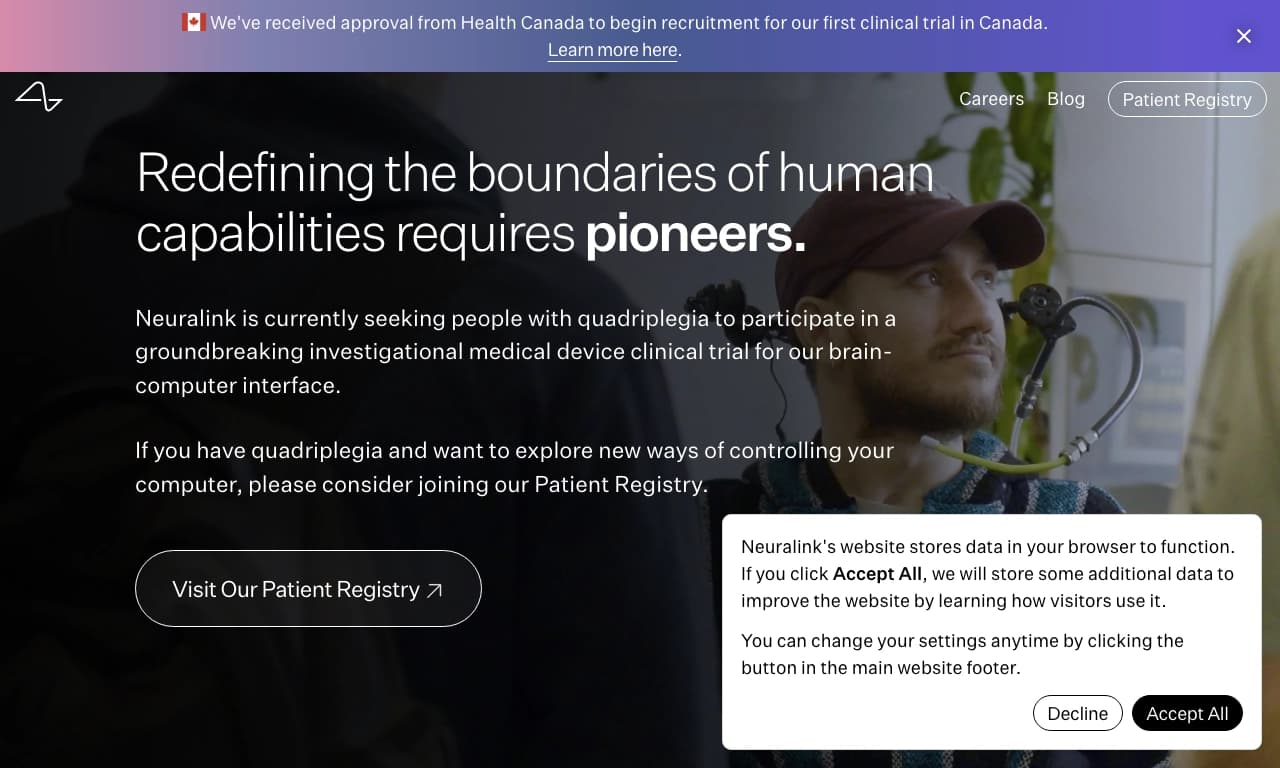
Neuralink is an innovative company developing implantable brain-computer interfaces that establish a direct communication channel between the human brain and external devices. The primary goal of the technology is to restore lost sensory and motor functions in people with disabilities and, in the long term, to create a fundamentally new way for humans to interact with digital devices.
The Neuralink system is a miniature implant placed directly in brain tissue using a specialized robot. Robotic surgery ensures high placement accuracy and minimal invasiveness. Once implanted, the device reads and stimulates neural signals, allowing the brain to send commands directly to external devices without using muscles or peripheral nerves.
Purpose and scope of application
The main purpose of Neuralink is medical rehabilitation. The device is intended for patients with paralysis, amputations, neurodegenerative diseases, and other conditions in which the connection between the brain and the body is impaired. In the future, the technology may be extended to healthy individuals to enhance cognitive abilities or integrate with digital systems.
Technological foundation
The core of the system consists of flexible ultra-thin electrode threads implanted into the cerebral cortex that can record the activity of thousands of neurons simultaneously. Signal processing is performed by an integrated chip that transmits data over a wireless link. The implant is invisible under the skin and requires no external wires or connectors.
Neuralink Specifications
| Characteristic | Value |
|---|---|
| Type | Neural network for brain-computer interaction |
| Category | Robots and devices |
| Platforms | Web |
| Editor's rating | 8.8 out of 10 |
| Access | Restricted in some regions |
Who is the Neuralink neural network suitable for?
People with disabilities
First and foremost, Neuralink is intended for patients who have lost the ability to move, speak, or feel due to spinal cord injury, stroke, or degenerative diseases. The implant can restore lost functions by allowing users to control prostheses, wheelchairs, or computer interfaces directly through thought.
Researchers and engineers in neurotechnology
The company's development is of interest to the scientific community and specialists working on brain-computer interfaces. The platform provides opportunities for studying neural activity and testing new approaches to treating neurological disorders.
Potential future users
Although access to the technology is currently limited to clinical trials, in the long term Neuralink may be in demand among a wide range of people interested in contactless control of devices and expanding their own cognitive capabilities.
How to use the Neuralink neural network?
Implantation procedure
The device is implanted in an operating room. The company's specialized robot performs microsurgery: through a small opening in the skull, it inserts flexible electrode threads into targeted areas of the cerebral cortex with micron-level precision. The entire operation takes about an hour and is performed under local anesthesia.
Calibration and training
After implantation, the system undergoes a calibration phase during which the neural network learns to recognize patterns of brain activity corresponding to the user's intentions. The person mentally imagines moving a limb or issuing another command, and algorithms match the signal to the action and fine-tune decoding. This process takes from several days to several weeks.
Everyday interaction
In everyday use, the device operates autonomously: the implant continuously reads neural signals and transmits them to an external receiver (for example, a smartphone or computer), where commands are processed and converted into control of a cursor, text input, prosthesis, or other interfaces. All interaction is wireless and only requires the implant's battery to be charged.
Main functions of Neuralink
Reading neural signals
The device can record the electrical activity of thousands of neurons simultaneously thanks to an array of ultra-thin electrodes. The data obtained make it possible to decode the user's intentions with high accuracy—from a simple finger movement to complex sequences of commands.
Brain stimulation
In addition to reading signals, the implant can deliver electrical pulses to specific areas of the cortex, opening up possibilities for restoring lost sensations (for example, touch when using prostheses) or treating neurological conditions such as severe depression, chronic pain, and epilepsy.
Wireless data transmission
Information is exchanged between the implant and external devices over a wireless channel with high bandwidth and latency below the human physiological response. This makes real-time control of external equipment possible—from an on-screen cursor to complex robotic manipulators.
Advantages of Neuralink
Minimal invasiveness of implantation
The implantation procedure is performed by a robot, which eliminates human error, reduces the risk of tissue damage, and speeds up patient recovery. The size and design of the implant allow it to be placed under the scalp with no visible external components.
High accuracy of the neural interface
Thanks to a large number of electrodes and their precise placement, Neuralink provides multichannel signal reading with high resolution. This allows the user to perform fine, multi-step actions—for example, typing text or drawing using only mental commands.
Broad development potential
The platform is designed to be universal: its architecture supports software updates and the addition of new features as the technology evolves. This means that an implanted device can be improved without repeated surgery.
Disadvantages of Neuralink
Invasiveness and surgical risks
Despite robotic precision, implantation remains a surgical procedure—it carries risks of inflammation, rejection, tissue damage, and related complications. Any brain surgery is potentially dangerous, and a patient must have strong medical reasons to undergo it.
Limited access
At present, the technology is in clinical trials and available only to a limited number of study participants. Widespread commercial deployment has not yet begun, making the product inaccessible to most potential users.
Geolocation restrictions
Access to Neuralink resources may be restricted in some regions. This creates additional barriers to learning about the product and potentially participating in testing programs.
What problems does Neuralink solve?
Restoring lost motor functions
The main task Neuralink addresses at this stage is restoring the ability to control external devices for patients who are fully or partially paralyzed. The implant bypasses damaged parts of the nervous system and sends commands directly from the cerebral cortex to prostheses, screen interfaces, or assistive robots.
Creating a communication channel for people with speech disorders
The device can decode the intention to say a word or phrase based on patterns of brain activity and convert it into text or synthesized speech. This enables communication for people who have lost the ability to speak due to stroke, injury, or neurodegenerative disease.
Stimulating neuroplasticity and restoring sensation
Electrical stimulation of specific brain areas via the implant may help restore neural connections and return tactile sensations in patients with spinal cord or peripheral nerve damage, and may also potentially aid in the therapy of certain mental disorders.
Neuralink Pricing
Current information about the cost of implantation, the device itself, or subsequent maintenance has not been officially disclosed. Neuralink is at the clinical trial stage, and commercial prices have not yet been set. Pricing is expected to be announced after necessary regulatory approvals and market entry. Until then, any figures are speculative and have not been confirmed by the company.
Terms of Use for Neuralink
At this stage, access to the technology is possible only through clinical trials conducted by Neuralink. Trial participants are patients with medical indications—usually people with severe motor impairments. Enrollment in the program requires meeting strict selection criteria defined by the study protocol and regulatory requirements (the FDA in the United States and similar organizations in other countries).
After trials are completed and permission for commercial use is obtained, the terms of use will include medical indications, voluntary informed consent, preoperative examination, and compliance with postoperative recommendations. Any commercial or research use will require purchasing the system through the company's official channels.
Neuralink Availability
Physically, the technology is available in the United States and a limited number of countries where clinical trials are conducted. Widespread geographic deployment is expected after regulatory approvals, the timing of which varies by jurisdiction.
At the level of information accessibility, the official Neuralink website and related online resources may be restricted in some regions. Users in those regions may need to use workarounds to access them. This restriction affects downloading materials, registering for news, and submitting applications to participate in research.
Platforms from which information about the device can be obtained include the web (browser versions of the site). There are currently no publicly available mobile applications for controlling or monitoring the implant.
How is Neuralink different from alternatives?
Competitors in the brain-computer interface market
The brain-computer interface market includes both invasive (implantable) and non-invasive solutions. Among Neuralink's analogues are NEO by 1x Technologies, GetBot, Atom Limbs, Unitree G1, and Tesla Optimus. Most of these systems fall into the category of robots or prostheses rather than brain-computer interfaces proper, which points to Neuralink's specific positioning.
Key differences from analogues
Unlike exoskeletons and external manipulators (such as Tesla Optimus or Unitree G1), Neuralink works by directly reading brain signals rather than through peripheral nerves or muscles. This makes it suitable for patients with complete paralysis who cannot control external devices even through minimal residual movements.
Compared with prostheses like Atom Limbs, Neuralink not only controls an artificial limb but can also provide sensory feedback through brain stimulation. However, Neuralink is not a ready-made, out-of-the-box device like GetBot, but a platform that requires surgical implantation and lengthy calibration.
Technological superiority and limitations
Neuralink's main advantage over its analogues is its high electrode density and robotic placement accuracy, which allows it to work with individual neurons rather than only groups of cells. However, this also makes the technology more invasive than non-invasive EEG headsets. None of the existing analogues offers the same combination of long-term stability, bandwidth, and wireless operation.
Conclusion
Neuralink is a breakthrough technology in the field of brain-computer interfaces, aimed at restoring lost sensory and motor functions in people with disabilities. The implantable system with robotic installation, high-precision neural signal reading, and the ability to directly stimulate the brain opens new prospects for rehabilitation and human interaction with technology. Although the technology is still at the clinical trial stage and its availability is restricted in some regions, Neuralink's potential in medicine and beyond remains among the most significant of modern neurotechnology developments.