

DeepNude
A program using AI to remove clothing from images of women, whose official development ceased in 2019.
Overview
DeepNude
Description of the DeepNude neural network
DeepNude is a computer vision program released in 2019 that used algorithms to automatically remove clothing from photos of women. The developer, known under the pseudonym Alberto, created the tool based on the pix2pix architecture, capable of generating realistic images. Immediately after its release, the project faced a powerful wave of criticism from the public, human rights advocates, and the tech community due to the high risk of abuse. Under public pressure, the creator shut down the project and removed the official download links. However, despite the discontinuation of official development, unofficial copies and clones of DeepNude continue to circulate online, and the tool itself has become a notable example of the ethical and legal issues associated with deepfake technologies.
DeepNude features
| Characteristic | Value |
|---|---|
| Type | Desktop application |
| Category | Photo processing, image generation, NSFW |
| Platforms | Windows, Linux |
| Release date | 2019 |
| Author | Alberto |
| Paid version price | $50 |
| Free version available | Yes (with watermark) |
Who is the DeepNude neural network for?
Developers and researchers of deepfake technologies
DeepNude is of interest to specialists studying computer vision algorithms and generative neural networks. The code and operating principles of the tool can be used for research purposes to understand how such models work and how they can be countered.
Public and human rights organizations
The tool became a case study for discussing digital ethics, privacy, and AI regulation. Activists and lawyers can study DeepNude as an example of the negative use of neural networks and as an argument in favor of stricter deepfake legislation.
General audience (not the target audience)
Despite its accessibility, the program is not intended for widespread use without a deep understanding of the ethical implications. The original author explicitly stated that the tool should not be applied to real people.
How to use the DeepNude neural network?
Installation and launch
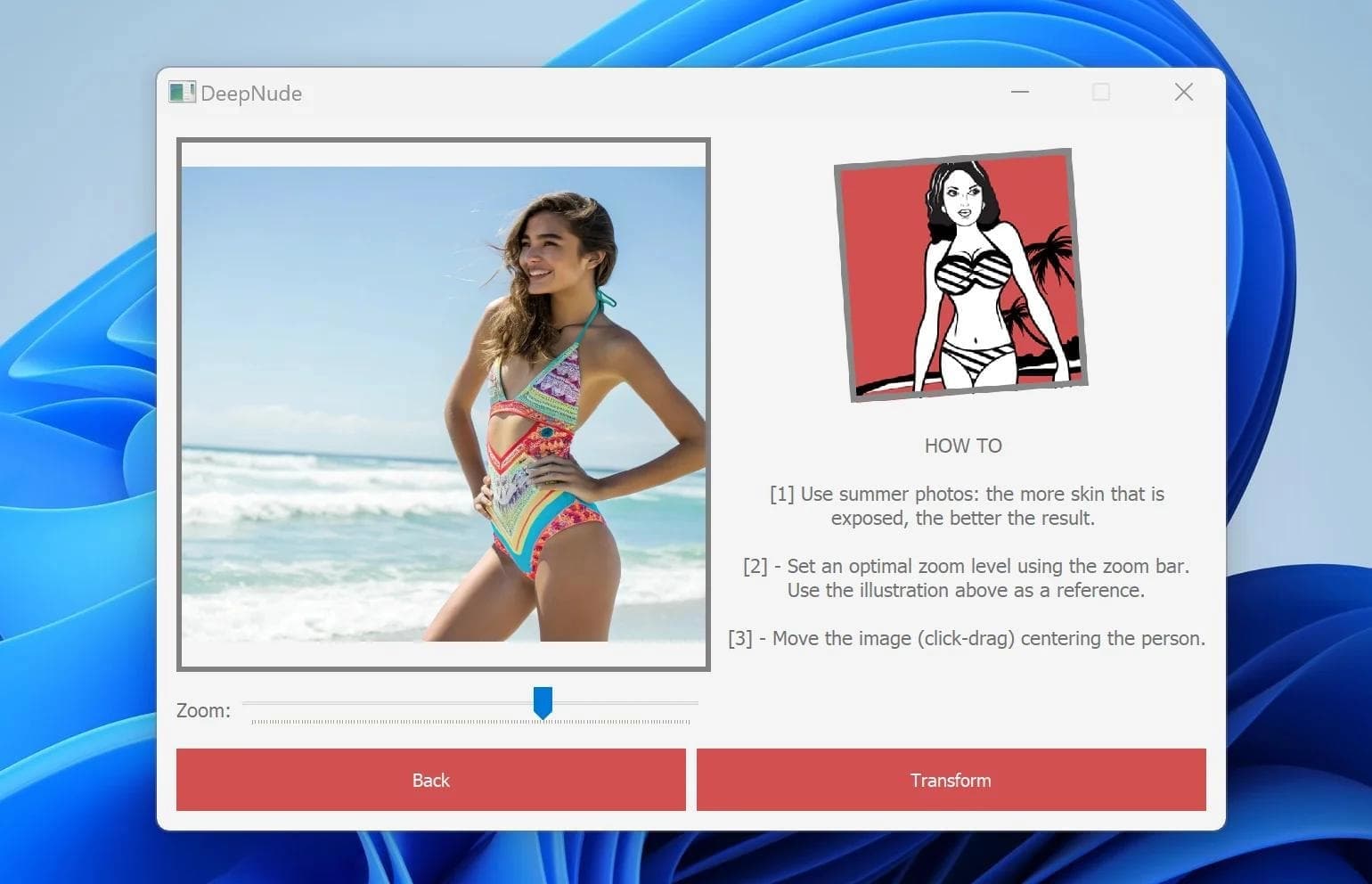
Working with DeepNude required a computer running Windows or Linux. The user needed to download the program archive, unpack it, and run the executable file deepnude.exe. The application ran locally, without connecting to cloud servers.
Uploading an image and getting the result
The program interface was extremely simple: you needed to upload a photo, click the processing button, and wait for the result. Processing one image took about 30 seconds on an average computer. The developer noted that testing was done on neural-network-generated images rather than real photos.
Usage limitations
The program was trained exclusively on images of nude women, so it only worked correctly with female photos. When trying to process an image of a man, the program replaced the lower part of the body with female genitalia.
Key features of DeepNude
Generating images without clothes
DeepNude's main function is the automatic removal of clothing from photos of women using the pix2pix algorithm. The neural network filled in the missing body parts based on a training set consisting of images of nude women.
Working with full-body photos
Correct operation required one full-body photo of a woman or a photo of her in a swimsuit. The more revealing the original clothing, the more realistic the result. The program was not designed to process group shots or low-quality images.
Fast local processing
DeepNude ran entirely on the user's side, without sending data to remote servers. Processing took about 30 seconds, making the tool usable on ordinary PCs without powerful graphics cards.
Advantages of DeepNude
Ease of use
The tool did not require special skills or knowledge of machine learning. The intuitive interface allowed users to get results in just a few clicks, which is what drove its rapid spread.
Availability of a free version
DeepNude was distributed in two versions: a free version with a large watermark, which allowed users to explore the program's capabilities without any financial investment, and a paid version for $50, in which the watermark was replaced by a small FAKE label in the corner of the image.
Local offline operation
The program worked offline, which ensured the privacy of the source photos — data was not transmitted to third-party servers. It also removed limitations related to internet connection speed.
Disadvantages of DeepNude
High ethical risk and abuse potential
The main and most serious drawback of DeepNude is its potential use for revenge porn and creating non-consensual content. The tool was almost impossible to control, which led to widespread criticism and calls for banning such technologies.
Limited accuracy and quality
The neural network did not always process images correctly, especially when clothing was complex or covered a large part of the body. The free version added a large watermark, and the paid version added a FAKE label, which reduced the realism of the final image.
Incorrect handling of male images
DeepNude was trained exclusively on female images. When male photos were uploaded, the program erroneously replaced the lower part of the body with female genitalia, making the tool useless for processing male photos.
Unavailability of the official version
After the project was shut down, the official download links were removed. All copies circulating online are unofficial and may contain malicious software.
What problems does DeepNude solve?
DeepNude solves one single task: generating fake nude images from photos of clothed women. The tool automated a process that previously required photo editing skills or the use of complex software. At the same time, this task itself is controversial from an ethical and legal standpoint, and it is this aspect that made DeepNude such a resonant project in the history of AI technology development.
DeepNude pricing
At the time of official distribution, DeepNude was offered in two price options. The free version was available for download at no cost but added a large watermark to the final image, making the result unsuitable for deception. The paid version cost $50 — in this case, the image was only marked with a small FAKE label in the corner, which could be relatively easily retouched. After the project was shut down, the pricing became irrelevant, as the official distribution channels ceased to operate.
DeepNude terms of use
The tool's developer stated that DeepNude was tested exclusively on neural-network-generated images, not on real photos of people. The terms of use explicitly stated that the program was not recommended for misleading others or distributing photos of real people without their consent. In effect, this was an attempt to limit the creator's liability, but the lack of technical control measures made these terms difficult to enforce. After the wave of criticism, the project was completely shut down precisely because it was impossible to ensure the ethical use of the tool.
DeepNude availability
At the time of launch, the original DeepNude files were available for download on Windows and Linux. After the developer decided to shut down the project, the official links were removed. Nevertheless, copies of the program continue to circulate on torrent trackers, file-sharing networks, and in open access. In addition, many clones and imitations using similar algorithms have appeared. There is no official support or updates, and any copy found online can be potentially dangerous both in terms of malicious code and from a legal standpoint.
How DeepNude differs from alternatives
DeepNude became the first mass-market and widely publicized tool of its kind, which distinguishes it from later alternatives that are often clones or modifications of the original program. Unlike many modern solutions, DeepNude ran entirely locally, requiring no cloud computing and not sending photos to a server. At the same time, it was noticeably easier to use than professional neural networks for image generation (such as Stable Diffusion or Midjourney), which require prompting skills and parameter tuning. However, unlike universal generative models, DeepNude was strictly limited to one narrow task and did not allow flexible control over the result. From an ethical standpoint, DeepNude stands out because its appearance sparked broad public discussion about the need to regulate deepfake technologies and protect privacy.
Conclusion
DeepNude became a landmark example of how deepfake technology moved from laboratory experiments to a mass-market product available to any user in a short period of time. Despite the project's shutdown in 2019, the story of DeepNude continued to influence the industry: it stimulated the development of deepfake detection methods, intensified the debate on legislative regulation of AI tools, and pushed the IT community to more actively discuss ethics in the creation of generative neural networks. The tool itself remains available online in the form of unofficial copies, but using it carries serious legal and ethical risks.
Pricing
Frequently asked questions




See also

A service for generating music from text descriptions using latent diffusion models.

A text-to-speech service with hundreds of customizable voices in multiple languages.
A neural network for music generation that creates tracks from text descriptions, transforms audio and video into new compositions, and turns MIDI files into full-fledged arrangements.
Free online text-to-speech service with over 200 voices in multiple languages.
Open-source computer vision library for face analysis, recognition, and detection.
Online tool for generating drum loops and rhythmic patterns using a neural network.
Platform for automatic extraction and structuring of unstructured data from Amazon S3.


A platform for professional audio processing with AI features for track separation, mastering, and voice changing.